


TL;DR:
- A hotel block transfer service combines a hotel room block contract with a group transfer service, which should be managed separately and linked through a passenger manifest. Premium transfer services include personalized meet-and-greet, real-time flight monitoring, luggage assistance, and executive vehicles, with clear confirmation and contingency plans required. Proper planning involves tracking hotel cutoff dates, adjusting for luggage and accessibility needs, and maintaining written communication to ensure smooth group arrivals.
A “hotel block transfer service” is not a single product. The phrase combines two separate contracts: a hotel room block (a set of rooms held under agreement with a cutoff date and attrition clause) and a group transfer service (coordinated pickups and drop-offs with meet-and-greet, flight monitoring, and luggage handling). Treat them as distinct contracts, then link them operationally through a shared passenger manifest and synchronized pickup windows. Solidride handles the transfer side for premium events across Estonia, including real-time flight monitoring and Mercedes-Benz V-Class vehicles.
Table of Contents
- Why people call it a “hotel block transfer” and what the terms actually mean
- What a premium hotel pickup service actually includes
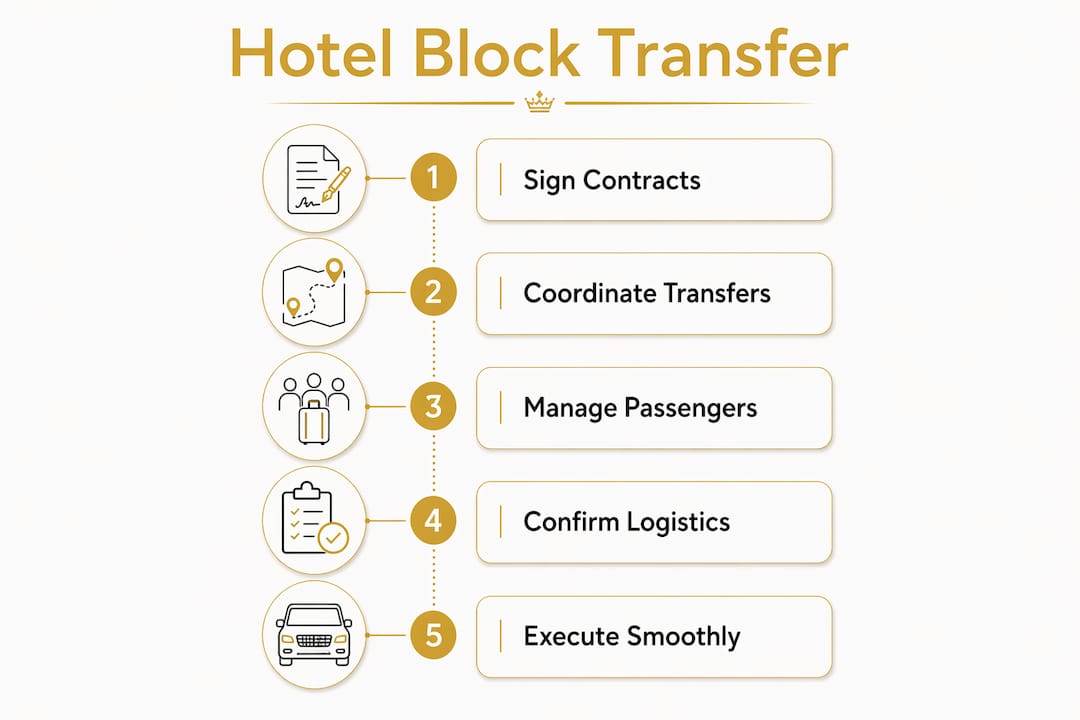
- How booking a hotel group transfer works, step by step
- Contract terms that connect your room block and your transfer
- What affects the price of a premium hotel transfer
- Best practices for moving groups smoothly on arrival day
- How to choose a premium hotel transfer provider
- Your hotel transfer booking checklist
- Common mistakes planners make and quick fixes
- Solidride handles the transfer side so you can focus on the event
- Key Takeaways
- The part of group travel planning most people get wrong
Why people call it a “hotel block transfer” and what the terms actually mean
The phrase is a common conflation in event planning. In hospitality, the correct term is hotel room block. In transportation, the correct term is group transfer service or hotel transfer. Mixing them into one phrase creates confusion when negotiating with hotels and transport vendors, who use entirely different contract structures.
To make it more confusing, “block transfer” already means something else in two other fields:
- In computing, a block transfer moves chunks of data between memory locations, a fundamental graphics operation.
- In public transit (GTFS), a block transfer is an in-seat transfer where a passenger stays on the same vehicle across consecutive trips sharing a
block_id.
Neither definition has anything to do with hotel rooms or airport pickups. When talking to a hotel, use: “We have a room block for [dates]; please confirm check-in windows for our group of [X] guests.” When talking to a transfer provider, say: “We need group pickups from Tallinn Airport tied to a room block at [hotel] — here is our passenger manifest and arrival schedule.”
Room blocks differ from allotments: a block is event-specific with a hard cutoff and attrition terms, while an allotment is an ongoing inventory commitment to a partner like a tour operator. Knowing the difference matters when you negotiate.
What a premium hotel pickup service actually includes
A premium group transfer is not a shuttle bus with a printed sign. The service components that separate a professional provider from a generic taxi dispatch are specific and verifiable.
Core components every premium provider should offer:
- Personalized meet-and-greet with a named driver holding signage at arrivals
- Real-time flight monitoring so the driver adjusts for delays without you making a single call
- Luggage assistance from baggage claim to the vehicle
- Executive vehicle options, including Mercedes-Benz V-Class vans for groups of up to seven passengers
- Multilingual drivers (critical for international delegations)
- Written pickup window and driver mobile contact sent before travel day
Standard upgrades and add-ons:
- Dedicated waiting time beyond the standard grace period
- Multiple vehicle staging for staggered arrivals
- Pet-friendly arrangements with advance notice
- Concierge-level baggage handling for oversized or fragile items
“When guests are consolidated into a single hotel, transfer routing, staging, and luggage handling all become simpler — and significantly more cost-efficient than splitting groups across multiple properties.” — Where Will They Stay
On safety: ask for driver credentials, vehicle insurance certificates, and a written contingency plan covering flight delays, early arrivals, and vehicle substitutions. A provider without a 24/7 contact number is not a premium provider.
How booking a hotel group transfer works, step by step
- Send a quote request with event dates, estimated group size, arrival windows, and vehicle preferences.
- Receive and review the quote, including per-vehicle pricing, wait-time policy, and flight-monitoring coverage.
- Sign the transfer confirmation — a written document, not a verbal agreement. It must include pickup windows, driver contact, and the contingency plan.
- Link your passenger manifest to the hotel rooming list. Hotels typically provide a group booking code or rooming list process for attendees; use the same guest data to build your transfer manifest.
- Confirm final headcount at least 48–72 hours before arrival, adjusting vehicle assignments for any changes.
- Day-of coordination: the driver monitors flights in real time; you receive a confirmation when the vehicle is on site.
For return trip logistics, repeat the manifest process for departures, factoring in checkout times and any guests with early flights.
Timing note: Hotel room block cutoff dates typically fall two to six weeks before arrival. Finalize your transfer headcount before that cutoff — once rooms are released back to general inventory, your passenger count can shift and your vehicle assignments may need revision.
Contract terms that connect your room block and your transfer
A hotel room block is a contractual arrangement, not a simple reservation. The organizer, not individual guests, can bear financial liability if the group fails to meet the minimum pickup percentage defined in the attrition clause.
Two terms planners consistently underestimate:
Cutoff date: The date after which unbooked rooms are released back to the hotel’s general inventory. Miss it, and guests may find no rooms at the negotiated rate. More relevant to transfers: your confirmed headcount should be locked before this date.
Attrition clause: If your group books fewer rooms than the contracted minimum, you owe the hotel a penalty — often calculated per unoccupied room night. This directly affects your transfer budget if you have pre-committed to vehicle capacity.
“Organizers often underestimate attrition exposure and can benefit from using intermediaries or specialized booking tools to reduce administrative risk and negotiate more protective terms.”
Pro Tip: Negotiate a sliding vehicle guarantee into your transfer contract. If your room block underperforms by more than 20%, you want the right to reduce your vehicle count without a full cancellation penalty. Get it in writing before you sign.
What affects the price of a premium hotel transfer
Pricing for group transfers is not a flat rate. These are the variables that move the number:
- Vehicle class and capacity: A Mercedes-Benz V-Class for seven passengers costs more than a standard sedan, but costs less per head than booking three sedans separately.
- Airport-to-hotel distance: Longer routes increase base fare; factor in tolls and parking fees at Tallinn Airport.
- Scheduled vs. on-call service: A pre-scheduled pickup with a fixed window is cheaper than an on-call arrangement with open-ended wait time.
- Flight monitoring surcharges: Out-of-hours monitoring (late-night or early-morning arrivals) may carry a surcharge — confirm this upfront.
- Staggered vs. consolidated arrivals: Guests arriving on different flights require separate vehicle runs. Consolidating arrivals into fewer windows cuts cost noticeably.
- Extra baggage and accessibility needs: Oversized luggage, wheelchair equipment, or pet transport require specific vehicles and advance notice, both of which affect pricing.
- Pet transport: Requires advance documentation and a pet-friendly vehicle; not all providers offer this.
For a detailed breakdown of luggage handling costs as a line item, factor it separately when building your quote request.
Best practices for moving groups smoothly on arrival day
Staging is where group logistics either hold together or fall apart. Assign vehicles by arrival window first, then by seat capacity, then by luggage volume. A group of twelve with heavy bags needs two V-Class vans, not one van and a sedan.
“Shuttle transportation is far easier and less costly when guests are consolidated at one property — routing, staging, and luggage workflows all simplify.” — Where Will They Stay
Pro Tip: Place a printed meet point sign at the arrivals exit with the driver’s name and your event logo. For international groups, add the hotel name in the local language. It eliminates the most common day-of confusion: guests who walk past their driver.
For accessibility, notify the provider at least 72 hours in advance of any mobility equipment needs. Pet transport requires documentation and a confirmed pet-friendly vehicle; do not assume it is included. For team airport pickups with staggered flights, brief your hotel liaison on expected vehicle arrival times so the drop-off area stays clear.

How to choose a premium hotel transfer provider
Questions to ask before signing:
- Do you offer real-time flight monitoring, and is it included or billed separately?
- What is your meet-and-greet procedure at Tallinn Airport arrivals?
- Can you provide driver credentials and vehicle insurance certificates in advance?
- What vehicle makes and models are available for groups of passengers?
- What is your written cancellation and change policy?
- Who is the 24/7 contact if something goes wrong on arrival day?
Red flags that disqualify a provider:
- Verbal-only confirmations with no written pickup window
- No contingency plan for delayed or diverted flights
- Vague vehicle capacity promises (“we’ll find something that fits”)
- No 24/7 contact number for day-of issues
Before signing, request a sample written confirmation, a driver profile, and proof of insurance. A private transfer service that cannot produce these documents within 24 hours of your request is not ready for a group event.
Your hotel transfer booking checklist
Use this before sending any quote request:
- [ ] Event dates and hotel name confirmed
- [ ] Hotel room block cutoff date noted
- [ ] Estimated group size and passenger manifest format agreed
- [ ] Arrival windows and flight numbers collected
- [ ] Vehicle class selected (sedan, V-Class van, minibus)
- [ ] Meet-and-greet instructions written (signage, driver name, meet point)
- [ ] Luggage volume estimated (bags per passenger, oversized items)
- [ ] Accessibility or pet transport needs flagged
- [ ] Contingency plan for delayed flights confirmed in writing
- [ ] Driver mobile contact and 24/7 provider number on file
- [ ] Invoice routing confirmed (direct billing or master account)
- [ ] Return transfer manifest prepared separately
Share this list with your hotel contact and your transfer provider simultaneously. For a print-ready version, the high-end transfer booking checklist covers all the above in a single-page format.
Common mistakes planners make and quick fixes
Treating the room block and transfer as one contract. They are not. Sign them separately, then link them through the passenger manifest.
Missing the cutoff date. Set a calendar reminder two weeks before the hotel cutoff. Confirm your transfer headcount at the same time.
Underestimating luggage volume. A group of ten with checked bags and ski equipment needs a different vehicle than ten business travelers with carry-ons. Ask each guest for a bag count.
Not confirming driver contact in writing. A driver name and mobile number must be in your confirmation document before travel day, not sent the morning of.
Day-of troubleshooting quick fixes:
- Late flight: a provider with real-time monitoring adjusts automatically; you should still have the driver’s direct number.
- Split pickup needed: call the provider immediately; most can dispatch a second vehicle if notified early.
- No-show guest: confirm with the hotel front desk before releasing the vehicle; the guest may have arrived separately.
For conference transfer coordination at scale, build a 30-minute buffer into every pickup window and share the hotel liaison’s direct number with your driver.
Solidride handles the transfer side so you can focus on the event

Solidride operates premium hotel pickups and drop-offs across Estonia, with a fleet that includes Mercedes-Benz V-Class vehicles and minibuses for groups of any size. Real-time flight monitoring, personalized meet-and-greet, and luggage assistance are standard, not add-ons. Drivers are available 24/7, multilingual, and carry full credentials and insurance documentation on request.
For event planners coordinating a hotel room block in Tallinn or elsewhere in Estonia, Solidride links your passenger manifest to flexible vehicle staging, provides written confirmations with driver contact before travel day, and holds a contingency plan for every booking. The booking process starts with a quote: send your event dates, group size, arrival windows, and vehicle preferences using the transfer booking form. For a structured starting point, download the high-end transfer booking checklist and attach it to your quote request.
Key Takeaways
A hotel block transfer service is two contracts managed as one workflow: keep the room block and the transfer agreement separate, but synchronize them through a shared passenger manifest before the hotel cutoff date.
| Point | Details |
|---|---|
| Two contracts, one workflow | Sign the hotel room block and the transfer contract separately, then link them via a shared passenger manifest. |
| Watch the cutoff date | Hotel cutoffs fall two to six weeks before arrival; lock your transfer headcount before that date to avoid vehicle reassignments. |
| Require written confirmation | Every transfer booking needs a pickup window, driver mobile number, and a contingency plan in writing before travel day. |
| Consolidate guests to cut costs | Guests in one hotel simplify routing, staging, and luggage handling, and reduce per-passenger transfer cost. |
| Solidride for Estonia events | Solidride provides Mercedes-Benz V-Class vehicles, real-time flight monitoring, and written confirmations for group hotel transfers across Estonia. |
The part of group travel planning most people get wrong
There is a persistent assumption among event planners that once the hotel room block is signed, the transport side will sort itself out. It rarely does. The room block tells you where guests sleep. It tells you nothing about when they land, how much luggage they have, or whether three of them booked a different flight at the last minute.
The planners who run smooth group arrivals treat the transfer manifest as a living document, not a one-time form. They update it as RSVPs come in, flag accessibility needs early, and confirm driver contact at least 48 hours out. They also negotiate flexibility into the transfer contract from the start, because room blocks almost always shift before the cutoff.
The practical tip that makes the biggest difference on arrival day: give your driver the hotel liaison’s direct number, not just the front desk. When a vehicle arrives at a busy hotel entrance and needs to hold position, a direct line to someone who can clear the drop-off area saves fifteen minutes and a lot of stress.
Lisa kommentaar