

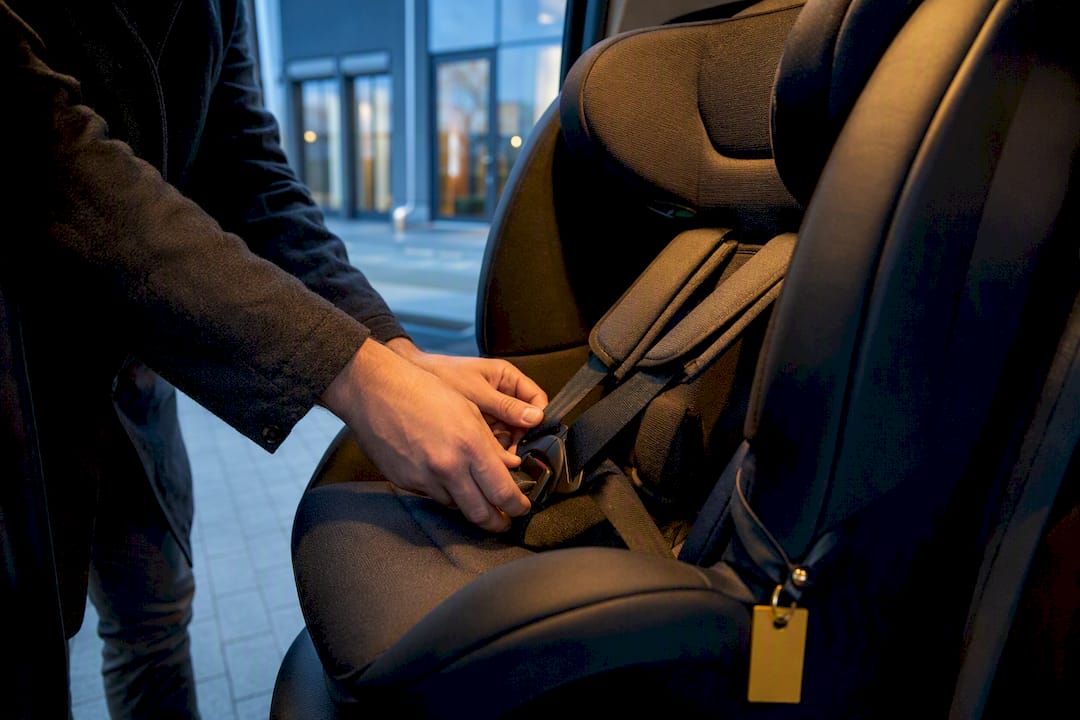
For infants, request a rear-facing seat; for toddlers past that stage, a forward-facing or convertible seat with a five-point harness. When you book your lapseiste transferis, tell the operator your child’s age, weight, and height, confirm whether the seat will use Isofix or a seatbelt install, and check the fit yourself at pickup. Transpordiamet sets the official standard for this, and Solidride can accommodate the request directly when you book.
TL;DR:
- Children taller than 150 centimeters must be secured in appropriately sized restraints based on their weight and height, not just their age.
- Matching the correct seat type to your child’s weight and height is crucial, with rear-facing seats recommended for infants and booster seats for children over four when the seatbelt fits properly.
- Proper installation, including checking angles, harness tightness, and routing, is essential, regardless of whether Isofix or seatbelt methods are used, and should be verified at pickup.
- When booking a transfer, specify your child’s size and seat type upfront to ensure the operator can prepare and install the correct, safety-compliant seat.
- Inspect the seat upon arrival using a quick physical check before the child rides to verify correct installation and secure fit, and photograph the setup for documentation if needed.
Inhaltsverzeichnis
- What Does Estonian Law Say About Child Car Seats?
- Which Seat Type Matches Your Child’s Age, Weight, and Height?
- How Do Isofix and Seatbelt Installs Work in a Transfer Vehicle?
- What Should You Say When Booking a Transfer With a Child Seat?
- How Does Solidride Handle Child-Seat Requests?
- Your Pre-Trip Safety Checklist at Pickup
- The Gap Between Official Guidance and What Actually Happens at the Curb
- Ready to Book a Family-Friendly Transfer in Estonia?
- Where to Find Official Guidance and Manufacturer Details
- Sources
- FAQ
What Does Estonian Law Say About Child Car Seats?
Estonian traffic law requires every child under 150 centimeters tall to travel in a restraint system sized to their weight and height, whether that’s a private car, a taxi, or a private transfer. The rule isn’t about age alone. A tall eight-year-old and a small ten-year-old can need different equipment, which is why Transpordiamet’s guidance leans on weight and height bands rather than birthdays.
The Transpordiamet guidance on safe child transport lays out the core principle plainly: a child restraint has to match the child’s actual size, be installed correctly, and be used every single trip, not just on longer drives. That last point trips up a lot of parents. A five-minute ride from the airport to a downtown hotel carries the same legal requirement as a two-hour drive to Tartu.
A few points from that guidance deserve special attention:
- The restraint must be approved for the child’s current weight and height, not the one they’ll grow into next year.
- Shoulder belts must cross the collarbone, never the neck or the arm, and lap belts must sit low across the hips, not the stomach.
- A child restraint installed loosely, at the wrong angle, or without checking the manual defeats much of its protective value even if the seat itself is correctly rated.
- Pregnant passengers should route the lap belt below the belly, across the hips, with the shoulder strap positioned normally across the chest and between the breasts.
Quick fact: Transpordiamet’s own guidance frames correct installation as inseparable from the seat choice itself. A premium seat installed wrong offers less real protection than a basic seat installed right.
The most common misunderstanding among parents booking transfers is assuming that any car seat satisfies the requirement. It doesn’t. A seat rated for a toddler strapped into place for an infant, or a booster used before a child is tall enough for the adult belt to sit correctly, both violate the spirit of the rule even if a seat is technically present. Estonian guidance treats “has a seat” and “has the right seat, installed correctly” as two different things, and only the second one actually protects your child.
Which Seat Type Matches Your Child’s Age, Weight, and Height?
Four broad categories cover almost every child passenger in Estonia, and matching your child to the right one is the single most important decision you make before a transfer.
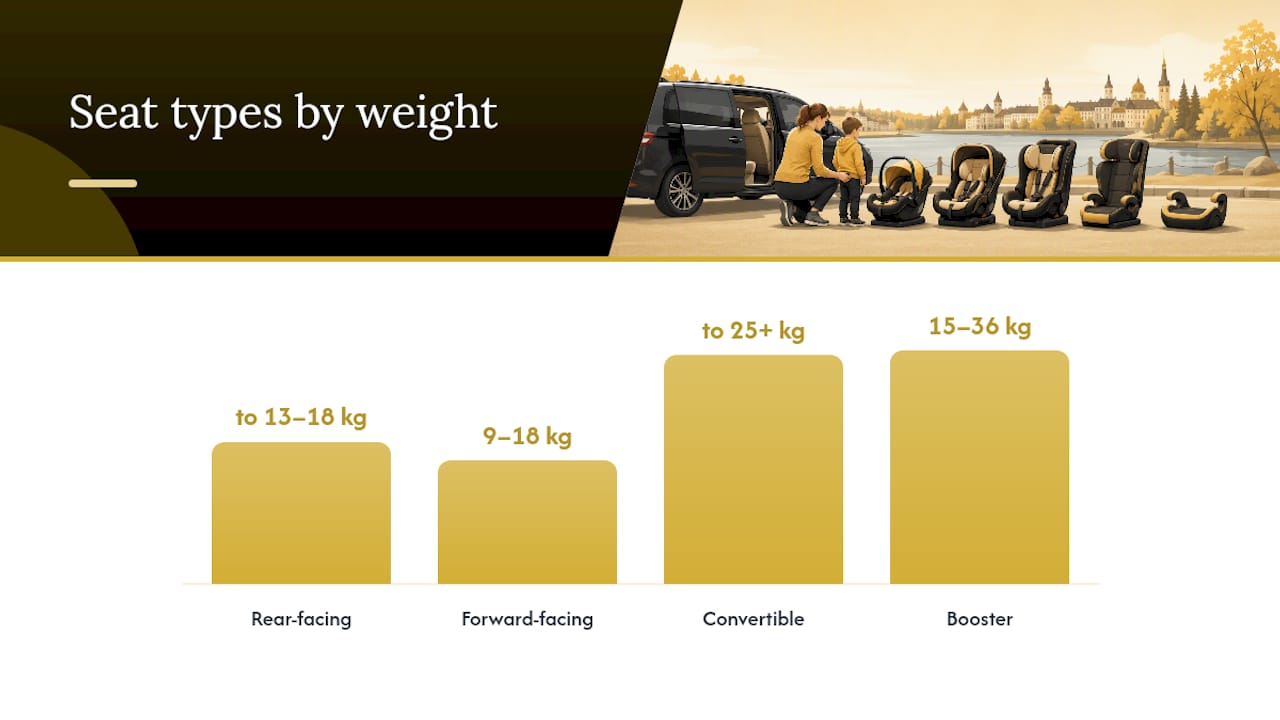
Rear-facing seats (often labeled Group 0/0+) suit infants from birth up to roughly 13 to 18 kilograms, depending on the model, and most guidance recommends keeping children rear-facing as long as the seat allows it, often past age two. Rear-facing distributes crash forces across the back and shoulders rather than the neck, which matters because an infant’s neck muscles and spine aren’t developed enough to handle forward-facing impact forces safely. This is the seat category to request without exception for a newborn or infant traveling by private transfer.
Forward-facing seats (Group 1) generally apply from around 9 to 18 kilograms, once a child has outgrown the rear-facing weight limit and the seat’s manufacturer explicitly permits the switch. These use a five-point harness and typically anchor with Isofix connectors plus a top tether.
Convertible seats cover a wider span, sometimes stretching from infant weights through 25 kilograms or more in a single unit, adjusting between rear-facing and forward-facing modes as the child grows. Retailers such as Nordbaby stock several of these multi-stage models, which is worth knowing if you’re trying to picture what “convertible” actually looks like before you request one from a transfer provider.
Booster seats (Group 2/3) suit children roughly 15 to 36 kilograms, generally from around age four through ten or eleven, though the real test isn’t age. It’s whether the vehicle’s adult seatbelt fits the child correctly without the booster. Run this check before assuming your child is ready to skip the booster:
- Does the shoulder belt cross the middle of the shoulder and collarbone, not the neck?
- Does the lap belt sit low across the hip bones, not the soft stomach?
- Can the child sit with their back flat against the seat and knees bent naturally over the edge, without slouching to reach that position?
If any of those three answers is no, the child still needs a booster, regardless of what age they’ve reached. A booster raises the child enough that the vehicle’s built-in belt geometry works the way engineers designed it to. Skip it too early, and a lap belt that rides up onto the stomach can cause serious internal injury in a crash, even at low-to-moderate speed.
One category worth mentioning only to steer you away from it: inflatable travel boosters and backpack-style restraints marketed for short trips or air travel are discussed as less safe alternatives in the Best Takingcarababies.com Alternatives for New Parents blog, which compares these convenience travel seats with standard restraints. They’re convenient for a weekend bag, but they aren’t a substitute for a properly rated car seat on Estonian roads, and no private transfer provider should be treating them as equivalent.
How Do Isofix and Seatbelt Installs Work in a Transfer Vehicle?
Isofix anchors are the metal attachment points built into most modern vehicle seats, and they’re the reason a correctly matched child seat clicks into place in seconds rather than requiring you to wrestle with a seatbelt buckle. Renault’s explanation of restraint systems describes how Isofix connectors lock the seat base rigidly to the vehicle chassis, cutting out the slack and shifting that a seatbelt-only install can allow during a crash. A top tether, where fitted, adds a third anchor point at the rear of the child seat that limits forward rotation on impact.
Not every seat position offers Isofix, though. Third-row bench seats in some minibuses and older van models still rely on the standard three-point seatbelt to secure a child restraint, and that’s a completely legitimate installation method when done correctly. The seatbelt just needs to route through the correct guide points on the child seat, pull tight without slack, and lock. Most convertible and forward-facing seats include a built-in locking clip or the vehicle’s belt itself locks when pulled to full extension. If you’re not sure which your seat needs, Volkswagen’s guidance on traveling with children walks through both methods with practical checks that translate well to any vehicle, not just their own models.
Here’s a step-by-step routine to run once the seat is in the vehicle, whether it’s your own seat or one supplied by the transfer provider:
- Confirm the anchor type. Look for the Isofix connector points, usually marked with small icons between the seat cushion and backrest, or confirm the seatbelt routes through the correct slots for a belt install.
- Push and pull test. Grip the child seat at the base and try to rock it side to side and front to back. It shouldn’t move more than about an inch in either direction.
- Check the recline angle. Rear-facing infant seats need a specific recline, usually 30 to 45 degrees, so the airway stays open. Most seats have a built-in level indicator.
- Tighten the harness. You should not be able to pinch a fold of harness strap at the shoulder once your child is buckled in. If you can pinch it, it’s too loose.
- Verify the chest clip position. It should sit level with the armpits, not the stomach or the neck.
- Confirm the top tether, if present. It should be clipped to the designated anchor point behind the seat, not looped over a headrest or left dangling.
Pro Tip: Ask the driver to show you the vehicle’s Isofix points or belt routing before your child is buckled in, not after. It takes thirty seconds and lets you catch a mismatch while it’s still easy to fix.
For families needing a minibus or larger vehicle, such as an MB Sprinter for a group with multiple children, third-row Isofix availability varies more than in a standard sedan. If a specific row lacks anchors, ask whether the seat can be moved to a row that has them, or confirm in advance that a seatbelt install is planned and appropriate for that seat model. A secure passenger transfer depends as much on matching the seat to the actual vehicle configuration as it does on the seat’s rating.
What Should You Say When Booking a Transfer With a Child Seat?
The clearer your request, the better the match at pickup. When you fill out a booking form or contact a provider, give three specific pieces of information: your child’s current weight and height (not just their age), the seat category you need (rear-facing, forward-facing, convertible, or booster), and your installation preference if you have one, such as “Isofix if the vehicle has it.”
A workable script sounds like this: “We’re traveling with a two-year-old, roughly 13 kilograms and 90 centimeters tall. We need a forward-facing or convertible seat with Isofix installation if available.” That single sentence gives a dispatcher everything needed to assign the right vehicle and seat, and it’s far more useful than simply writing “need car seat” in a booking note.
Timing matters more than most parents expect. Private transfer operators generally hold a limited stock of child seats, and vehicle assignment often happens a day or more before pickup based on the requests already logged. Booking your seat request at the same time you confirm your transfer, rather than adding it as an afterthought by email later, gives the operator time to match both the right seat and a vehicle configured to install it properly.
Fee patterns vary by provider. Some include a child seat at no extra charge as part of a family-friendly service tier; others apply a modest surcharge, particularly for premium seat models or when multiple seats are needed for several children. Ask directly at booking:
- Is a child seat included in the quoted fare, or is there a surcharge?
- What seat categories are in stock, and can you confirm the exact model before pickup?
- Will the seat already be installed when the vehicle arrives, or does the driver install it on-site?
- What happens if the requested seat isn’t available for the confirmed pickup time?
Getting those four answers in writing, even a quick confirmation text, protects you against the frustrating scenario of arriving at a terminal with an infant and finding a booster seat waiting instead of a rear-facing one.
How Does Solidride Handle Child-Seat Requests?
Some private transfer services operate primarily with spacious vehicles suitable for fitting child seats alongside luggage and additional passengers. These services often operate around the clock, so a late-arriving flight with a sleeping toddler onboard doesn’t mean scrambling for a daytime-only provider.
Requesting a child seat happens at the point of booking, the same way you’d specify vehicle type or additional stops. Tell Solidride your child’s weight, height, and preferred seat category when you fill out the booking form, and the team accommodates the request as part of preparing the vehicle for your pickup.
A few service details matter specifically for parents:
-
Real-time flight monitoring adjusts the pickup time automatically if a flight is delayed, which matters more with a young child in tow than it does for a solo business traveler waiting alone.
-
Meet-and-greet service means a driver is waiting inside the terminal rather than a curbside scramble with a car seat, a stroller, and luggage all at once.
-
Luggage assistance frees up a hand, literally, when you’re also managing a child and a car seat bag.
-
Drivers can assist with fitting a seat within standard safety practice, though the final fit check at pickup should always be your call, not something you delegate entirely.
If your itinerary includes multiple stops, such as an airport pickup followed by a hotel drop and a day trip toward Pärnu or Tartu, mention the child seat need once at booking and it carries through the full itinerary rather than needing to be re-confirmed at every leg.
Your Pre-Trip Safety Checklist at Pickup
Run this sequence the moment the vehicle arrives, before your child gets in. It takes under two minutes and it’s the single best insurance policy against a seat that looks fine but isn’t actually secure.
- Look at the installation angle. For a rear-facing seat, check the built-in level indicator sits within the marked range, not tipped too upright or too flat.
- Grip and shake the seat base. Less than an inch of movement in any direction means the anchors or belt are properly tightened.
- Buckle your child in and listen for the click. Every strap connection, chest clip and buckle, should click audibly and resist a firm tug.
- Do the pinch test on the harness straps at the shoulder. No slack should be pinchable between your fingers.
- Check belt or strap routing one more time against the seat’s own guide points, visible on most seats as small colored loops or clips.
- For an infant, use the vehicle’s mirror or ask the driver to angle one so you can see your baby’s face from your own seat during the ride.
If anything fails one of these checks, say so immediately and ask the driver to pause and reinstall before departure. A reputable operator would rather lose two minutes at the curb than have a parent riding anxious, or worse, an improperly secured child. If the seat provided doesn’t match what you requested, or no seat is available at all, ask whether an alternative vehicle with the correct equipment can be swapped in, or whether the pickup can be briefly delayed while a suitable seat is sourced.
Pro Tip: Take a quick phone photo of the installed seat, harness routing and all, before you pull away. It costs nothing, takes five seconds, and gives you a clear record if you ever need to follow up with the provider about how the seat was set up.
The Gap Between Official Guidance and What Actually Happens at the Curb
Most advice on child car seats stops at the rulebook: use the right category, tighten the harness, done. That’s necessary, but it skips the part that actually determines whether a transfer goes smoothly, which is the handoff moment at pickup. Parents rarely fail at knowing which seat category their child needs. They fail at verifying, in the ninety seconds they have curbside with bags and a tired child, that the seat handed to them is actually installed the way Transpordiamet’s own guidance describes.
The honest priority isn’t memorizing weight bands. It’s building the habit of the physical check, the shake test, the pinch test, every single time, even when a driver assures you it’s fine. Confidence in an operator’s professionalism doesn’t replace a thirty-second inspection you can do yourself. Ask for the seat details when you book, then verify with your own hands when the vehicle arrives. That two-step habit matters more than any single piece of equipment.
— Erki
Ready to Book a Family-Friendly Transfer in Estonia?
Booking a private transfer with the right child seat shouldn’t mean a dozen back-and-forth emails or crossing your fingers at pickup. Solidride handles child-seat requests directly through its standard booking process, using Mercedes-Benz V-Class vehicles with the cabin space to fit a seat, luggage, and the rest of your family comfortably.

When you book, specify your child’s age, weight, and height, along with the seat category you need, and confirm whether a surcharge applies for that particular request. Solidride’s pricing page lists current rates for airport and city-to-city routes, including the Tallinn Airport transfers where families most often need a child seat on arrival. The service runs 24/7 with real-time flight monitoring, so a delayed landing doesn’t throw off your pickup, and meet-and-greet plus luggage assistance take some of the physical load off your hands the moment you land. Head to the booking page now, add your child’s seat details to the request, and confirm the fit yourself when the driver arrives.
Where to Find Official Guidance and Manufacturer Details
For anything beyond the practical steps in this guide, go straight to the primary sources rather than relying on secondhand summaries.
- The Transpordiamet PDF on safe child transport is the authoritative Estonian reference for legal requirements and correct restraint use. Consult it for anything related to legal compliance or belt positioning rules.
- Nordbaby’s seat category listings show real product examples across Group 0 through Group 3, useful if you want to see what a specific seat category actually looks like before requesting one.
- Renault’s restraint system guidance explains Isofix anchor mechanics in plain terms, helpful when you want to understand why an anchored install behaves differently from a seatbelt install in a crash.
- Volkswagen’s guide to traveling with children covers installation checks and comfort tips specifically aimed at longer drives, relevant for routes like Tallinn to Tartu or Pärnu.
Use the Transpordiamet document for legal and safety questions, and the manufacturer pages when you need to understand a specific installation mechanism.
Sources
- LAPSE OHUTU SÕIDUTAMINE AUTOS
- Laste turvatoolide ja turvahällide valik – Ohutu ja mugav sõit.
- Istmete turvasüsteemid | Avastage Renault
- Autoga reisimine laste ja teismelistega
FAQ
Is a Child Seat Legally Required for Taxis and Transfers in Estonia?
Yes. Estonian law requires a properly sized child restraint for any child under 150 centimeters tall in any vehicle, including taxis and private transfers, with no exception for short trips.
At What Weight Can My Child Switch to a Booster Seat?
Boosters generally suit children from a weight starting in the low teens of kilograms, but the real test is whether the adult seatbelt fits correctly. The shoulder belt should cross the collarbone and the lap belt should sit low on the hips without a booster before you skip one.
What Happens if the Transfer Vehicle Has No Isofix Points?
A seatbelt install is a legitimate and safe alternative when done correctly, routing the belt through the seat’s designated guide points and locking it with no slack; ask the driver to confirm the correct routing before departure.
Does Solidride Charge Extra for a Child Seat?
Solidride accommodates child-seat requests directly through its booking process; confirm any applicable fee for your specific seat request when booking through the pricing page.
How Early Should I Request a Child Seat Before My Transfer?
Request it at the same time you confirm your booking rather than as a follow-up, since vehicle and seat assignment typically happens a day or more ahead based on the requests already on file.
Einen Kommentar hinzufügen