

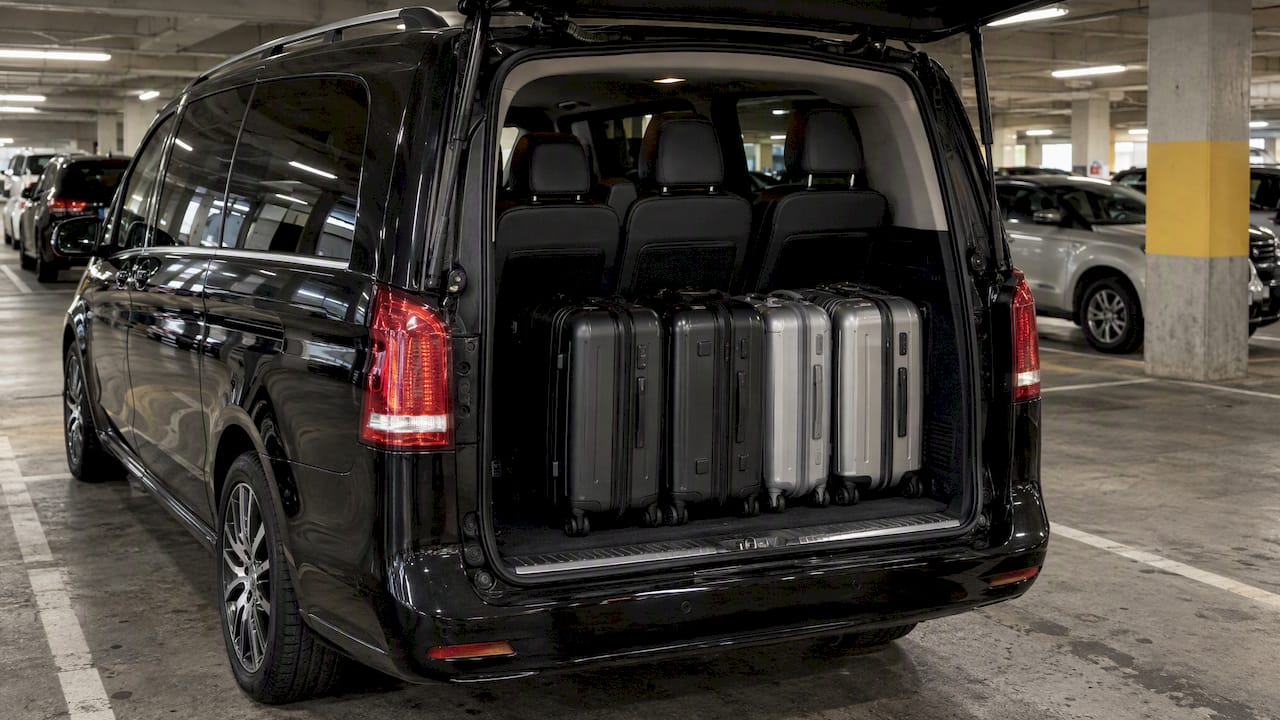
Most minivans hold about 4 to 6 large checked suitcases behind the third row when every seat is occupied, and roughly 12 to 15 once that row folds flat. The exact count depends on the model, the suitcase shapes you pack, and how the seats are arranged, details we break down model by model below, along with packing moves that stretch whatever space you have.
TL;DR:
- Folding the third row raises capacity to roughly 12 to 15 large suitcases, but only when nobody needs those seats.
- Adults or child seats in the third row can reduce luggage room by taking up space that bags might otherwise use.
- The Multivan offers 469 liters behind the third row in its base version and 763 liters in the long wheelbase, so confirm the exact configuration.
- When booking, provide your passenger count, largest bag dimensions, and oversized items, then ask for the offered vehicle’s cargo capacity and seat layout.
- A roof box adds room but increases weight and wind resistance, so check availability and the vehicle’s roof load limit before relying on one.
Inhaltsverzeichnis
- What “luggage capacity” actually means for a minivan
- How testers turn cargo volume into suitcase counts
- Real minivan specs: Kia Carnival, Chrysler Pacifica, Volkswagen Multivan
- Packing tips to fit more without losing space
- How passenger count changes luggage space in a Mercedes-Benz V-Class
- Matching luggage capacity to your trip type
- How the Mercedes-Benz V-Class compares on cargo space
- Booking a transfer around your luggage needs
- What travelers should ask before booking
- Book a transfer that fits every suitcase
- FAQ
- Sources
What “luggage capacity” actually means for a minivan
When people ask how many bags fit in a minivan, they usually picture a large hard-shell suitcase, something close to 28 to 30 inches tall, the kind airlines accept as a checked bag. That is the assumption behind the counts used throughout this article: not a regulated size, just the common reference point most travelers pack.
With every seat filled, a minivan typically swallows 4 to 6 of those large suitcases behind the raised third row. Fold that row down and the number jumps to roughly 12 to 15, since the cargo floor extends all the way to the second-row seatbacks. These ranges come from observational counts and from measured testing that fits real suitcase-sized boxes into the space, rather than relying on manufacturer volume specs alone.
A few things shrink those numbers fast:
- Full-size adults in the third row leave less legroom buffer, which can nudge bags forward and reduce what fits behind them.
- Rear-facing child seats or boosters often eat into foot space that would otherwise hold a duffel or backpack.
- Seats that recline into the cargo area instead of folding flush reduce the usable floor, even when technically “folded.”
Knowing which scenario applies to your trip, full seating or a folded row, is the first step to picking the right vehicle.
How testers turn cargo volume into suitcase counts
Manufacturer spec sheets list cargo volume in liters or cubic feet, but those numbers do not tell you how many bags will actually fit. Consumer Reports solves this by measuring cargo with an expandable rectangular pipe-frame box, finding the largest box that slides through the hatch opening while still letting the tailgate close. That method captures usable space, not just the theoretical volume between the floor and roofline.
One figure worth knowing: Consumer Reports’ luggage-count method counts suitcases behind the raised third row specifically because that mirrors the real situation most families face: everyone seated, luggage stacked behind them.
There is also a gap between a manufacturer’s maximum cargo figure, measured with all seats folded or removed, and the usable space behind an upright third row. A minivan advertised with a large maximum volume might still offer a modest amount of everyday luggage room. A rough way to estimate suitcase counts from a liter figure: a large checked suitcase occupies somewhere around 100 to 110 liters of irregular space once you account for its shape, so dividing a cargo volume by that figure gives a ballpark count, though packing efficiency always falls short of pure math.
Real minivan specs: Kia Carnival, Chrysler Pacifica, Volkswagen Multivan
Specs vary enough between popular minivans that picking the right one matters if luggage space is a priority.
- Kia Carnival: Listed cargo volume runs around 40.2 cubic feet in the configuration most commonly cited, translating to roughly 4 to 5 large suitcases behind the third row, with considerably more once that row is folded down.
- Chrysler Pacifica: Maximum cargo volume reaches up to 140.5 cubic feet with seats folded, a figure that explains why the Pacifica is a frequent pick for families who need to switch between passenger-heavy trips and full cargo-hauling runs. Behind the raised third row, usable space is a fraction of that maximum, closer to the 4 to 6 suitcase range typical of the class.
- Volkswagen Multivan: The base model offers 469 liters behind the third row, 1,844 liters behind the second row, and 3,672 liters with rear seats removed. Long-wheelbase versions push those figures higher, to 763 liters, 2,171 liters, and 4,005 liters respectively. At roughly 100 to 110 liters per large suitcase, the base Multivan’s 469-liter figure behind the third row works out to around 4 suitcases, while the long-wheelbase variant comfortably fits more.
Wheelbase and trim differences matter enough that two vehicles from the same model line can carry noticeably different loads, so checking the exact variant before you book or buy is worth the extra minute.
Packing tips to fit more without losing space
A few packing habits make a measurable difference before you even consider roof storage.
- Pack soft-sided duffels instead of rigid hard-shells wherever possible. They compress into gaps that hard suitcases cannot fill.
- Load the largest, heaviest bags first, flat against the cargo floor, then build upward and forward.
- Fill dead space, wheel wells, gaps between bag corners, with smaller items like shoes or jackets instead of leaving air pockets.
- Stack bags on their long edge rather than flat when ceiling height allows, since this often adds a bag or two over flat stacking.
Pro Tip: Measure your largest suitcase before the trip and compare it against the vehicle’s loading height; a bag that fits diagonally still needs enough door-opening clearance to slide in.
A roof box adds meaningful volume for trips where the trunk alone will not cut it, while an open roof rack suits odd-shaped gear like skis or bikes better than soft bags. Either option adds weight up high and increases aerodynamic drag, which can affect fuel use and handling at highway speed, so check the vehicle’s maximum roof load rating first. Before departure, confirm your largest bag’s dimensions, your passenger count, the vehicle’s actual cargo space with whoever is providing it, and the roof load limit if you plan to use a box or rack.
How passenger count changes luggage space in a Mercedes-Benz V-Class
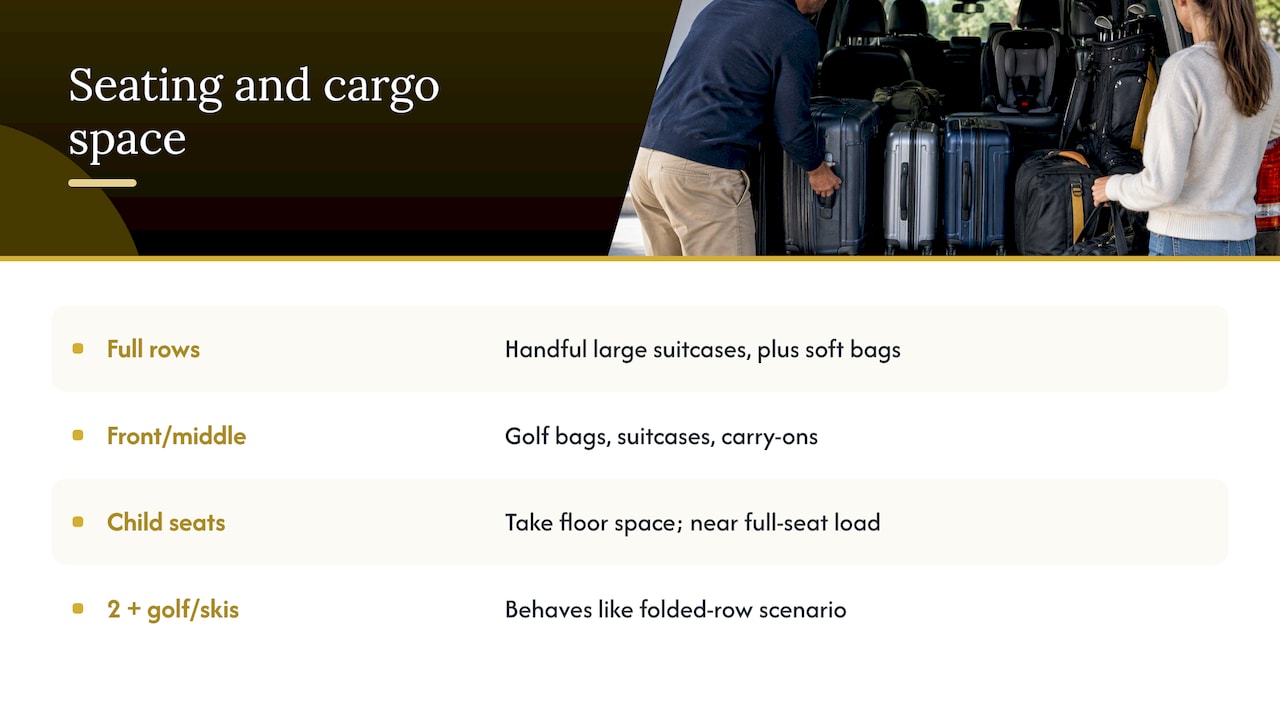
The Mercedes-Benz V-Class follows the same basic rule as any minivan: more seated passengers means less usable cargo floor. With a full load of passengers across all rows, luggage space is limited to whatever sits behind the last occupied row, which works out to a handful of large suitcases plus soft bags wedged around them.
Drop the passenger count and the math improves quickly. A group of two or three travelers using only the front and middle rows frees up the entire rear section for luggage, often enough for a full set of golf bags, several large suitcases, and carry-ons without any tight packing. This is why groups booking an airport transfer with heavy luggage benefit from mentioning passenger count upfront: it determines whether the third row needs to stay up at all.
Family trips with children’s car seats face a double squeeze, since the seats themselves take up floor space that would otherwise hold bags. A V-Class configured for five adults plus full luggage sits closer to the “all seats in use” scenario described earlier in this article, while a trip with two passengers and a stack of golf clubs or ski bags behaves more like a folded-row scenario.
This is the practical reason to think about seating and luggage together rather than separately when booking a transfer. The vehicle’s rated capacity on paper does not change, but the usable space very much does depending on how many seats you actually need filled.
Matching luggage capacity to your trip type
Not every transfer carries the same luggage load, and the type of trip usually predicts how much space you will need.
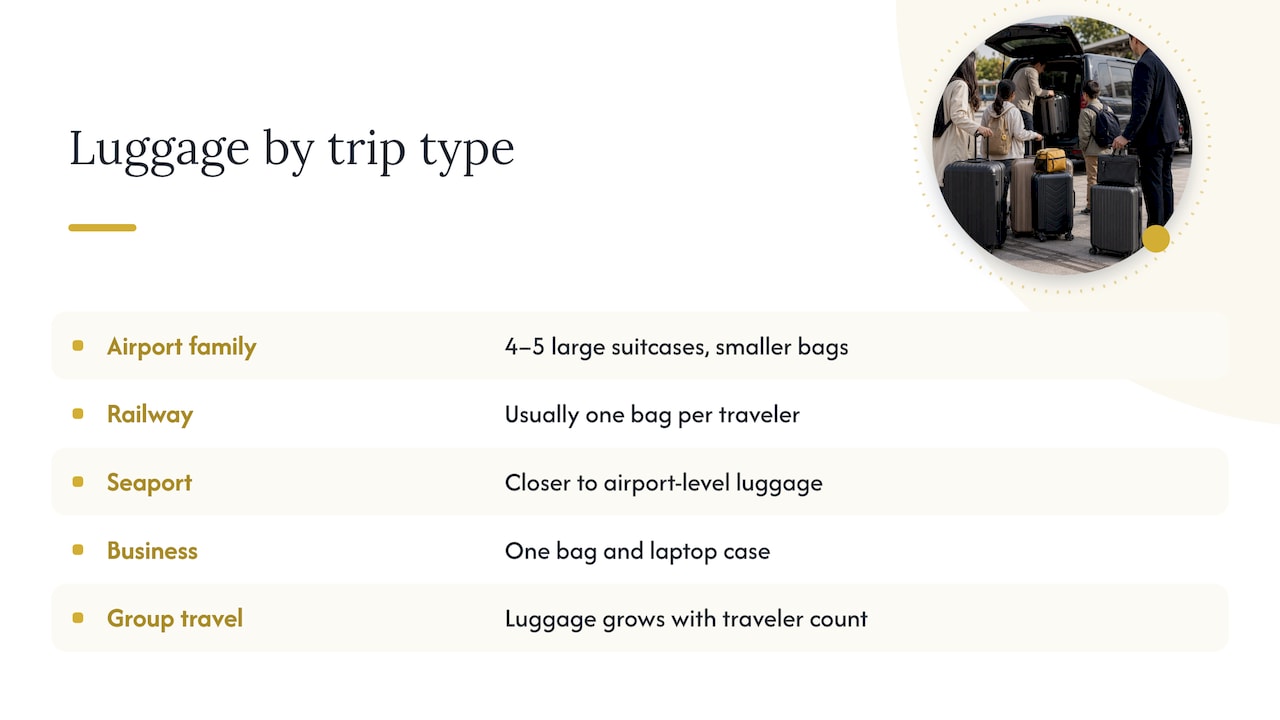
Airport transfers tend to involve the heaviest loads: checked suitcases, carry-ons, and sometimes duty-free bags collected after landing. A family of four returning from a two-week vacation might arrive with four or five large suitcases plus smaller bags, which fits the “all seats in use” range of 4 to 6 suitcases for most minivan-class vehicles, with little room to spare.
Railway station pickups usually involve lighter loads, since train travelers tend to pack less than long-haul flyers and often carry a single bag each. Seaport transfers sit somewhere in between: cruise passengers frequently travel with more luggage than a typical business trip, closer to airport-level volumes, especially at the start or end of a multi-week cruise.
Business travelers moving between hotels or meetings typically carry one bag and a laptop case, leaving ample room regardless of vehicle size. Group travel, by contrast, multiplies the luggage question by the number of travelers, making seat count and cargo space equally important variables to confirm before booking.
Matching the transfer vehicle to the specific trip type, rather than assuming a standard sedan or van will cover every scenario, avoids the scramble of sorting bags curbside.
How the Mercedes-Benz V-Class compares on cargo space
Among premium minivans and large MPVs used for private transfers, the Mercedes-Benz V-Class is a strong option for groups traveling with substantial luggage, offering a cargo area that holds several large suitcases behind a full row of seated passengers and considerably more when fewer seats are needed.
Compared with the Kia Carnival’s roughly 40.2 cubic feet of listed cargo volume or the Chrysler Pacifica’s maximum figure near 140.5 cubic feet with seats folded, the V-Class occupies a similar practical range for everyday airport and city-transfer use: a handful of large suitcases with all seats occupied, expanding meaningfully once the rear seating is reduced. The Volkswagen Multivan’s base figure of 469 liters behind the third row sits in a comparable bracket for that same fully-seated scenario.
Where the V-Class distinguishes itself for transfer use specifically is flexibility: configurations that keep rear seating open for two or three passengers free up substantial space for golf bags, oversized suitcases, or multiple travelers’ luggage combined, something a fully-loaded seven or eight-seat configuration cannot match. For travelers deciding between vehicle classes for a luggage-heavy trip, this makes the V-Class a dependable middle ground between a standard sedan’s limited trunk and a full-size minibus.
Booking a transfer around your luggage needs
Before locking in a vehicle, a few questions prevent an unpleasant surprise at pickup.
Ask for the exact cargo volume of the vehicle being offered, not just the model name, since trims and wheelbase lengths change capacity significantly, as shown by the Multivan’s base versus long-wheelbase figures. Confirm whether the third row needs to stay up for your group size, since that single detail swings usable space by a factor of two or three. If your load includes oversized items like golf bags, skis, or extra suitcases beyond the vehicle’s rated comfortable capacity, ask whether a roof box is available and whether there is an additional cost or weight limit attached.
Finally, consider whether the vehicle model itself matches the job. A sedan transfer suits one or two travelers with carry-on bags; a minivan or V-Class suits families and small groups with checked luggage; a minibus suits larger groups or bulky equipment. Naming your passenger count and luggage volume when you book, rather than after the vehicle arrives, is the simplest way to avoid repacking on the curb.
What travelers should ask before booking
The questions that matter most rarely change: what is the vehicle’s actual cargo volume, does the third row need to stay raised for your group, is a roof box available if needed, and does the provider offer help loading and unloading at both ends of the trip.
Vehicle selection, luggage assistance, and real-time flight tracking are the features we build our airport transfers around, which directly answer those questions rather than leaving them to guesswork at the curb. A short checklist before you call: confirm passenger count, measure your largest bag, ask for cargo volume in liters or cubic feet, and mention any oversized items like golf bags or car seats upfront.
— Erki
Book a transfer that fits every suitcase
For groups traveling with a full set of luggage, choosing the right vehicle class matters as much as choosing the right driver. We use vehicles designed to accommodate luggage needs, with luggage assistance included and around-the-clock availability for flights arriving at any hour.

Whether you are coordinating an airport pickup, a seaport transfer, or a multi-stop group trip, check our current vehicle lineup and pricing to match the right car to your passenger count and luggage load before you book.
FAQ
How many suitcases fit in a minivan with all seats up?
Most minivans hold 4 to 6 large checked suitcases behind a raised third row when every seat is occupied. The exact count depends on the model and how the bags are packed, with soft-sided luggage generally fitting better than rigid cases.
How much more space do I get folding the third row?
Folding the third row typically increases usable cargo space to around 12 to 15 large suitcases, since the floor extends all the way to the second-row seatbacks. This assumes no passengers are seated in that row for the trip.
Does the Volkswagen Multivan fit more luggage than other minivans?
The base Volkswagen Multivan offers 469 liters behind the third row, rising to 1,844 liters behind the second row and 3,672 liters with rear seats removed. Long-wheelbase versions increase these figures further, so the specific variant matters more than the model name alone.
Is the Mercedes-Benz V-Class a good choice for luggage-heavy transfers?
The V-Class offers strong cargo flexibility for private transfers, especially when fewer rear seats are needed, freeing up space for multiple large suitcases or oversized items like golf bags. Mentioning your passenger count and luggage volume when booking helps match the right configuration to your trip.
Should I get a roof box if my minivan cargo area is full?
A roof box adds meaningful cargo capacity for trips where interior space runs short, but it adds weight and wind resistance that can affect fuel use and handling. Always check the vehicle’s maximum roof load rating and confirm with your rental or transfer provider whether roof storage is available before relying on it.
Sources
- Cargo Room for SUVs and Minivans as Measured by Consumer Reports
- New Multivan — VW press document
- 2026 Chrysler Pacifica specs — CarsDirect
- 2026 Kia Carnival dimensions — iSeeCars
Einen Kommentar hinzufügen