


Private long-distance transfers are a standard, bookable service across Estonia, not a niche luxury. The most reliable way to travel between cities, airports, and ports is to prebook a fixed-quote, chauffeur-driven car rather than arrange something last minute. One Estonia-based option that fits this model runs Mercedes-Benz V-Class vehicles around the clock with flight monitoring built into the service.
TL;DR:
- Private long-distance transfers in Estonia are reliably booked in advance with fixed prices, especially for groups, airport, or port connections.
- Costs depend mainly on vehicle class, route length, and additional fees like waits, tolls, or stops, with upfront written confirmation crucial to avoid surprises.
- Larger vehicles like the Mercedes-Benz V-Class are more expensive per trip but economically better for groups of six or more, with options to coordinate multiple cars.
- Booking should be done at least a week ahead for groups and longer routes, with a clear confirmation of total price, driver details, and pickup time essential.
- Reputable providers monitor flights and ferries to accommodate delays, and verifying cancellation policies and driver professionalism before payment protects against unexpected issues.
Inhaltsverzeichnis
- What a Pikkade Vahemaade Transfeer Actually Covers
- How Is Pricing Calculated for Long-Distance Transfers?
- Which Vehicle Class Fits Your Long-Distance Trip?
- How Do You Book a Long-Distance Transfer Step by Step?
- Planning Group, Pet, and Special-Occasion Transfers
- How SolidRide.ee Handles Long-Distance Transfer Needs
- What Do Long-Distance Transfers Cost on Common Estonian Routes?
- How Far in Advance Should You Book a Long-Distance Transfer?
- What Are Typical Cancellation and Refund Policies?
- How Do Providers Ensure Driver Professionalism and Safety?
- What Payment Methods Do Estonian Transfer Providers Accept?
- What Do Reviews Say About Long-Distance Transfer Reliability?
- Book Your Long-Distance Transfer With Solidride
- What Matters Most When Booking a Long Transfer
- Sources
What a Pikkade Vahemaade Transfeer Actually Covers
A pikkade vahemaade transfeer, or long-distance transfer, is a prearranged private car journey between two points that are typically too far apart for a casual taxi ride. In Estonia that usually means trips connecting cities, airports, ports, and rail stations rather than short hops across town. The industry term for this is a private transfer service, and it’s worth knowing both phrases since providers use them interchangeably on their booking pages.
The most common scenarios fall into a few clear categories:
- Airport to city or region — landing in Tallinn and heading to Pärnu, Tartu, or a countryside hotel.
- City to city — a route like Tallinn to Valga, roughly 250 kilometers south, where public transport takes far longer than a direct car.
- Port and rail connections — meeting a ferry at the Tallinn passenger port or a train at Tartu’s station and continuing onward by road.
- Group and event transfers — moving a wedding party, corporate group, or tour group between venues, on a fixed schedule.
Private transfers win over buses or self-drive rentals on long routes for a simple reason: door-to-door pickup with a guaranteed departure time. That matters most when you’re juggling tight connections, traveling with several bags, or moving a group that can’t afford to split up mid-journey. Choosing a premium transfer over a taxi also removes the metering uncertainty that makes long taxi rides unpredictable on price.
How Is Pricing Calculated for Long-Distance Transfers?
Estonian transfer providers generally price long trips one of two ways: a per-kilometer rate tied to vehicle class, or a fixed quote for a known route. Larger movers and transfer companies elsewhere use this same structure, confirming the final price before departure rather than adjusting it mid-trip, and that’s the standard worth expecting from any Estonian provider too.
A handful of variables drive the number on your quote:
- Vehicle class — a Mercedes-Benz V-Class costs more per kilometer than an economy sedan, but carries more passengers and luggage.
- Distance and route — straightforward highway routes like Tallinn to Tartu price more predictably than routes through multiple towns.
- Wait time — flight delays, ferry queues, or extra stops can trigger hourly waiting fees if not covered by a monitoring service.
- Extras — pet transport, additional stops, tolls, and parking at pickup or drop-off points.
Before confirming any booking, ask the provider four questions: Is this price fixed or estimated? What happens if my flight is delayed? Are tolls and parking included? Is VAT already factored into the quoted total?
Pro Tip: Always ask for the total price in writing before the trip, not just the per-kilometer rate. A “cheap” rate can turn into a higher final bill once waiting time and stops are added.
Which Vehicle Class Fits Your Long-Distance Trip?
Vehicle choice affects both comfort and cost more than most travelers expect on a long route. Provider sites typically list several categories with rough passenger and luggage limits, and matching your group size to the right one avoids paying for space you don’t need or squeezing into a car that’s too small for the trip.
- Economy or comfort sedan — fits one to three passengers with standard luggage, best for solo travelers or couples on a budget.
- Business or V-Class — typically seats up to six or seven passengers with generous luggage room, the standard pick for small groups or anyone wanting more legroom on a two or three hour drive.
- Minivan — handles seven to eight passengers, useful for families or small tour groups with moderate luggage.
- Minibus — built for larger groups of nine or more, common for wedding parties or corporate transfers between venues.
The tradeoff is straightforward: bigger vehicles cost more per trip but split cheaper per person once a group is large enough. Privacy also drops as vehicle size increases, since minibuses and minivans are shared-cabin by nature. If your group exceeds one vehicle’s practical capacity, most providers can coordinate multiple cars under one booking rather than forcing you to split into separate reservations with different drivers.
How Do You Book a Long-Distance Transfer Step by Step?
Booking a long-distance transfer in Estonia usually takes just a few minutes online, but the details you provide upfront determine how smoothly the trip runs. Skipping a field, like flight number or exact luggage count, is the most common reason for confusion at pickup.
- Enter pickup and drop-off addresses — be specific, especially for hotels or rural addresses with no clear street number.
- Specify passenger and luggage count — this determines which vehicle class the provider assigns.
- Add flight, train, or ferry details if arriving from elsewhere, so the driver can track delays.
- Choose your vehicle class based on group size and comfort preference.
- Decide on a return trip at booking time, since return bookings often lock in a better combined rate than two separate one-way trips.
- Review your confirmation for the fixed total price, driver contact number, vehicle plate, and estimated pickup time.
For a single traveler, booking a day or two ahead is usually enough. Group transfers of eight or more passengers benefit from booking at least a week out, since larger vehicles and multiple cars need more lead time to schedule. Cancellation terms vary by provider, so confirm the policy before you pay anything.
Planning Group, Pet, and Special-Occasion Transfers
Group transfers change the planning math because vehicle choice, parking, and arrival timing all need to be locked down earlier than for a solo trip. A wedding party moving between a ceremony venue and reception, for instance, needs confirmed parking or loading access at both locations well before the event date, since on-site delays are harder to fix once the day arrives.
- Group bookings need earlier confirmation of vehicle count and parking access at each stop.
- Pet-friendly transfers typically require a secured crate or carrier, and it’s worth asking about extra fees and any health documentation the provider wants for longer trips.
- Event and photo tour transfers often involve waiting time between stops and multi-stop routing, so confirm whether those minutes are billed separately or built into the quote.
- Chauffeur-style service for weddings or corporate events usually costs more than a standard point-to-point transfer, reflecting the extra waiting and coordination involved.
How SolidRide.ee Handles Long-Distance Transfer Needs
SolidRide.ee runs on the same fixed-quote model described above, built specifically for Estonia’s airport, rail, port, and hotel routes. The service operates 24/7 with Mercedes-Benz V-Class vehicles, pairing that fleet with real-time flight monitoring so a delayed landing doesn’t turn into a missed pickup or a surprise fee.
Booking flexibility is one of the more useful details here: trips can be one-way or return, and the same booking flow handles group travel, pet-friendly transport, and event-specific transfers like photo tours.
- 24/7 availability with flight and ferry monitoring included
- Meet-and-greet service with luggage assistance at pickup
- One-way or return trip options selected at booking
- Group travel, pet-friendly transport, and event transfer support
When a flight runs late, monitoring and meet-and-greet typically mean the driver adjusts pickup timing without changing your quoted price — a detail worth confirming with any provider before you book, since not every service handles delays the same way.
Before confirming, check that your booking confirmation lists the fixed total, driver contact, vehicle plate, and pickup window. From there, the private transfer service guide walks through service definitions in more depth if you want to compare options before committing.
What Do Long-Distance Transfers Cost on Common Estonian Routes?
Pricing on Estonian long-distance routes tracks distance and vehicle class more than anything else. Common Estonian long-distance routes vary in length, such as Tallinn to Tartu, Tallinn to Valga, and Tallinn to Pärnu, with distances corresponding to typical travel durations. Longer routes cost more in absolute terms, but the per-kilometer rate on a fixed quote often drops slightly on longer trips since providers build in less relative overhead per kilometer.
Vehicle class shifts the total noticeably. A comfort sedan on a mid-length route like Tallinn to Pärnu will price lower than the same route in a V-Class, and a minibus for a group naturally costs more per trip but can come out cheaper per passenger once you’re moving six or more people together. Return trips booked together typically price better than two separate one-way bookings, since the provider avoids sending a car back empty.
Extras change the final number too. Waiting time beyond what’s built into the quote, extra stops along the route, pet transport, and tolls on highway sections all add to the base fare. This is exactly why asking for a written, all-in total before departure matters more than comparing headline per-kilometer rates between providers. A rate that looks cheap on paper can end up costing more once stops and waiting time get tallied at the end of the trip.
Group and event bookings add another layer, since multiple vehicles or a minibus for a large wedding party get quoted as a package rather than a simple per-kilometer calculation. Ask any provider for a full breakdown before you commit, not just a starting rate.
How Far in Advance Should You Book a Long-Distance Transfer?
Timing depends heavily on group size and route complexity. A solo traveler booking a straightforward airport-to-city transfer can often reserve a car same-day or the night before, especially with a provider running 24/7 operations. Business travelers with predictable schedules tend to book a day or two ahead simply for peace of mind, not because availability is usually tight.
Group transfers work differently. Moving eight or more passengers, or coordinating a multi-vehicle booking for a wedding or corporate event, needs at least a week of lead time. That window gives the provider room to confirm vehicle availability, driver assignments, and any parking or loading arrangements at each stop along the route.
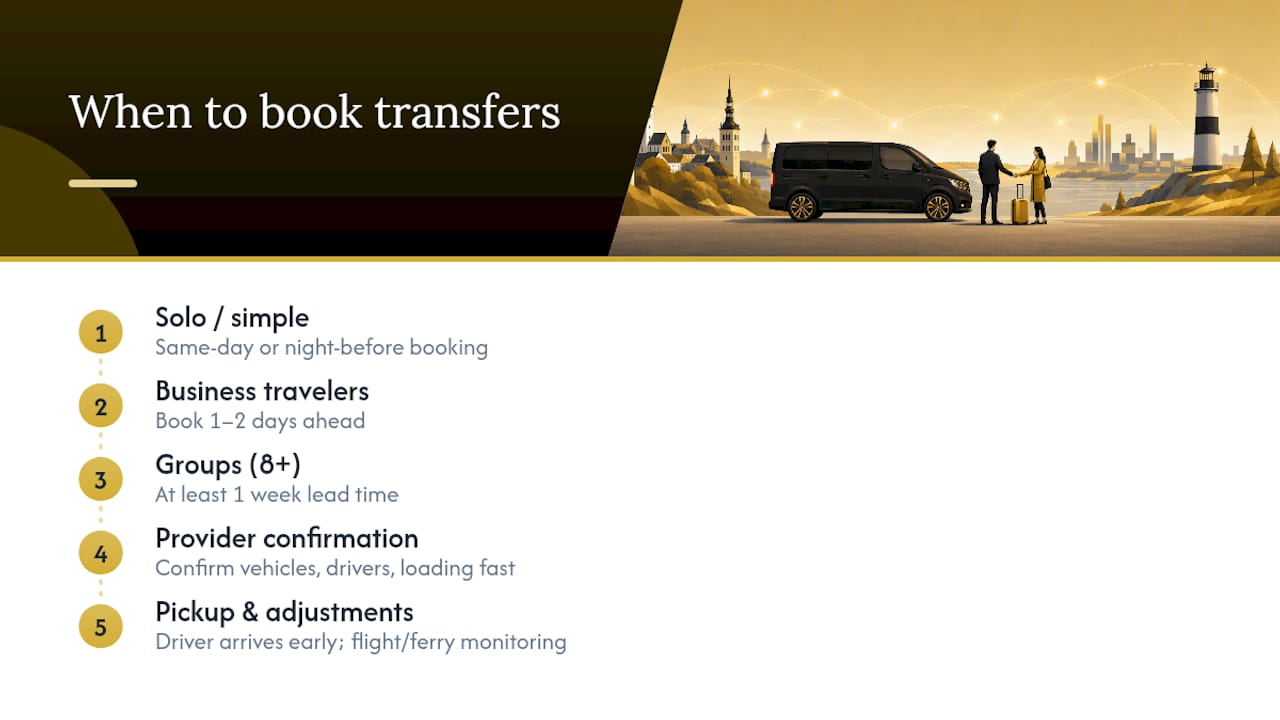
Once a booking is confirmed, the transfer itself runs on a fairly tight schedule. Drivers typically arrive at the pickup point ahead of the scheduled time, and flight or ferry monitoring adjusts that arrival automatically if your incoming transport runs late. The transfer duration itself is simply drive time between the two points, though Estonia’s rural roads and seasonal weather can add ten to twenty minutes on longer routes during winter months.
The gap between booking and pickup confirmation should be short regardless of how far ahead you book. A provider that takes more than a few hours to confirm a booking request is one worth double-checking before you commit, since a same-day pickup with no confirmed driver contact and vehicle plate leaves too much to chance.
What Are Typical Cancellation and Refund Policies?
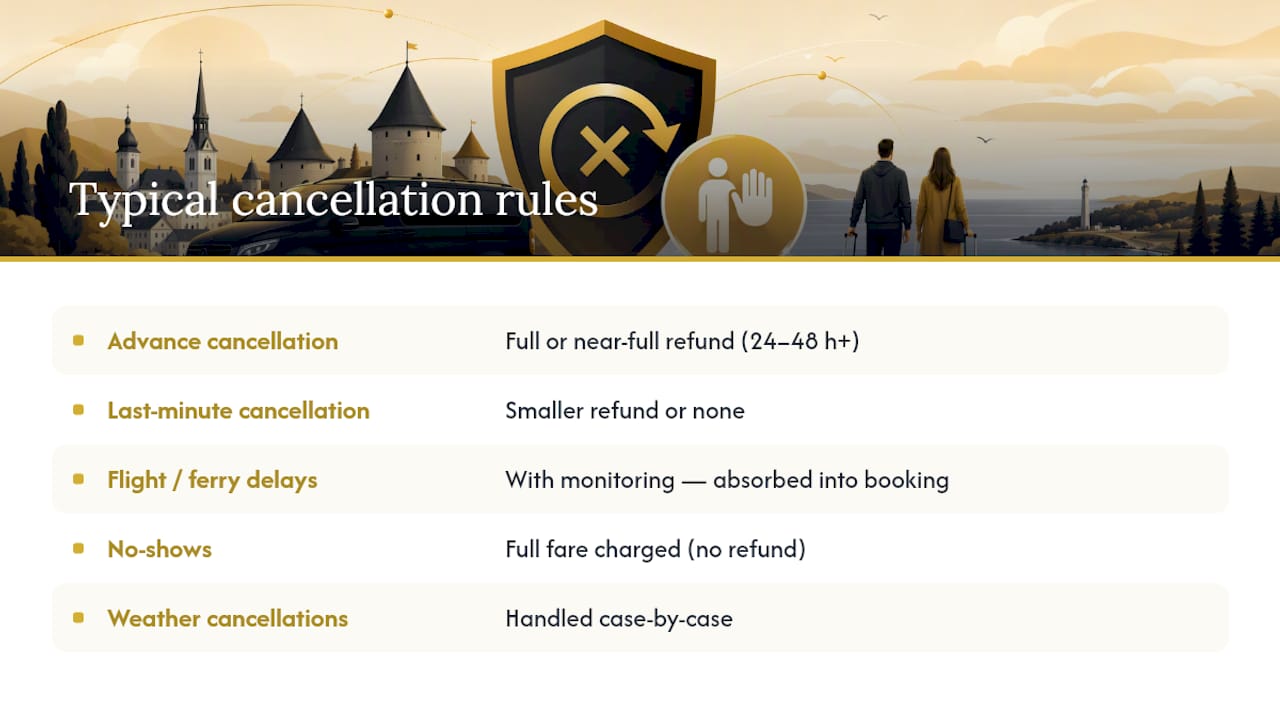
Cancellation terms vary from one Estonian provider to the next, so this is one of the first things to confirm before paying anything. Most reputable services offer a full or near-full refund for cancellations made well ahead of the pickup time, often 24 to 48 hours out, with a smaller refund or none at all for last-minute cancellations.
Flight and ferry delays are usually treated differently from a straightforward cancellation. A provider offering flight monitoring will typically absorb reasonable delays into the existing booking rather than charging a cancellation fee, since the trip is still happening, just later than planned. That distinction is worth confirming directly, since it’s easy to assume monitoring and cancellation policy are the same thing when they’re not.
No-shows tend to be the strictest category. If a passenger simply doesn’t appear at the pickup point with no notice, most providers charge the full fare since the driver and vehicle were already committed to that time slot. Weather-related cancellations, which come up more often in Estonian winters, are usually handled case by case rather than under a fixed rule.
Before booking, ask directly: what’s the cutoff for a full refund, what happens if my flight is delayed by hours rather than minutes, and is there a different policy for group bookings versus solo trips? Group cancellations often carry stricter terms since multiple vehicles or a larger car may already be scheduled around that booking.
How Do Providers Ensure Driver Professionalism and Safety?
Driver quality is one of the harder things to verify from a website alone, but a few concrete signals help. Providers that mention licensing, insurance coverage, and multilingual staff are generally being specific rather than vague, and specificity here is a good sign compared to a page that just claims “professional drivers” with no detail behind it.
Vehicle maintenance matters just as much as the driver behind the wheel. A fleet built around a single vehicle type, like Mercedes-Benz V-Class cars, is often easier to keep consistently maintained than a mixed fleet pulled together from various sources. Ask whether vehicles are company-owned or contracted, since that affects how consistently maintenance standards get applied across the fleet.
For long routes especially, ask about driver rest and route familiarity. A three-hour drive from Tallinn to Valga is a different job than a fifteen-minute airport run, and a provider that assigns experienced long-haul drivers to longer routes is doing something Estonia-based transfer providers generally treat as standard practice rather than an upsell.
What Payment Methods Do Estonian Transfer Providers Accept?
Most Estonian transfer providers accept the usual mix of major credit and debit cards through their online booking systems, alongside direct bank transfer for corporate or group bookings that need an invoice. Cash payment to the driver is less common for prebooked long-distance transfers than it is for casual taxi rides, since the fixed-quote model works best when payment is settled at booking or confirmed in advance.
Corporate and travel agency clients often need a different payment path entirely, since a single trip might get billed against a company account or a recurring invoice arrangement rather than a one-off card charge. If you’re booking on behalf of a business or handling fleet bookings for a travel agency, ask specifically whether the provider supports invoice billing, since not every booking form is built for that by default.
Whatever payment method you use, confirm the currency and total amount in writing before the trip. Estonian providers price in euros, and a fixed quote should show that final euro amount clearly on your booking confirmation, not just an estimated range.
What Do Reviews Say About Long-Distance Transfer Reliability?
Customer feedback on long-distance transfers tends to cluster around a few recurring themes: punctuality, communication when flights or ferries run late, and whether the final price matched the original quote. Reviews that specifically praise a provider for holding the quoted price despite a delay carry more weight than generic five-star ratings with no detail behind them.
Vehicle condition and driver conduct come up almost as often. Travelers booking a V-Class or minibus for a group tend to comment on comfort and space more than pricing, since group transfers are usually chosen specifically to avoid splitting a party across multiple cars. Negative reviews across the industry tend to focus on unclear pricing or a driver who didn’t track a delayed flight, both of which point back to the trust signals worth checking before booking rather than after a bad experience.
When comparing providers, look past the overall star rating and read a handful of recent reviews that mention specific routes or situations similar to yours. A provider with strong reviews for airport pickups but thin feedback on longer intercity routes may still be worth booking, but it’s useful information going in.
Book Your Long-Distance Transfer With Solidride
Solidride gives you the fixed-quote reliability this guide has walked through, without the guesswork of comparing vague per-kilometer rates across providers. You get a Mercedes-Benz V-Class fleet, flight and ferry monitoring built into every booking, and the flexibility to add pets, group travel, or event logistics to a single reservation rather than juggling separate arrangements.

Whether you’re planning a solo airport run into Tallinn or coordinating a multi-vehicle group transfer across the country, the booking flow captures everything covered above: pickup details, vehicle class, return trip options, and a confirmed total before you travel. The High-End Transfer Booking Checklist walks through exactly what to confirm before you commit to any provider, Solidride included. If you’re ready to lock in a route, start with your pickup and drop-off details on the booking form and get your fixed quote in writing before you travel.
What Matters Most When Booking a Long Transfer
The biggest mistake travelers make on long-distance routes isn’t picking the wrong vehicle. It’s assuming a quoted rate and a confirmed total are the same thing, when they often aren’t until you get it in writing. Fixed pricing only protects you if the provider actually confirms it before departure rather than leaving room for “adjustments” once you’re already in the car.
Here’s a six-step checklist worth running through before you book any long-distance transfer in Estonia:
- Confirm your vehicle class matches your passenger and luggage count.
- Get the final price confirmed in writing, not just an estimate.
- Verify flight or ferry monitoring is included if you’re arriving from elsewhere.
- Ask about luggage limits and any extra fees for oversized items.
- Read the cancellation terms before you pay, especially for group bookings.
- Book with enough lead time, more for groups than for solo trips.
— Erki
Einen Kommentar hinzufügen