


TL;DR:
- Executive transport services offer pre-arranged, secure, and reliable chauffeur-driven travel for high-profile clients and corporate needs. They differ from rideshares through fixed pricing, professional drivers, and active logistics management, ensuring efficiency and privacy during critical business trips. Proper vehicle and fleet coordination reduce costs, mitigate risks, and support seamless large event transportation.
Executive transport services are pre-arranged, chauffeured travel solutions designed to deliver reliable, secure, and comfortable travel for business professionals, corporate delegations, and high-profile clients. Unlike rideshare apps or standard taxis, these services operate on fixed pricing, professional driver standards, and active logistics management. The types of executive transport services available today range from individual executive sedans to full motor coach fleets, each built for a specific business travel scenario. Selecting the right option directly affects punctuality, client perception, and your company’s overall travel budget.

1. What are the main types of executive transport services?
Executive transport, also called executive ground transportation in the industry, covers a spectrum of vehicle categories and service models. The right choice depends on group size, event type, and the level of privacy required. Hourly rates reflect this range: sedans run $85–$200, SUVs $100–$250, Sprinter vans $175–$400, and motor coaches $250–$600 per hour. That pricing spread signals how differently each vehicle category is positioned in the market.
The five core vehicle categories in executive ground transportation are:
- Executive sedans (1–3 passengers): Best for individual executives, airport transfers, and one-on-one client meetings. Vehicles like the Mercedes-Benz E-Class or S-Class set the standard for this category.
- Luxury SUVs (1–6 passengers): Preferred when extra luggage space or a slightly larger group is involved, without sacrificing comfort.
- Stretch limousines (6–10 passengers): Reserved for formal events such as galas, award ceremonies, and VIP arrivals where presentation matters as much as transport.
- Executive Sprinter vans (8–14 passengers): The workhorse of corporate group travel. Teams move together, luggage travels with them, and the vehicle can be configured for in-transit briefings.
- Motor coaches (40–56 passengers): Used for large-scale corporate retreats, conventions, and conference shuttles where moving a full delegation efficiently is the priority.
Each category serves a distinct operational need. Choosing the wrong vehicle type creates friction, whether that means a cramped sedan for a five-person team or an oversized coach for a two-person executive visit.
2. How executive transport differs from rideshare and taxi options
The most important operational difference is predictability. Executive ground transportation runs on pre-arranged bookings with fixed rates, dedicated dispatch teams, and real-time monitoring of flights and traffic. Rideshare platforms use dynamic pricing that spikes during peak hours, bad weather, or high-demand events. That unpredictability is a direct liability for corporate travel planning.
Pro Tip: Book executive transport at least 24 hours in advance for standard transfers, and 72 hours ahead for multi-vehicle event coverage. Last-minute bookings on rideshare platforms during major conferences can cost three to five times the standard rate.
The service model also differs at the driver level. Executive chauffeurs are trained for security, discretion, and business protocol. Many high-end providers require chauffeurs to sign Non-Disclosure Agreements to protect sensitive conversations and client identities during transit. A rideshare driver has no such obligation and no training for high-stakes corporate environments.
Active logistics management is another separator. Dedicated dispatch teams monitor real-time flight data, road conditions, and security alerts, then adjust pickup times proactively. Clients rarely know a schedule change happened because the provider handled it before it became a problem. That level of operational management does not exist in the rideshare model.
3. Pricing factors and service packages for corporate transport
Pricing in executive transport follows a clear structure based on vehicle type, duration, and service complexity. The base hourly rates cited above represent standard market pricing, but corporate accounts change that equation significantly. Corporate accounts offer consolidated invoicing, priority booking, and volume-based rates that reduce per-ride costs compared to standard public pricing. For companies running regular executive travel, an account relationship is the single most effective way to control costs.
| Vehicle Type | Passengers | Hourly Rate Range | Best Use Case |
|---|---|---|---|
| Limousine der Oberklasse | 1–3 | $85–$200 | Airport transfers, client meetings |
| Luxury SUV | 1–6 | $100–$250 | Small group travel, extra luggage |
| Sprinter van | 8–14 | $175–$400 | Team transfers, corporate shuttles |
| Motor coach | 40–56 | $250–$600 | Conventions, retreats, large events |
Fixed-rate pricing eliminates budget unpredictability from surge pricing and enables transparent corporate expense reporting. Finance teams can reconcile travel costs against approved budgets without chasing variable charges. That predictability is not a minor convenience. It directly reduces the administrative burden on travel managers and accounting departments.
Pro Tip: For multi-day corporate events, negotiate a package rate rather than booking individual trips. Providers typically offer meaningful discounts for guaranteed volume over two or more consecutive days.
Package structures also scale for complexity. A single-day conference might require airport pickup, hotel-to-venue shuttles, and a closing dinner transfer. Bundling those into one service agreement simplifies coordination and often reduces total cost compared to booking each leg separately.
4. Coordinating multiple vehicle types at corporate events
Large corporate events require a fleet strategy, not just a vehicle booking. Mixing vehicle types using sedans, Sprinter vans, and SUVs optimizes transportation for groups of different sizes and roles. A senior executive arriving from an international flight gets a sedan with meet-and-greet service. The project team traveling together from the hotel gets a Sprinter van. That matching of vehicle to passenger role is what separates professional event logistics from improvised transport.
Coordination at scale requires active itinerary management. The key practices for multi-vehicle deployments are:
- Centralized scheduling: One point of contact manages all vehicle assignments, timing, and driver briefings.
- Real-time driver communication: Dispatchers maintain contact with every vehicle throughout the event, not just at pickup and drop-off.
- Buffer time built into schedules: Events run late. Vehicles should be staged and ready, not en route when a session overruns.
- Role-based vehicle assignment: Match the vehicle to the passenger’s status and group size, not just availability.
- Contingency vehicles on standby: For events with 50 or more attendees, having one backup vehicle staged nearby prevents a single breakdown from disrupting the entire program.
Privacy and security considerations also intensify at large events. When multiple executives travel simultaneously, the risk of schedule exposure increases. Professional providers use trained protection agents who treat time, security, and privacy as core deliverables, not afterthoughts. For events like major industry conferences or high-stakes board meetings, that security layer is a genuine operational requirement.
Luxury event logistics, including executive transport coordination for major business gatherings, consistently shows that the providers who succeed are those who plan for failure points before they occur. The best transport coordinators run scenario planning for weather delays, venue changes, and VIP schedule shifts before the event begins.
5. Specialized executive transport formats worth knowing
Beyond the five core vehicle categories, several service formats address specific corporate travel needs that standard bookings do not cover.
Airport transfer services are the most common entry point into executive transport. These are point-to-point transfers with fixed pricing, flight tracking, and meet-and-greet at the arrivals hall. Solidride, for example, operates 24/7 airport transfers in Tallinn with real-time flight monitoring and luggage assistance included as standard. The meet-and-greet element matters more than most corporate travelers realize. A driver holding a name sign in a crowded arrivals hall removes a genuine stress point from the start of a business trip.
Executive shuttle services run on a fixed route and schedule between a hotel and a conference venue, or between multiple corporate campuses. They work like a private bus line, but with executive-grade vehicles and professional drivers. For multi-day conferences, a dedicated shuttle loop eliminates the coordination overhead of individual bookings for each attendee.
Private hire vehicle services cover on-demand or pre-booked use of a specific vehicle for a set period, typically a half-day or full-day block. This format suits executives who need a vehicle available throughout a day of meetings rather than booking individual point-to-point trips. The vehicle and driver remain dedicated to that client for the entire booking window.
Event-specific transport packages combine multiple vehicle types under one service agreement for a defined event. This is the format used for product launches, investor days, and corporate retreats where transport is part of the client experience, not just a logistical necessity. Protecting high-value vehicles during events is also a consideration; luxury car asset protection practices apply to fleet vehicles operating in high-traffic event environments.
Die wichtigsten Erkenntnisse
Matching the vehicle type to the passenger role and group size is the single most important decision in executive transport planning.
| Punkt | Details |
|---|---|
| Vehicle type drives cost | Sedans start at $85/hr; motor coaches reach $600/hr. Match the vehicle to actual group size. |
| Feste Preise schonen das Budget | Fixed-rate contracts eliminate surge pricing and simplify corporate expense reporting. |
| Corporate accounts reduce costs | Volume agreements deliver priority booking and lower per-ride rates for frequent travelers. |
| Multi-vehicle events need a fleet strategy | Assign vehicles by passenger role, not just availability, to maintain efficiency and security. |
| Chauffeurs are more than drivers | NDAs, security training, and business protocol distinguish executive chauffeurs from rideshare drivers. |
Why executive transport is a business tool, not a perk
I’ve watched companies cut executive transport budgets and replace chauffeured services with rideshare apps for senior leadership travel. The short-term savings look real on a spreadsheet. The actual cost shows up elsewhere: a missed flight connection because surge pricing made a driver 20 minutes late, a sensitive pre-merger conversation held in a rideshare vehicle with no confidentiality agreement, a client left waiting at arrivals because the app assigned a driver who canceled.
Executive transport is a risk mitigation tool. That framing matters because it changes how procurement teams evaluate the spend. When you account for the cost of a missed meeting, a delayed executive, or a confidentiality breach, the price difference between a rideshare and a professional chauffeur service looks very different.
The trend I find most significant right now is the demand for mixed-fleet solutions at corporate events. Companies are not just booking one vehicle type anymore. They are asking providers to manage a coordinated fleet across an entire event, with real-time logistics and a single point of accountability. That complexity requires a provider with genuine operational infrastructure, not just a booking platform. The providers who invest in dispatch technology, driver training, and proactive schedule management are the ones delivering real value. The ones who treat executive transport as a commodity are the ones whose clients end up stranded.
— Erki
Solidride’s approach to corporate transport needs
Solidride operates private chauffeur services across Estonia with 24/7 availability, real-time flight monitoring, and meet-and-greet included on every airport transfer. The fleet covers individual executive travel through group transfers, with Mercedes-Benz V-Class vehicles as the core offering for both comfort and capacity.
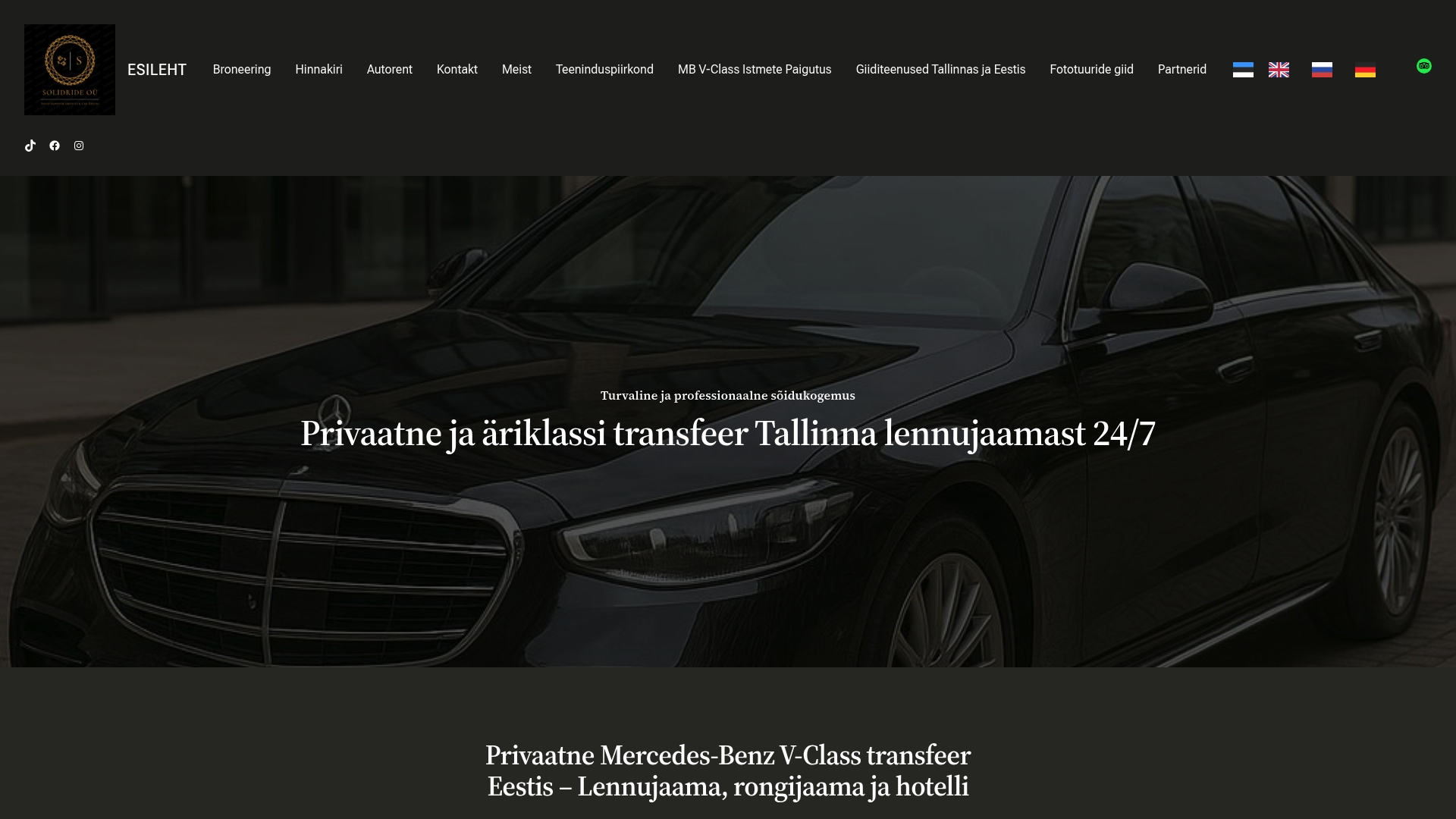
Corporate clients get fixed-rate pricing with no surge fees, making expense reporting straightforward for travel managers. Solidride also handles event-specific transport, group shuttles, and multi-vehicle coordination for conferences and corporate retreats. For businesses that need reliable, professional transport in Tallinn and across Estonia, book a transfer directly through the website or contact the team to discuss a corporate account structure.
FAQ
What is the difference between executive transport and a taxi?
Executive transport is pre-arranged, fixed-rate, and operated by professionally trained chauffeurs with active dispatch support. Taxis and rideshare apps use dynamic pricing and do not offer the same security, privacy, or logistics management.
How much does executive car service cost per hour?
Hourly rates range from $85–$200 for executive sedans to $250–$600 for motor coaches, depending on vehicle type, location, and booking duration.
What vehicle type is best for a small corporate group?
A Sprinter van is the best option for groups of 8–14 passengers. It keeps the team together, accommodates luggage, and costs $175–$400 per hour, which is more efficient than booking multiple sedans.
Do executive chauffeurs sign confidentiality agreements?
Many high-end executive transport providers require chauffeurs to sign Non-Disclosure Agreements as a standard part of their employment, protecting sensitive client conversations and travel details.
How do corporate accounts work with executive transport providers?
Corporate accounts provide consolidated invoicing, priority booking, and volume-based rate reductions. They are the most cost-effective structure for companies with regular executive travel needs.
Einen Kommentar hinzufügen