


TL;DR:
- An event transportation plan is a detailed system that ensures the safe and timely movement of all event participants. It covers routing, vehicle types, staging, communication, and contingency procedures, especially for large or complex events. Proper planning prevents delays, safety hazards, and logistical chaos, making transportation a vital operating model rather than an afterthought.
An event transportation plan is a documented operational blueprint that coordinates the safe, timely movement of every person connected to your event: attendees, staff, vendors, VIPs, speakers, and media. It is not a spreadsheet of names or a list of booked rides. It is a living system that covers routing, vehicle mix, staging, communications, contingency protocols, and accessibility from the first shuttle run to the last return trip.
You need one the moment your event involves more than a handful of arrivals, a constrained venue, or guests arriving from multiple locations. For a 500-person conference, a multi-day festival, or any event that touches public roads, the plan is not optional. It is what separates a smooth arrival experience from a parking-lot crisis at 8:45 AM.
A complete event transportation plan typically includes:
- Guest segmentation (VIPs, speakers, staff, general attendees, vendors)
- Vehicle mix and mode selection (coaches, vans, private cars, accessible vehicles)
- Routing and staging (exact pickup/drop-off points, curb management, loading zones)
- Parking and site access (primary, overflow, staff, vendor load-in, permits)
- Communications and technology (live tracking, SMS updates, on-site signage)
- Contingency and incident response (backup vehicles, escalation thresholds)
Success looks like this: every attendee arrives within the target window, no segment waits more than a short period at a pickup point, and every accessible vehicle is confirmed operational before the first run.
Inhaltsverzeichnis
- Why does event transportation planning affect your entire event?
- What must every event transportation plan include?
- How do you build an event transportation plan step by step?
- How does a Traffic Management Plan differ from your event transportation plan?
- How much does event transportation cost, and what drives the budget?
- What does day-of operations actually look like?
- Reusable checklist and templates you can copy right now
- Die wichtigsten Erkenntnisse
- The plan is not the paperwork — it is the operating model
- Authoritative sources and further reading
Why does event transportation planning affect your entire event?
Transportation failure does not stay contained. A delayed shuttle at the airport ripples into a late keynote, which compresses the lunch break, which backs up the afternoon sessions. One missed VIP pickup can derail a sponsor relationship. These are not hypothetical scenarios; they are the predictable result of treating transport as an afterthought.
Beyond schedule protection, there are real safety and crowd-control stakes. Unmanaged pedestrian flows near vehicle staging areas create hazards. Vehicles queuing on public streets without a plan draw police attention and can trigger permit violations. Group transportation failures are most often caused by confusion and poor communication rather than traffic itself, which means the fix is almost always a written plan, not more vehicles.
Operationally, a documented event logistics plan gives you predictable timelines, cleaner vendor coordination, and far fewer ad-hoc fixes on event day. Vendors know where to stage. Drivers know their routes. Your ops team has a single source of truth.
Statistic callout: FHWA’s planned special events guidance frames transportation management as a public safety function, not just a logistics convenience. When your event measurably diverts traffic or affects pedestrian flows on public rights-of-way, formal Traffic Management Plan requirements apply.
Pro Tip: Treat transportation as a repeating operating model, not a one-off booking task. Build a master template after each event, update it with lessons learned, and you will spend significantly less time on logistics for the next one.
What must every event transportation plan include?
Guest segmentation and passenger manifests
Start by sorting your passengers into segments: VIPs and speakers (highest service level, dedicated vehicles), staff (scheduled shuttles, often earlier than guests), general attendees (high-volume shuttle loops), vendors (load-in windows separate from guest arrivals), and any non-ticketed visitors such as press or media. Each segment has different timing, pickup locations, and service expectations. Mixing them into one undifferentiated manifest is where plans break down.

For VIP and speaker airport transfers, the manifest must include flight numbers, terminal details, meet-and-greet instructions, and luggage counts. General attendee manifests can be lighter, but they still need hotel distribution data and arrival windows.
Vehicle mix and mode selection
Match the vehicle to the segment and the route. High-volume airport loops call for coaches or large shuttles. Hotel-to-venue runs for 20–30 guests work well with minibuses or vans. VIP and speaker legs warrant private cars with professional chauffeurs. Accessible vehicles must be confirmed for every event, not added as an afterthought.
Venue mapping is the foundation of mode selection: identify the main entrance, bus access points, turning radius constraints, and ADA-accessible entrances before you choose a single vehicle type.
Routing, staging, and curb management
Every pickup and drop-off point needs an exact address or GPS coordinate, not just “the front of the hotel.” Staging maps should show loading zones, no-go areas for private vehicles, and the sequence in which vehicles pull forward. Turning radius matters more than most planners expect: a 45-foot coach cannot navigate a tight hotel porte-cochère, and discovering that on event day is expensive.
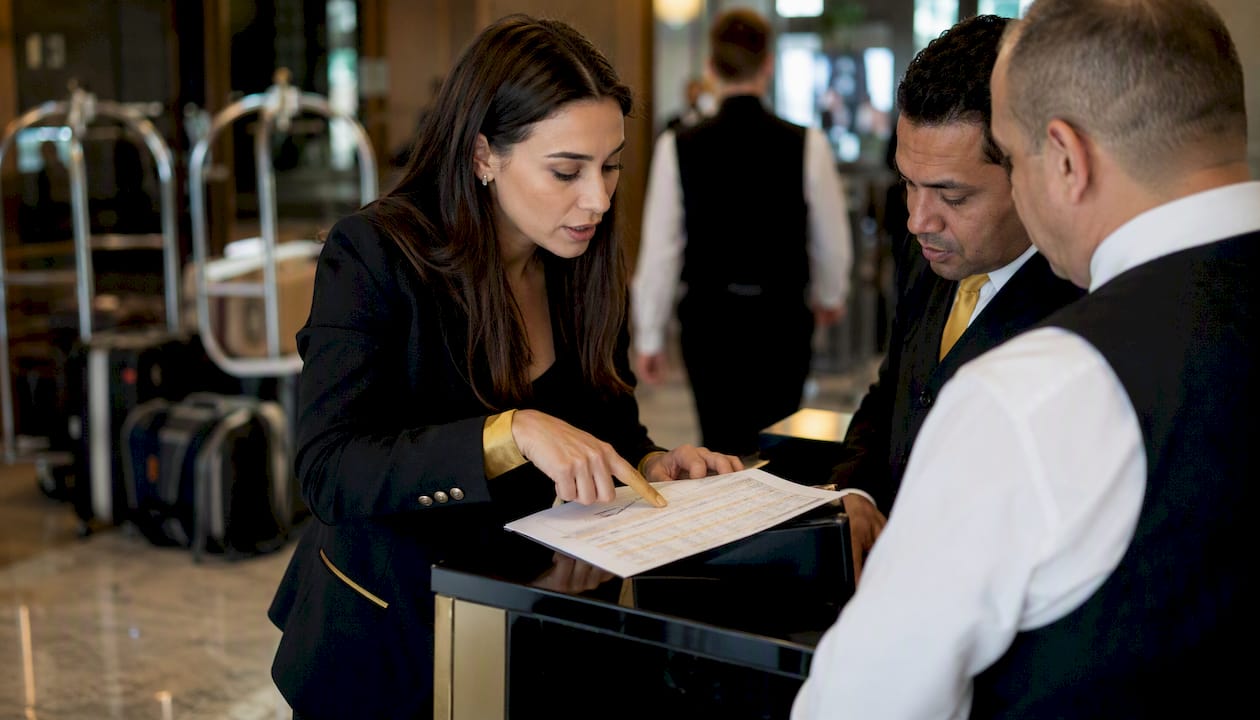
Parking and site access
Separate parking zones for staff, vendors, and attendees reduce congestion at the main entrance. Temporary permits and custom parking tickets are practical tools for controlling onsite parking and preventing unauthorized vehicles from blocking staging lanes. Vendor load-in windows should be scheduled before general attendee arrival, with a hard cutoff enforced by a marshal.
Communications and technology
A live manifest that tracks each passenger movement from “pending” to “in vehicle” to “delivered” is the difference between reactive and proactive operations. Centralized systems with live tracking, flight synchronization, and automated SMS updates allow teams to manage hundreds of movements without fragmented communication channels. On-site, clear signage and a staffed information point handle the guests who did not read the pre-event email.
Contingency planning
Every plan needs a backup vehicle on standby for high-impact legs. Define escalation thresholds in writing: at what point does a delayed flight trigger a vehicle hold versus a rebooking? Who authorizes a surge vehicle? These decisions made in advance take seconds on event day; made in the moment, they take 20 minutes and cost you the schedule.
Pro Tip: Verify accessibility specs and driver training during vendor contract negotiation, not the week before the event. Lift functionality, securement systems, and driver experience with mobility devices are contract terms, not assumptions.
| Component | What to document | Who owns it |
|---|---|---|
| Guest segmentation | Segment names, counts, service levels | Event planner |
| Vehicle mix | Vehicle types, capacities, ADA units | Transport lead |
| Routing and staging | GPS coordinates, staging sequence, curb map | Transport lead |
| Parking/site access | Zone assignments, permits, load-in windows | Venue ops |
| Communications | SMS templates, signage plan, contact tree | Comms lead |
| Contingency | Backup vehicles, escalation matrix, incident levels | Transport lead |
How do you build an event transportation plan step by step?
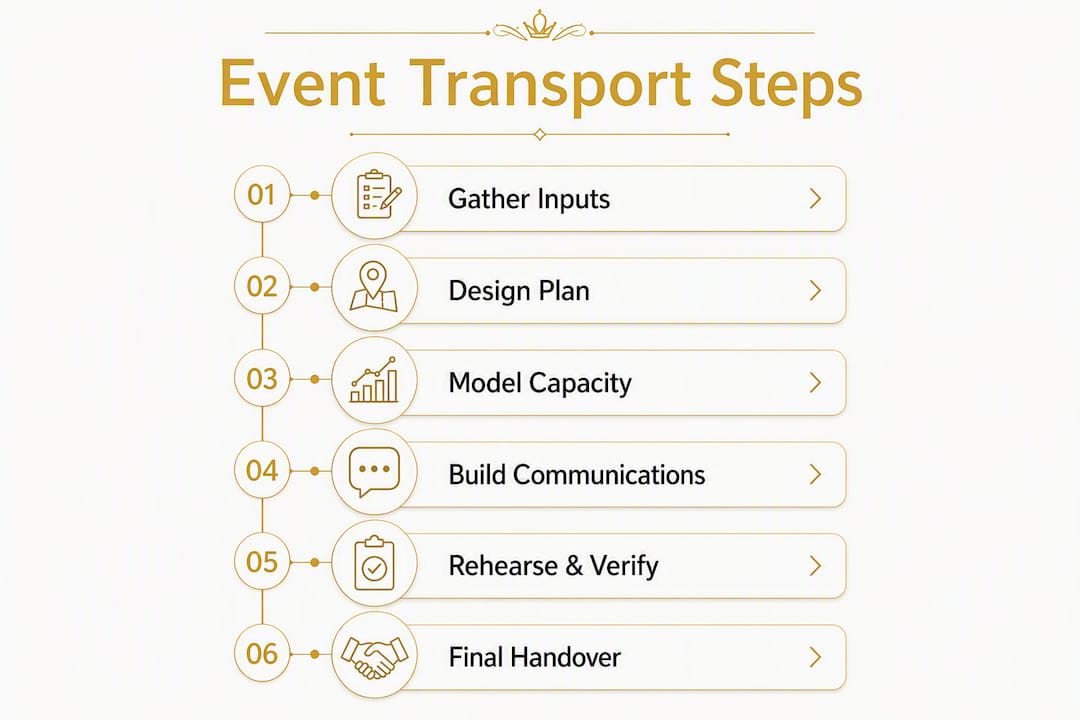
Step 1: Gather your inputs
Before designing anything, collect: attendance estimate and arrival mode breakdown (air, rail, drive), hotel distribution by property, flight and rail schedules for VIPs and speakers, venue access constraints (road widths, loading dock hours, permit requirements), ADA needs by segment, and any local traffic events or road closures on your event dates. A conference transfer service provider can often supply venue-specific access data from prior events.
Step 2: Design the plan
With inputs in hand, define your guest segments, assign vehicle types, map pickup and drop-off points with GPS coordinates, and build schedule windows with buffers. A 10-minute buffer on every airport run is not padding; it is the margin that absorbs a slow customs line or a gate change.
Step 3: Model capacity
Here is a simple vehicle math example. You have 200 attendees arriving at the airport in a 3-hour window, and your shuttle holds 40 passengers. Assume a 45-minute round trip (airport to venue and back). In 3 hours, one vehicle completes roughly 4 round trips, carrying 160 passengers. You need at least 2 vehicles to cover 200 passengers with a buffer, or 3 if arrivals cluster in the first 90 minutes. Run this math for every high-volume leg before you book a single vehicle.
For multi-stop itineraries, add dwell time at each stop to the round-trip calculation or you will consistently underestimate vehicle hours.
Step 4: Select vendors
Ask every carrier these questions before signing:
- What is your fleet’s ADA capability, and can you document lift certifications?
- Do your vehicles carry GPS/AVL telemetry, and can you share a live feed?
- What is your surge policy if a vehicle breaks down mid-event?
- What insurance coverage do you carry, and does it cover passenger liability?
- How do your drivers communicate with your ops team during the event?
Step 5: Build the communications plan
Pre-event: send attendees a transport confirmation with pickup location, time, and a contact number 48 hours out. Day-of: automated SMS updates when vehicles depart and arrive. On-site: a staffed transport desk or clearly signed information point. Designate a single point of contact for drivers and a separate one for the venue. Never let drivers call the event director directly.
Contact template (copy and adapt):
Step 6: Rehearse and verify
Walk the route. Stand at the staging area and watch a vehicle pull in and out. Test your tracking dashboard with a live vehicle. Send a test SMS to your own phone. These checks take two hours and prevent the kind of surprises that take two hours to fix on event day.
Step 7: Final handover and live manifest
72 hours before the event, freeze the manifest and distribute it to all drivers, the venue ops team, and your transport lead. 24 hours out, run a final confirmation call with all vendors. On event day, the manifest goes live: every completed trip gets marked, every delay gets flagged, and the transport lead has a real-time picture of where every vehicle is.
How does a Traffic Management Plan differ from your event transportation plan?
These are two related but distinct documents, and confusing them creates gaps in both.
Your event transportation plan is the broader operational document. It covers private transfers, passenger manifests, guest communications, vendor coordination, and internal logistics. It is primarily an internal planning tool.
A Traffic Management Plan (TMP) is the day-of component focused specifically on how traffic, parking, and pedestrian operations will be managed on public rights-of-way. FHWA defines the TMP as containing:
- Site access and parking plans
- Pedestrian access controls
- Traffic flow and control plans
- En-route traveler information
- Traffic surveillance
- Incident management and safety plans
“A Traffic Management Plan is the day-of operations component that specifies how traffic, parking, and pedestrian operations will be managed. A comprehensive TMP includes site access and parking plans, pedestrian plans, traffic control, traveler information, traffic surveillance, and incident management and safety plans.” — FHWA, Managing Travel for Planned Special Events
When your event causes measurable traffic diversion or affects public streets, local authorities will expect a formal TMP. FHWA’s Chapter 6 guidance provides checklists and modeling frameworks for developing a TMP scaled to your event’s size and local conditions.
Municipalities vary in their requirements. Some cities, like San Diego, publish special event transportation plan templates that specify exactly what to document for permit approval, including safe arrival and departure procedures for attendees, participants, and vendors. Check with your local Department of Transportation and police department at least 60 days before the event.
Elements to prepare for authorities:
- Site access map with ingress/egress routes
- Parking zone assignments and capacity
- Pedestrian crossing points and marshal positions
- Traffic control device plan (cones, barriers, signage)
- Incident response contacts and escalation chain
How much does event transportation cost, and what drives the budget?
The largest cost drivers, in order of typical impact, are vehicle hours and mileage, standby/waiting time, specialized equipment (wheelchair lifts, luxury vehicles), staging and permit fees, and staffing for marshals and security.
| Cost driver | Typical range (U.S.) | Notes |
|---|---|---|
| Charter coach (per day) | — | Varies by market, distance, and vehicle age |
| Minibus/van (per day) | — | Shorter runs, hotel loops |
| Private car/chauffeur (per trip) | — | VIP and speaker legs |
| ADA-accessible vehicle (per day) | — | Lift-equipped, driver-certified |
| Staging/permit fees | — | City and venue dependent |
| Marshal staffing (per person/day) | — | Varies by market |
For a 500-person conference with three hotel properties and airport shuttle service over two days, a realistic budget includes: 3 coaches for hotel loops ($4,800–$12,000), 2 airport shuttle vehicles ($1,600–$4,000), 4 private cars for VIPs and speakers ($600–$2,400), 1 ADA vehicle on standby ($1,000–$2,400), and 4 marshals ($600–$1,600). Total rough range: $8,600–$22,400, before permit fees and contingency.
Negotiation levers that actually move the number: booking 90+ days out typically yields better rates than last-minute requests. Block hours (a guaranteed minimum) cost less per hour than per-trip pricing for high-frequency routes. Clarify cancellation and penalty terms in writing before signing.
Pro Tip: Reserve one contingency vehicle and budget a 2-hour standby block for your highest-impact legs (airport runs and VIP transfers). The cost is small; the protection is significant.
What does day-of operations actually look like?
Designate a single transportation lead before anything else. This person owns the manifest, communicates with all drivers, and makes real-time decisions. Supporting roles: a manifest manager (tracks trip completions and flags delays), a staging marshal at each major pickup point, a vendor liaison for driver issues, and a comms lead for attendee-facing updates.
For an event of moderate size, a reasonable staffing model involves a transport lead, a couple of staging marshals, a manifest manager, and a communications lead, scaling staffing according to the number of major pickup locations.
Communications flows on event day:
- Drivers report trip completion to the manifest manager via app or SMS
- Manifest manager updates the live dashboard and flags any delay over 10 minutes
- Transport lead notifies the venue ops contact and relevant speaker handler if a VIP is delayed
- Comms lead sends attendee-facing updates for any shuttle delay over 15 minutes
Monitoring tools that matter: AVL/GPS tracking on every vehicle, flight status integration for airport runs, and a live manifest accessible to the full ops team. Integrating flight APIs and GPS telemetry into a single dashboard eliminates the fragmented phone calls that slow down response time.
Pro Tip: Build an incident classification matrix before event day. Level 1: minor delay under 10 minutes, transport lead handles. Level 2: vehicle breakdown or delay over 20 minutes, escalate to senior ops. Level 3: safety incident, escalate immediately to venue security and event director. Teams that know the thresholds act faster and with less confusion.
| Role | Responsibility | Comms channel |
|---|---|---|
| Transport lead | Owns manifest, makes real-time decisions | Direct line to all leads |
| Manifest manager | Tracks completions, flags delays | Dashboard + SMS |
| Staging marshal | Controls curb, directs vehicles and guests | Radio + transport lead |
| Comms lead | Sends attendee updates, manages signage | SMS platform + PA |
Reusable checklist and templates you can copy right now
Pre-event checklist (60–30 days out)
- Confirm vehicle types, counts, and ADA units with all vendors
- Obtain all required permits (staging, parking, TMP if applicable)
- Distribute staging maps to venue ops and all drivers
- Set up live tracking dashboard and test with a real vehicle
- Draft and test SMS templates for all attendee segments
- Confirm driver contact list and escalation chain
72–24 hour checklist
- Freeze and distribute final passenger manifest to all drivers and venue ops
- Run confirmation call with all vendors; verify vehicle condition and fuel
- Walk the staging area and confirm signage placement
- Send pre-event transport confirmation to all attendees
- Confirm contingency vehicle availability and standby location
Day-of checklist
- Transport lead and all marshals on-site 90 minutes before first pickup
- Live manifest activated; all drivers checked in via app or SMS
- Staging lanes clear; no-go zones marked and enforced
- Flight status monitoring active for all VIP/speaker arrivals
- Comms lead ready to send updates; attendee contact number live
Sample day-of timeline (500-person conference, single venue)
| Time | Activity |
|---|---|
| — | Transport lead and marshals on-site; staging confirmed |
| 6:30 AM | First airport shuttle departs (early arrivals) |
| — | Hotel loop shuttles begin (30-minute frequency) |
| — | VIP/speaker transfers begin (flight-synced) |
| — | Registration opens; peak arrival window |
| 10:30 AM | Morning shuttle frequency reduces to 60 minutes |
| — | Return shuttle loops begin |
| — | VIP/speaker return transfers |
| — | Final shuttle run; contingency vehicle released |
Vendor contract clauses to require
- Minimum insurance coverage: $1M per occurrence commercial auto liability
- ADA capability: lift-equipped vehicle available on request, driver certified
- GPS/AVL telemetry: live feed accessible to event ops team
- Surge policy: replacement vehicle within 45 minutes of breakdown
- Cancellation terms: full refund 30+ days out, 50% refund 15–29 days out
- Reporting: trip completion log delivered within 24 hours post-event
Die wichtigsten Erkenntnisse
An event transportation plan is a documented operational system covering every passenger movement at your event, and building one before you book a single vehicle is what keeps your master schedule intact.
| Punkt | Details |
|---|---|
| Segment passengers early | Separate VIPs, staff, attendees, and vendors before designing any route or vehicle mix. |
| Plan staging before vehicles | Map exact GPS pickup points, curb sequences, and turning radii before selecting vehicle types. |
| Automate communications | Use live manifests with flight sync and automated SMS to manage hundreds of movements without manual calls. |
| Reserve contingency capacity | Budget one standby vehicle and a 2-hour buffer block for high-impact legs like airport runs and VIP transfers. |
| Align with FHWA TMP requirements | When your event affects public streets, coordinate with your local DOT and police at least 60 days out. |
The plan is not the paperwork — it is the operating model
Most planners I have seen struggle with event transportation are not missing information. They have spreadsheets, they have vendor contacts, they have a rough schedule. What they are missing is the architecture that connects those pieces into something that can absorb a flight delay or a vehicle breakdown without cascading into a schedule failure.
The shift that changes outcomes is treating mobility as an operating model rather than a booking task. That means a live manifest that updates in real time, a communications chain where every person knows their role, and contingency decisions made in advance. When a VIP’s flight lands 40 minutes late, the team that has a flight-synced manifest and a pre-authorized vehicle hold handles it in two minutes. The team without one spends 20 minutes making phone calls and still misses the opening remarks.
One practical move you can make today: save GPS coordinates for every venue, hotel, and airport terminal you work with as named favorites in your mapping tool. On event day, you share a coordinate, not an address that a driver misreads. It is a small thing that eliminates a surprising number of staging errors.
For events where the logistics demand professional-grade execution, Solidride’s coordinated airport pickup services and group transfer capabilities are built around exactly this model: real-time flight monitoring, meet-and-greet, and live coordination so your transport lead is managing outcomes, not chasing drivers.
If you are ready to lock in premium transfers for your next event, start with Solidride’s high-end transfer booking checklist to confirm every contract detail before you sign.

Authoritative sources and further reading
- Managing Travel for Planned Special Events (FHWA FAQ) — Regulatory: defines TMP components and when formal plans are required by U.S. authorities.
- FHWA Planned Special Events Handbook, Chapter 6 — Regulatory: checklists, modeling guidance, and integration frameworks for developing a TMP at scale.
- Special Event Transportation Plan Template (San Diego) — Municipal template: shows what a local permitting office expects in a submitted transportation plan.
- Event Parking Lot Management (Caymil) — Practitioner: temporary permits, custom parking tickets, and curb congestion control.
Einen Kommentar hinzufügen