

The Mercedes V-Class is a luxury people mover that prioritizes passenger comfort and premium appointments, at the cost of higher purchase and running expenses and van-derived driving dynamics. It suits luxury shuttle operators, large families and corporate transfer fleets more than drivers who want engagement behind the wheel. Anyone considering one should weigh cabin quality against the ownership costs that come with a heavy, diesel-powered MPV.
TL;DR:
- The V 300d engine provides the best performance for full loads, reaching 0 to 100 km/h in about 7.9 seconds with high torque, while the V 220d is suitable for lighter, everyday use.
- Choosing a used V-Class requires verifying the full service history and inspecting the gearbox, sliding doors, and diesel emissions system to avoid costly repairs.
- The interior options, including VIP seating and high-tech displays, significantly influence passenger experience but may increase ownership costs without improving driving dynamics.
- The vehicle’s van-like handling offers comfort on motorways but results in noticeable body roll and light steering feedback on twisting roads, making it less engaging to drive.
- Booking a loaded test drive or a transfer service helps evaluate cabin comfort, luggage capacity, and access features before purchasing.
Table of Contents
- 1. Engines, transmission and dimensions you need to know
- 2. What the cabin feels like once you’re inside
- 3. How the V-Class drives and where it falls short
- 4. Trim levels, options and what they cost
- 5. What to check before buying a used V-Class
- 6. Ownership costs and what keeps the V-Class reliable
- 7. How operators actually use the V-Class day to day
- 8. Final verdict: who should actually buy one
- 9. What buyers consistently get wrong about this car
- 10. Want to experience one before you commit to buying?
- Sources
- FAQ
1. Engines, transmission and dimensions you need to know
The facelifted V-Class, updated in 2024, keeps a lineup of 2.0-liter four-cylinder diesel engines rather than switching to anything more exotic. The V 220d, V 250d and V 300d outputs run from 163 horsepower up to 237 horsepower, and every version pairs with the 9G-TRONIC nine-speed automatic transmission as standard.
The V 300d is the one to know if performance matters at all: it reaches 0 to 100 km/h in about 7.9 seconds, brisk for a vehicle this size, and its 530 Nm of torque means fewer downshifts when the cabin is full. Rear-wheel drive comes standard across the range, with 4MATIC all-wheel drive available on certain trims for buyers who need better traction in poor weather or with heavier loads.
Dimensions matter as much as power here. The standard-length V-Class measures around 5,140 mm with a wheelbase of about 3,200 mm, giving it the interior volume that defines the whole car. Seating runs from six to eight depending on configuration, and the fuel tank holds roughly 70 liters.
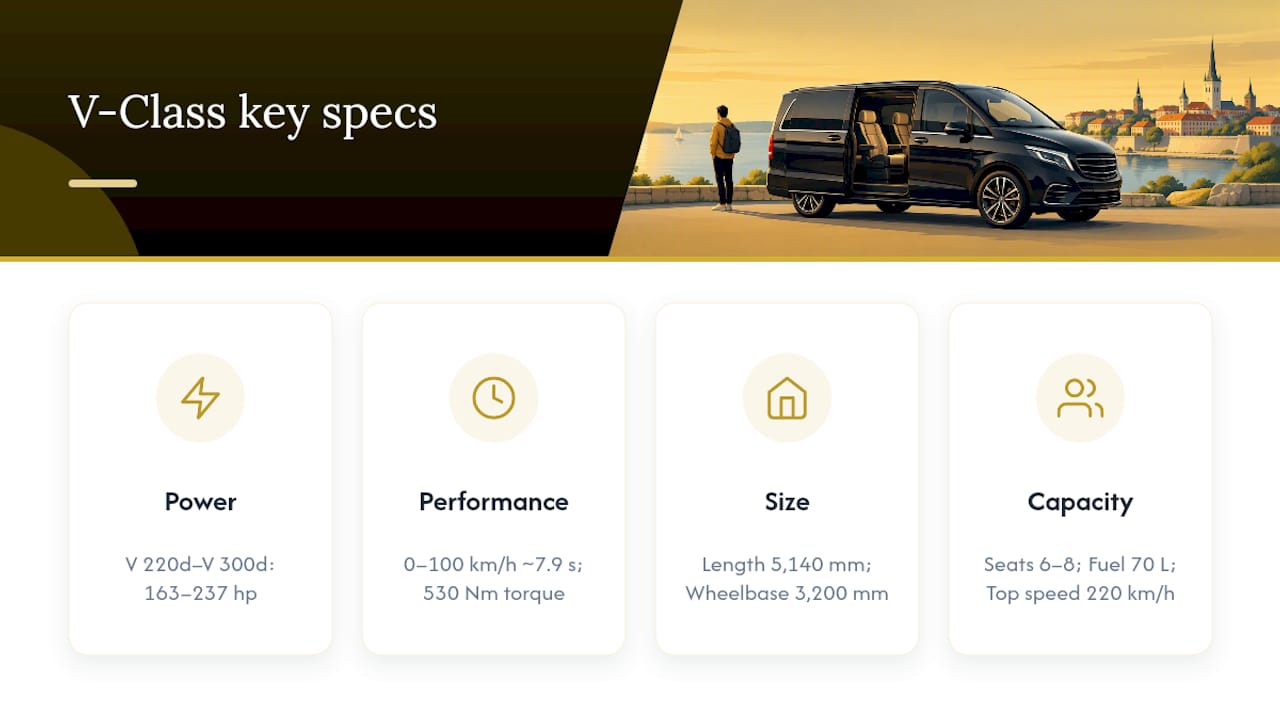
Figures sourced from Automoli’s technical listing, which also lists a top speed of 220 km/h for the range.
For buyers who expect to carry full loads regularly, the V 300d’s extra torque reduces strain on the gearbox and makes daily driving noticeably less effortful than the entry diesel.
2. What the cabin feels like once you’re inside
The interior is where the V-Class earns its price tag. Buyers choose between a six-seat VIP layout with individual captain’s chairs and more generous legroom, or seven to eight-seat configurations that prioritize headcount over lounge space. The VIP layout eats into luggage volume behind the rear row, so families or operators who need both people and bags should think carefully about which trade-off matters more.
Standard and optional equipment pushes the cabin closer to a Mercedes saloon than a van:
- Dual 12.3-inch displays running MBUX, added as part of the 2024 update noted by Auto Express.
- Ambient lighting that changes the mood of the rear cabin on longer journeys.
- Electric sliding doors on both sides, which speed up boarding for multiple passengers.
- Optional massage seats and a VIP middle-row package for buyers who want the rear cabin to feel closer to a private lounge.
The sliding doors are more than a comfort feature. They make the V-Class genuinely practical for airport and corporate transfer use, where passengers with luggage need quick, low-effort access without squeezing past a B-pillar. Combined with the tall roofline, they turn what could be an awkward boarding process into something closer to stepping into a train carriage.
The options that actually change the passenger experience the most are the VIP middle-row package and the upgraded display layout. Everything else, from ambient lighting to trim finishes, is polish rather than substance.
3. How the V-Class drives and where it falls short
Mercedes builds the V-Class on a van platform, and that shows the moment you turn the wheel. Top Gear’s review describes a plush, spacious MPV that still carries van-like driving dynamics, and that assessment holds up on twisting roads where body roll becomes noticeable and steering feedback stays light and remote.
On motorways, the story changes. Wind and road noise stay well suppressed, the ride settles into a calm cruise, and the driving position, sitting higher than in a typical saloon, gives good visibility in traffic. Autocar’s driving notes point out that this upright position and van-derived ride mean the V-Class never matches the dynamic polish of something like an E-Class, even though the cabin feels just as premium.
The V 300d or 4MATIC becomes the sensible choice once you’re regularly carrying a full load of passengers and luggage, or driving in winter conditions where the extra traction changes how confident the car feels on wet or icy roads. Buyers who mostly drive solo or with one or two passengers on dry roads will rarely notice the difference between engine variants.
Pro Tip: Book a test drive with the vehicle loaded close to its intended real-world weight, not empty, since ride quality and body control change noticeably once the rear seats and cargo area are in use.
4. Trim levels, options and what they cost
Estonia’s official Mercedes-Benz model pages list Avantgarde and Exclusive as the two core trims, with equipment and campaign pricing that reflect current local offers on the V-klass page. Avantgarde covers the essentials, exterior styling cues, 9G-TRONIC, and driver-assistance basics, while Exclusive adds the finishes that make the cabin feel closer to a chauffeured saloon.
Certain options push the price sharply higher regardless of trim:
- The VIP middle-row seating package, which replaces bench seating with individual lounge chairs.
- Burmester sound systems, a common upgrade on Exclusive-spec cars.
- Driving Assistance packages that bundle radar cruise control and lane-keeping features.
- 4MATIC all-wheel drive, which adds cost but also improves resale appeal in colder markets.
New pricing varies by market and specification, and the official Estonian pages list example campaign prices alongside equipment lists for both trims, so checking current local offers before budgeting is worth the five minutes it takes. Used values move just as widely depending on mileage, engine choice and whether the car carries a full service history, and specialist guides consistently flag documentation as the single biggest swing factor in resale value.
For buyers optimizing for resale rather than showing off, prioritizing the Driving Assistance package and a verified service history tends to matter more than chasing every comfort option on the list. A well-documented Avantgarde with the V 250d often holds value better than a poorly maintained Exclusive with every box ticked.
5. What to check before buying a used V-Class
A used V-Class can be a smart buy or an expensive mistake, and the difference usually comes down to how carefully you inspect it before handing over money.
- Ask for the full service history and confirm whether the vehicle was used commercially, since fleet or transfer use adds mileage and wear faster than private ownership.
- Test the gearbox through its full range under load, since Parkers’ review guidance flags gearbox wear as a recurring issue on higher-mileage examples.
- Check the diesel emissions system, including the DPF and AdBlue components, along with the turbo and injectors, since repairs in this area tend to be costly on any modern diesel.
- Operate both sliding doors repeatedly, listening for rail noise or hesitation, and inspect the tracks for damage from repeated commercial use.
- Look over interior wear points, underbody panels for rust, and run a full electronics check, since specialist analysis warns that body, electronics and diesel systems are the recurring risk areas on higher-mileage cars.
- Have an independent inspection read stored fault codes and take the car on a loaded test drive before finalizing any purchase.
Skipping the documentation check is the costliest mistake buyers make. A poorly documented service history combined with evidence of heavy commercial use is the single strongest warning sign that a V-Class will turn into an expensive project rather than a comfortable daily driver.
6. Ownership costs and what keeps the V-Class reliable
Servicing follows Mercedes’ standard intervals for the diesel range, and most of the ongoing cost sits in a handful of predictable areas rather than everyday running expenses.
- Emission system components, particularly the DPF and AdBlue hardware, represent the most expensive routine failure point on high-mileage cars.
- The 9G-TRONIC automatic gearbox needs its fluid changed on schedule, and neglecting this shortens its life considerably.
- Sliding-door mechanisms and their electronics wear faster under commercial use than private use, since they cycle far more often.
- Buying certified pre-owned, confirming a verified service history, or securing an extended warranty are the three most reliable ways to control long-term costs.
A car used privately, mostly short trips with occasional long drives, will generally cost less to maintain than the same model run daily in transfer or shuttle service, where doors, seats and climate systems see near-constant use.
7. How operators actually use the V-Class day to day
Transfer operators lean on the V-Class for airport and corporate runs because the combination of sliding doors, tall cabin and generous luggage space cuts turnaround time between pickups. Comfort features that feel like luxury to a private buyer, ambient lighting, VIP seating become practical tools in commercial use, keeping corporate clients and VIP passengers comfortable on repeat bookings.
Operators who run these vehicles daily schedule more frequent preventative checks on doors and transmission than a private owner typically would, since the extra cycles add wear faster than the odometer suggests. Real-time flight monitoring also reduces idle time between airport pickups, which matters for reliability planning as much as customer service. Pet-friendly trips and event transport round out where the V-Class shines: spacious, comfortable and flexible enough to handle passengers, luggage and the occasional carrier in the same run.

8. Final verdict: who should actually buy one
The V-Class delivers genuine luxury in the cabin and enough diesel torque to handle full loads, but it never disguises its van origins on the road, and running costs sit above what a comparable saloon would demand. It fits large families, corporate fleets and anyone prioritizing passenger comfort over driving enjoyment. Buyers chasing dynamic handling or lower running costs should look elsewhere. Whoever buys one should prioritize service history and match the engine and trim to how the car will actually be used.
9. What buyers consistently get wrong about this car
Most buyers focus on trim badges and options lists when the engine choice and service history matter far more to how the car actually feels to own. A V 220d with a clean history will serve a private family better than a heavily optioned V 300d with gaps in its paperwork, yet the spec sheet gets more attention than the maintenance record ever does.
The conventional advice, chase the highest trim for resale, undersells how much a documented service history and the right engine for your actual use case affect both ownership cost and day-to-day satisfaction. A six-seat VIP layout looks impressive in a brochure, but it only pays off for buyers who genuinely need lounge-style seating rather than headcount.
Anyone shopping this car should test drive it loaded, not empty, and treat the service book as more important than the options list. The van underneath the luxury trim never fully disappears, and buyers who accept that going in tend to end up happier than those expecting saloon-like dynamics.
— Erki
10. Want to experience one before you commit to buying?
Buying a V-Class means committing to a purchase price and ongoing maintenance before you truly know how the car handles a real passenger run with luggage, multiple stops and full seating. SolidRide operates Mercedes-Benz V-Class vehicles for Tallinn Airport transfers and private chauffeur services, along with corporate and event transport, so you can ride in one under real conditions first.

A booked transfer lets you judge sliding-door access, rear cabin comfort and luggage capacity firsthand, exactly the details that matter most once you’re behind the wheel of your own car. SolidRide’s Mercedes V-Class transfer runs €45 per hour, with one-way and return bookings available and extras like meet-and-greet or pet-friendly options added at booking. It is a low-cost way to test the exact experience a purchase decision is built around.
Sources
- Mercedes-Benz Klasa V Klasa V Compact (V447, facelift 2024) – Tehnilised andmed sõidukite – Automoli
- Mercedes-Benz V-Class Review 2026 | Top Gear
- Mercedes-Benz V-klass | Meie ühine teekond
FAQ
Which V-Class engine should you choose?
The V 300d suits buyers who regularly carry full loads or want the strongest performance, reaching 0 to 100 km/h in about 7.9 seconds. The V 220d is the more affordable, lower-power option for lighter, everyday use.
How many people can the Mercedes V-Class seat?
Seating configurations range from six to eight passengers depending on the layout chosen. The six-seat VIP arrangement trades headcount for individual lounge-style chairs and extra legroom, sourced from Automoli’s specification listing.
Is the Mercedes V-Class expensive to run?
Running costs sit above a comparable saloon due to its size, diesel emissions hardware and automatic gearbox servicing needs. Emission systems, gearbox fluid changes and sliding-door maintenance are the areas most likely to drive up long-term ownership costs.
What should you check before buying a used V-Class?
Confirm the full service history, check whether the car was used commercially, and test the gearbox and sliding doors thoroughly, since Parkers’ review flags these as common failure points. An independent inspection with a fault-code read and a loaded test drive is the safest final step.
Can you try a Mercedes V-Class without buying one?
Yes, booking a private transfer service that operates the V-Class lets you experience its cabin, seating and luggage handling firsthand. SolidRide’s V-Class airport transfer offers exactly this at €45 per hour.
Add a comment