

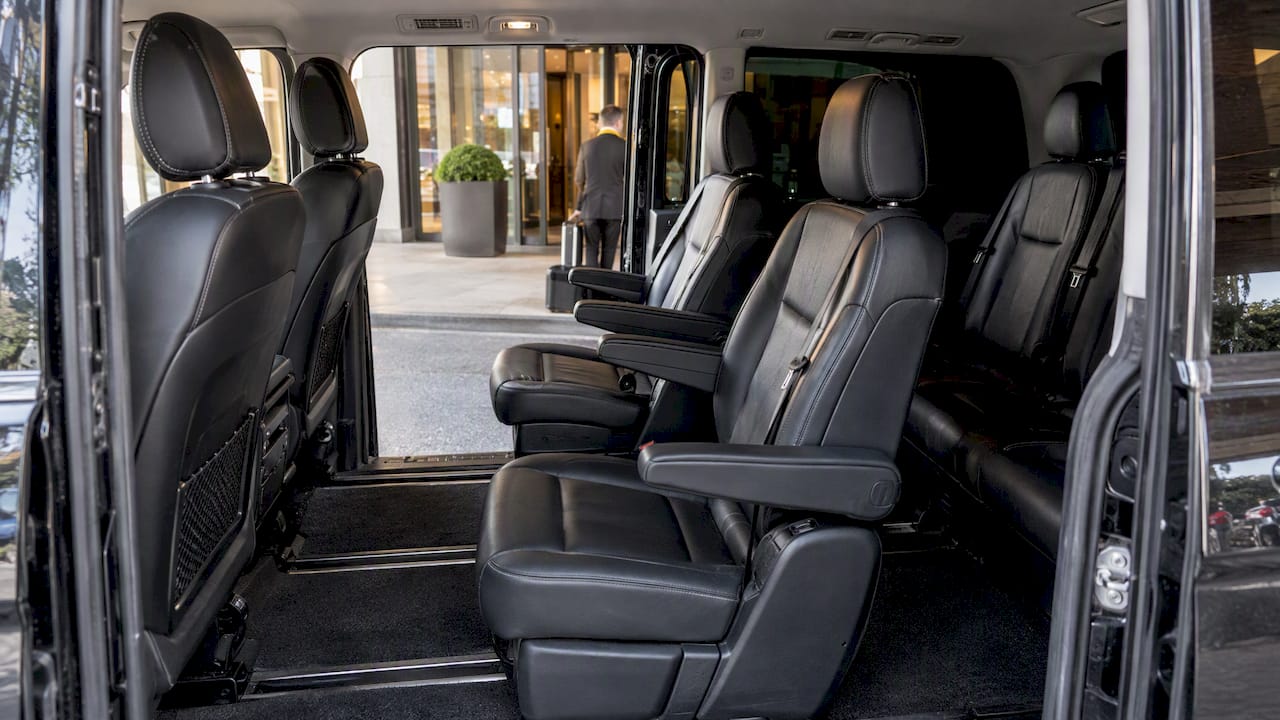
The Mercedes-Benz V-Class supports a reconfigurable cabin, typically seating 6, 7, or 8 passengers, because its second and third-row seats sit on floor rails and can slide, fold, or be removed entirely. Reconfiguring the cabin trades passenger capacity against luggage space, and every adjustment depends on one safety habit: listening for an audible click that confirms each seat is locked onto its rail before anyone travels.
TL;DR:
- Extra Long loadspace rises from 1,410 liters with all seats installed to 4,630 with rear seats removed, favoring smaller groups carrying bulky bags.
- Captain chairs create an aisle to the third row, helping older passengers and people with injuries board without climbing over a bench.
- Before carrying passengers, verify both locking indicators are retracted, both sliders are engaged, and the rails are clear; reinstall seats at their marked basic position.
- A full seat swap with two people takes at least fifteen minutes, so confirm the booked layout and luggage plan before pickup.
Table of Contents
- Common Seating Layouts: 8-Seat, 7-Seat, and 6-Seat Configurations
- Luxury Packages and Comfort Options That Reshape the Cabin
- How to Safely Slide, Fold, and Remove V-Class Seats
- Luggage Capacity and the Passenger-Versus-Cargo Trade-Off
- A Transfer Planner’s Setup Checklist for the V-Class
- Dimensions and Legroom Across Each Seating Layout
- Accessibility: Entry and Exit Across Different Configurations
- Storage Compartments and How They Relate to Seating Layout
- Customization Beyond Seating: Upholstery and Added Amenities
- Matching Layout to the Job: An Editorial Take
- Book a Preconfigured Mercedes-Benz V-Class With Us
- FAQ
- Sources
Common Seating Layouts: 8-Seat, 7-Seat, and 6-Seat Configurations
The factory-standard V-Class seats eight across three rows: two front seats, a three-person bench in the second row, and a three-person bench in the third row. Swapping either bench for two individual chairs drops the total to seven, and swapping both benches gets you to six, which is the layout most often chosen for business and executive work.
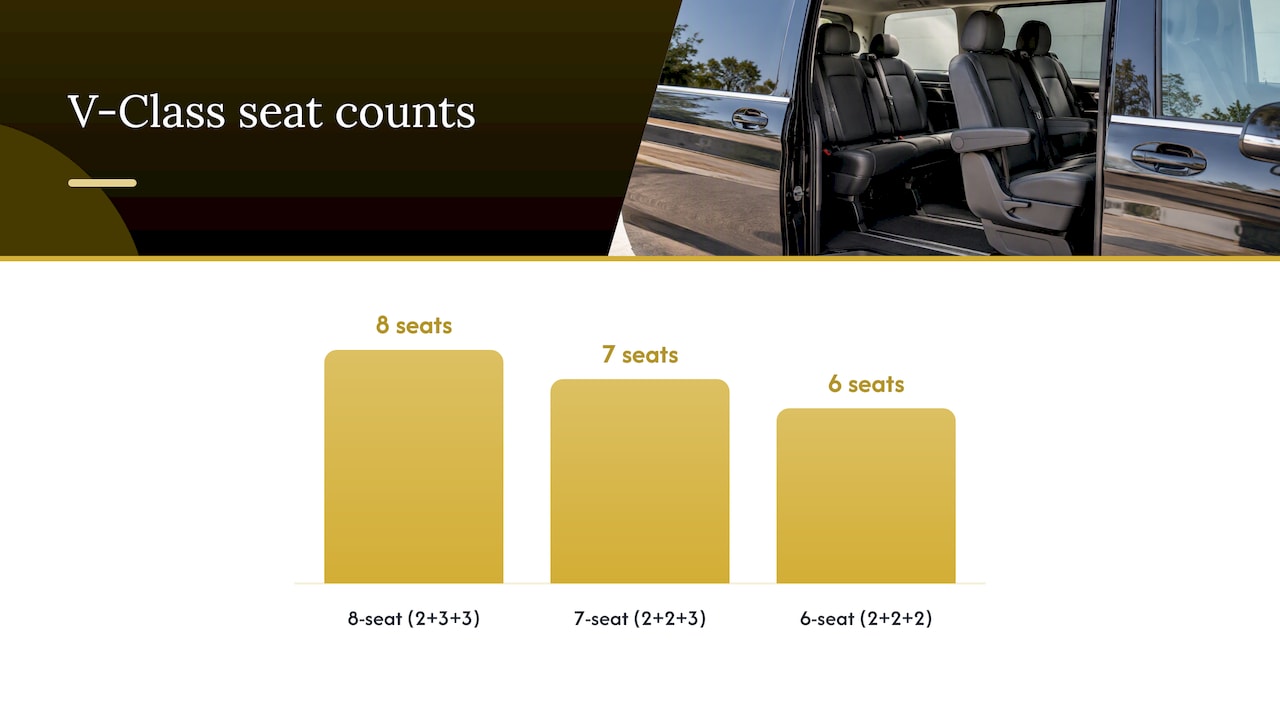
Captain-chair configurations change more than the seat count. Individual chairs usually slide further apart than a shared bench allows, which opens a walk-through aisle to the rear row and makes it far easier for a passenger to reach the back without climbing over a neighbor. That aisle access matters more than the lost seat for many buyers, since most six-seat orders are not about fitting fewer people but about giving each one more room.
Wheelbase changes the math behind every layout. The Long and Extra Long V-Class share the same seat hardware, but the Extra Long body adds rear overhang that increases both seat pitch (the legroom between rows) and the loadspace behind the final row.
A few practical examples of how this plays out:
- An airport run for a family of six with luggage often works best in the standard 8-seat layout with the third row folded flat for bags, rather than removed.
- A two-executive meeting transfer suits a 6-seat captain layout, giving both passengers a private row and a worktable between them.
- A group of seven heading to a conference with light carry-on bags fits a 7-seat mixed bench-and-chair setup without touching the cargo area.
Equipment and fittings vary by trim and model year, so the exact seating configurations and options available on a given van depend on how it left the factory.
Luxury Packages and Comfort Options That Reshape the Cabin
Factory option packages change more than how many seats are fitted. They change what each seat does, and that shifts how a cabin feels on a long transfer.
The Luxury and Exclusive six-seat packages replace both rear benches with individual captain chairs, and those chairs frequently add ventilation, massage, and adjustable calf rests, along with individual wireless charging pads built into the armrests. The practical effect is a cabin built for fewer people who each get noticeably more.
Common comfort and tech extras that layer onto these packages include:
- Seat memory settings that recall a passenger’s preferred position after reconfiguration.
- Multi-zone climate control that lets front and rear rows run different temperatures.
- Ambient lighting that can be tuned separately for each row.
Choosing one of these packages means accepting a trade-off: fewer total seats, and in some configurations, chairs that do not fold as flat as a standard bench, which can reduce how much cargo space opens up when you need it. For a transfer built around passenger comfort rather than headcount, that trade-off is usually the right one. For a group transfer where every seat counts, the standard bench layout keeps more flexibility on the table. How a vehicle’s class shapes travel comfort often comes down to exactly this kind of seating choice.
How to Safely Slide, Fold, and Remove V-Class Seats
Every rear seat in the V-Class locks onto floor-mounted rails using anchors and sliders, and the manufacturer marks a specific “basic position” on those rails where each seat is designed to sit when reinstalled. Getting that position wrong is the most common reason a seat feels loose or refuses to lock.
The owner’s manual lays out the safe sequence for removing and refitting a seat:
- Clear the guide rails and anchorages of dirt, grit, or debris before touching the seat.
- Tilt the first-row rear seats forward before attempting to remove or tilt the second-row seats behind them.
- With a second person helping, lift the seat clear of its rail rather than dragging it.
- To reinstall, insert the seat legs from above and at an angle into the rail.
- Tilt the seat back until it drops into the marked basic position.
- Listen for the audible click that confirms the locking mechanism has engaged.
Before trusting a seat with a passenger, run through a short checklist: you should hear the click on both sides, the indicator tabs that show an unlocked seat should be fully retracted and out of sight, both fore-and-aft sliders need to show as engaged, and the rails themselves should be free of anything that could block the slider from seating fully. Skipping this check is how a seat that looks installed ends up shifting under load.
Pro Tip: Remove the lighter front-row-adjacent seats first when working alone, and lay a protective cover over the rail track to avoid scuffing the carpet or trim while heavier rear seats are lifted in and out.
Luggage Capacity and the Passenger-Versus-Cargo Trade-Off
Every seat left in place is space a suitcase cannot use, and the V-Class makes that trade-off explicit in its published figures. On the Extra Long body, loadspace runs up to 1,410 liters with all seats installed, climbing to as much as 4,630 liters once the rear seats come out entirely.
That roughly 3,220-liter jump between seats-in and seats-out configurations means removing just two rear seats can free up space for several large suitcases plus overflow gear, which matters directly for airport transfer planning.
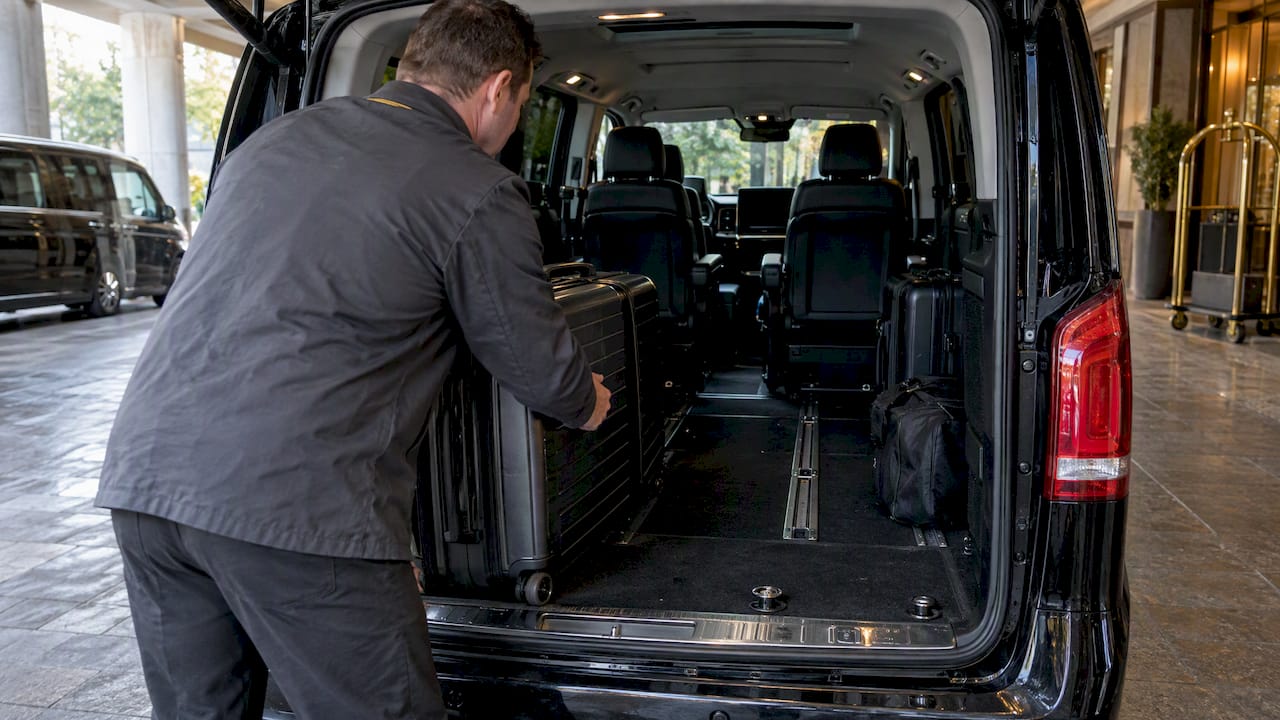
A simple rule for transfer work: if you are running close to a full eight passengers with standard check-in luggage each, plan to fold rather than remove seats, and lean on roof or trailer space only as a last resort. If the group shrinks to four or five with heavy bags, pulling the third row gives you room to spare. When neither folding nor removing seats gets you enough space, the honest answer is to move up to a larger vehicle rather than force the fit.
A Transfer Planner’s Setup Checklist for the V-Class
Configuring a V-Class for a client pickup works best as a short routine rather than a last-minute decision. Before a vehicle leaves for a job, we confirm the seating layout against the booking, the luggage plan against the seating layout, and whether the job needs one driver or an extra pair of hands for the reconfiguration.
A practical pre-trip checklist looks like this:
- Confirm the agreed seating configuration matches what the client booked, not just what is already fitted.
- Estimate reconfiguration time honestly. A full seat swap with two people rarely takes less than fifteen minutes.
- Plan loading before passengers arrive: use luggage covers or boxes for loose items, keep heavy bags low and near the tailgate, and strap down anything that could shift in transit.
Clients booking through us can request a preconfigured layout ahead of time, and our team provides luggage assistance at pickup so the reconfiguration never becomes the client’s problem. Real-time flight monitoring also means a delayed arrival does not throw off a seating plan set up for a tight window. For operations running their own small-group transfers, a planner-focused corporate shuttle checklist covers similar pre-trip groundwork worth borrowing.
Pro Tip: Set MBUX seat position and climate presets before passengers board. It saves the minute or two that otherwise gets spent adjusting settings with the vehicle idling at the curb.
Dimensions and Legroom Across Each Seating Layout
Legroom in the V-Class changes with both wheelbase and how far the seats are spaced on their rails, since captain chairs are rarely set at the same pitch as a fixed bench. The Extra Long body gives the rear rows measurably more stretch room than the standard Long wheelbase, which is one reason Extra Long versions are favored for executive six-seat builds.
Because seats slide independently along their rails, legroom is not fixed even within a single layout. A six-seat captain configuration can be set with generous spacing for two business passengers, then tightened up if a third and fourth passenger need to fit for a shorter leg of a trip. The standard eight-seat bench layout gives up some of that flexibility: benches move as a single unit, so legroom is shared evenly across all three occupants in a row rather than adjustable per seat.
Headroom stays consistent across layouts since it depends on roofline rather than seat choice, but entry height to the third row changes depending on whether a captain chair or bench sits in the second row, since individual chairs that slide forward open a taller, more direct path to the back.
Accessibility: Entry and Exit Across Different Configurations
Getting in and out of a V-Class varies more with seat choice than with the number of seats fitted. Captain chairs that slide forward and tilt create a genuine walk-through aisle to the third row, which makes a real difference for passengers who find climbing over a bench seat awkward, including older travelers or anyone managing an injury.
The standard bench layout trades that walk-through access for simplicity. With a shared bench in the second row, reaching the third row usually means folding or tilting part of the bench forward, which takes an extra step compared to simply sliding a captain chair out of the way.
Low step-in height and a wide sliding door opening help every layout, but the seating choice still determines how much maneuvering room exists once a passenger is inside. For transfers involving guests who need extra time or assistance boarding, a six-seat captain layout with a clear aisle is worth specifying ahead of the pickup rather than adjusting on the spot.
Storage Compartments and How They Relate to Seating Layout
Underfloor and side-panel storage compartments in the V-Class are fixed to the body rather than the seats, but how much of them stays usable depends heavily on which seating layout is fitted. A full eight-seat layout with both rear benches in place can still access underfloor storage channels beneath the floor rails, since those compartments sit below the seat mounts rather than inside the passenger footwell.
Door pockets, overhead compartments, and the center console remain available no matter which seats are fitted, since none of them sit on the seat rail system. The one exception is the cargo area behind the final row, which functions as both luggage space and, in some trims, additional underfloor storage. Removing the rearmost seats does not just add floor space for bags. It also opens access to shallow storage wells that sit beneath where those seats were mounted, useful for stowing softer items like jackets or bags that do not need to stand upright.
Planning a layout around storage, not just seat count, pays off on transfers with awkward cargo: golf bags, instrument cases, or stacked boxes often fit better once a seat and its surrounding compartment are both cleared.
Customization Beyond Seating: Upholstery and Added Amenities
Seating layout is only one axis of customization. Upholstery choices, typically ranging from standard cloth to leather or Exclusive-trim leather with contrast stitching, change both the look and the feel of a cabin independent of how many seats are fitted or how they are arranged.
Ambient lighting, already mentioned as a comfort feature tied to seating packages, extends further into customization territory through adjustable color zones that some trims allow passengers or drivers to set per row. Multi-zone climate control pairs with this, letting upholstery and lighting choices work together to create a distinct cabin character rather than a generic one.
Added amenities beyond the factory options include aftermarket additions some operators fit for specific jobs: tables between captain chairs, extra charging points, or branded interior touches for corporate work. None of these change the underlying rail system or seat count, but they shape how a six or eight-seat layout actually feels to the people riding in it.
Matching Layout to the Job: An Editorial Take
Most people overthink seat count and underthink cargo. The right process is backward from how most guides present it: size the luggage and cargo need first, then pick the seat count that fits what is left. A 6-seat captain layout suits executive transfers where comfort outranks capacity, while an 8-seat bench layout with careful luggage planning serves airport groups better than removing seats ever will. Before booking or ordering a configuration, always check the exact options available on your specific model year and trim, since fittings and packages are not identical across every V-Class built.
— Erki
Book a Preconfigured Mercedes-Benz V-Class With Us
We operate Mercedes-Benz V-Class vehicles and handle the seating reconfiguration before you get in the car. Tell us your passenger count and luggage needs when you book, and we set the layout, from a full eight-seat bench arrangement to a six-seat captain configuration, before we arrive.

Booking with us includes a few things that take the guesswork out of seat planning:
- Seating customization requested directly during booking, matched to your group size and bags.
- Luggage assistance and a personal meet-and-greet at pickup, so reconfiguration is never your problem to solve curbside.
- Real-time flight monitoring and 24/7 availability, so a delayed arrival does not throw off the layout we have set up for you.
Our V-Class transfer pricing starts at €45 per hour, and booking takes just a few minutes through our site.
FAQ
How many passengers can a V-Class seat?
A V-Class typically seats up to eight passengers in its standard layout, with seven and six-seat configurations available depending on which seats are fitted. The exact capacity depends on the equipment and packages ordered, so it is worth checking your specific model’s seating configurations and options before assuming a maximum.
Can you remove the rear seats from a V-Class?
Yes, the rear seats sit on floor rails and are designed to be removed following the owner’s manual procedure, which includes clearing debris from the rails and using two people for heavier rear seats. Reinstallation requires returning the seat to its marked basic position and confirming an audible click on both sides.
How much luggage space is there with the seats removed?
On the Extra Long V-Class, loadspace reaches up to 4,630 liters with the rear seats removed, compared to up to 1,410 liters with all seats installed. The difference makes seat removal worthwhile mainly when passenger count drops and luggage volume rises.
What does a Luxury six-seat package change?
The Luxury and Exclusive six-seat packages swap both rear benches for individual captain chairs, often adding ventilation, massage, and individual wireless charging. The trade-off is fewer total seats in exchange for more personal space and comfort features per passenger.
Does SolidRide offer a V-Class with a preconfigured seating layout?
Yes, our V-Class transfers can be set up with a specific seating configuration requested at the time of booking, along with luggage assistance and a personal meet-and-greet. Pricing for the V-Class transfer starts at €45 per hour.
Sources
- Mercedes‑Benz V‑Class 2020 Owner’s Manual (ManualsLib)
- Parkers — Mercedes‑Benz V‑Class practicality
- TopGear — Mercedes‑Benz V‑Class interior
- Mercedes‑Benz V‑Class (media PDF) — seating configurations and options
Add a comment