


TL;DR:
- Planning airport transfers for VIP speakers involves coordinating luxury transportation that is punctual, discreet, and tailored to the speaker’s needs. Effective planning begins with gathering verified flight details, identifying stakeholders, and creating a consolidated itinerary to ensure clear communication and smooth execution. Proper scheduling, real-time flight monitoring, and thorough driver briefings reduce stress, protect schedules, and uphold professionalism, thereby preventing common logistical failures.
VIP speaker airport transfer planning is the process of coordinating luxury, punctual, and discreet ground transportation tailored to the specific needs of high-profile event speakers. When done well, it protects a speaker’s schedule, conveys professionalism before they arrive at the venue, and eliminates a major source of stress on the day of the event. When done poorly, it creates the kind of first impression that will shape your event’s reputation for years to come. Executive travel services are defined by concierge-level flexibility focused on productivity, not just cost. That distinction sets a true private speaker transfer apart from a standard car booking.
What are the essential requirements for planning airport transfers for VIP speakers?
Effective planning starts with information, not vehicles. Before you contact any chauffeur service, you need a complete picture of who is arriving, when, and what they expect.
Gather verified flight details
Confirm the speaker’s flight number, airline, terminal, and estimated arrival time. Do not rely on the speaker’s assistant for real-time updates. Real-time flight tracking is the standard for professional airport transfer coordination, enabling dynamic driver dispatch and eliminating unnecessary wait times. A flight that lands 40 minutes early should not result in the speaker standing alone at baggage claim.
Create a stakeholder map before compiling a vehicle list
Most planners jump straight to booking a car. The better approach is to prioritize arrivals by stakeholder, taking into account visibility constraints, post-event obligations, and scheduling conflicts. A keynote speaker arriving the night before a conference has different needs than a panelist flying in on the morning of the event. Sequencing those priorities determines vehicle selection, timing, and driver briefing—not the other way around.
Create a single source of truth itinerary
A consolidated itinerary that includes flight, hotel, and ground transportation details helps prevent miscommunication across your entire support team. Every stakeholder, from the venue coordinator to the chauffeur, should be working from the same document. Requests for clarification slow everything down on the day of the event.
Pro Tip: Include the speaker’s cell phone number, hotel name, and any dietary or accessibility notes in the driver briefing document. Chauffeurs who know their passengers’ preferences provide a noticeably different experience.
Here is a quick checklist of prerequisites to consider before booking any executive transfer:
- Confirmed flight number, terminal, and arrival time
- The speaker's luggage count and any oversized items
- Accessibility requirements or medical considerations
- Hotel Address and Check-In Contact Information
- Venue Security Contact and Access Protocol
- Preferred vehicle type or any stated preferences
- Emergency contact for the speaker’s team
| Prerequisite | Why It Matters |
|---|---|
| Verified flight details | Enables real-time tracking and accurate driver dispatch |
| Stakeholder Map | Prevents scheduling conflicts and sets vehicle priorities |
| Consolidated Itinerary | Brings all parties into alignment and reduces confusion on the day itself |
| Security Access Information | Prevents entry delays at the venue or hotel |
| Speaker Preferences | Allows the chauffeur to personalize the pickup experience |
How do you carry out step-by-step scheduling for VIP airport transfers?
Execution is where planning either succeeds or fails. A clear workflow from booking to drop-off eliminates the guesswork and protects the speaker’s time.

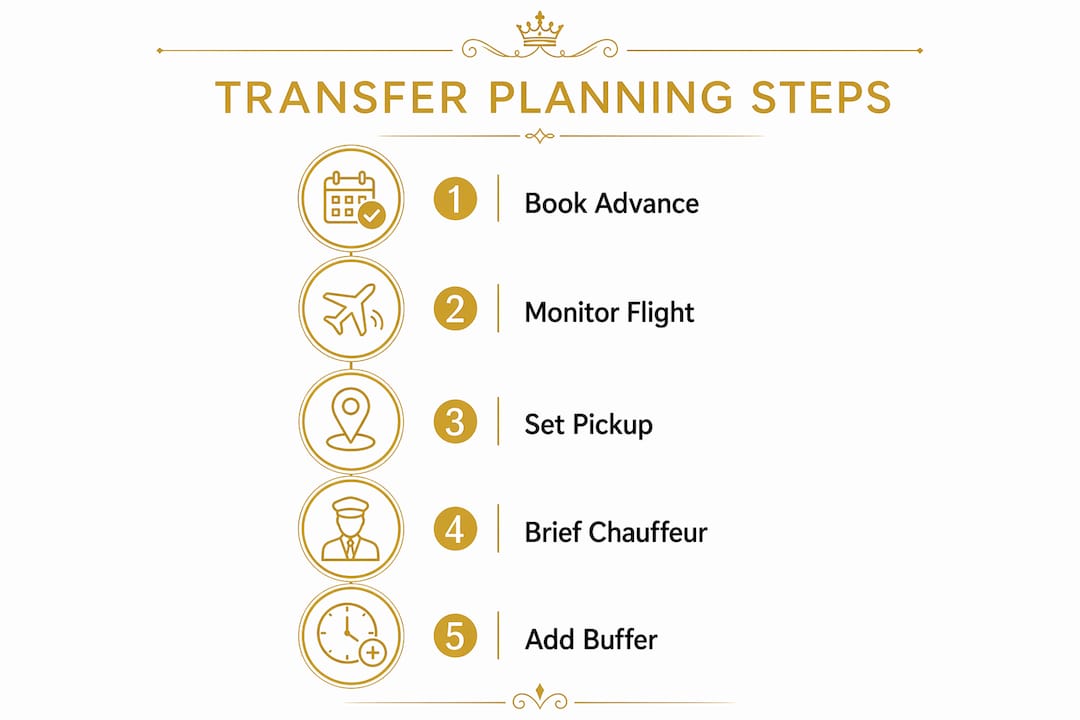
Step 1: Book transfers 1–3 days in advance. During peak conference periods, premium vehicles fill up quickly. Waiting until the day before is a risk that no event planner should take when it comes to a keynote speaker.
Step 2: Activate real-time flight monitoring. Assign this responsibility to one person. When a flight is delayed or rerouted, the chauffeur needs to know before the speaker lands, not after. Flight monitoring reduces waiting time and ensures that pickup times remain accurate regardless of arrival variations.
Step 3: Specify the exact pickup point: a terminal, curbside zone, or private FBO location. Vague instructions lead to confusion. VIP airport transfers are carried out according to detailed operating plans that involve advance coordination with the terminal, timed baggage handling, and continuous dispatch oversight. The driver should know exactly where to stand and what sign to hold.
Step 4: Brief the chauffeur on the client’s notes. Share the speaker’s name, a photo (if available), the number of bags, the destination, and any preferences. A well-briefed driver does not ask the speaker for directions or confirmation. They take the lead.
Step 5: Provide security and access details 24–48 hours before arrival. Information regarding security gate access and venue maps should be sent to both the driver and the speaker’s team within this timeframe. Last-minute security communications are a leading cause of entry delays.
Step 6: Establish an escalation procedure. Assign a single point of contact for same-day changes. If a flight is diverted or a speaker misses their connection, someone needs the authority to rebook, reroute, and notify the venue within minutes.
The transfer is not just a minor detail of the event. It is the first time the speaker experiences your organization’s standards. If the car is late, the driver is confused, or the route adds 20 minutes of unnecessary stress, that impression carries over into the room.
Pro Tip: Build a 15-minute buffer into every transfer from the airport to the venue. Traffic, baggage delays, and security lines are predictable variables. A buffer in the itinerary protects the speaker’s schedule without requiring anyone to rush.
What are some common challenges in planning airport transfers for VIP speakers?
The most common problems with luxury airport transportation are not logistical mishaps. They are predictable gaps in planning that experienced coordinators learn to address in advance.
Incomplete itinerary information. A driver who does not know the terminal, the flight number, or the speaker’s phone number cannot handle a delayed flight. Incomplete communication with drivers causes traffic congestion and must be addressed well before arrival. Send the full briefing document at least 24 hours in advance.
Ignoring stakeholder sequencing. When multiple speakers arrive on the same day, planners often treat each transfer as a separate task. Stakeholder mapping prevents scheduling conflicts and reputational risk by aligning vehicle assignments with business impact and arrival priority.
Underestimating flight variability. A 30-minute delay is commonplace. A 3-hour delay or a missed connection is not rare enough to be ignored. Planners who do not build a buffer into their transfer schedules turn ordinary travel disruptions into crises.
Skipping the chauffeur briefing. A driver who knows only the pickup address is not prepared to provide VIP service. Customized client notes—including the speaker’s name, appearance, and any specific preferences—are what set professional chauffeur services apart from standard car bookings.
Treating the airport transfer as an isolated task is the single biggest mistake in business travel planning for events. The moment you integrate it into the overall operational plan—giving it the same attention you give to audiovisual setup or catering—the failure rate drops sharply.
This is where most planners lose control:
- Sending security access details on the morning of arrival instead of 24–48 hours in advance
- Booking a vehicle without confirming the correct terminal or FBO location
- Failure to designate one person as the real-time escalation contact
- Using a general booking platform instead of a dedicated VIP transportation service
- Assuming the speaker’s assistant will handle the coordination of ground transportation
What types of vehicles and service features are best suited for VIP speaker transfers?
Vehicle selection is based on the stakeholder map, not on the budget alone. The right vehicle for a solo keynote speaker is different from the right vehicle for a panel of four arriving together.
Sedans are ideal for solo travelers with minimal luggage who prioritize speed and discretion. SUVs offer more space and a higher seating position, which many executives prefer. Vans and minivans, such as the Mercedes-Benz V-Class, can accommodate groups of four to seven passengers with luggage without sacrificing comfort or privacy. For high-profile speakers, a dedicated vehicle with a fully briefed chauffeur is a must, regardless of group size.
Pro Tip: For speakers flying in the night before a major session, a meet-and-greet airport pickup with name board, luggage assistance, and a direct hotel route sets the tone for the entire engagement.
Beyond the vehicle itself, the features of the service are just as important as the car:
- Meet-and-greet service: The chauffeur waits in the arrivals area with a name sign, handles the luggage, and escorts the speaker directly to the vehicle.
- In-car amenities: Bottled water, phone chargers, and Wi-Fi allow speakers to prepare or relax during the transfer.
- Luggage assistance: Especially important for speakers traveling with presentation equipment or multiple bags.
- 24/7 availability: Late-night arrivals and early-morning departures are common in event schedules. The service must fit the itinerary, not the other way around.
- Discreet service: High-profile speakers often require privacy. A professional chauffeur does not engage in unsolicited conversation or share client information.
When multiple speakers arrive within a short time frame, coordination among multiple vehicles becomes necessary. Assign a dispatcher to manage the sequencing in real time. Solidride operates on a 24/7 basis, with real-time flight monitoring built into every booking, which makes same-day adjustments manageable rather than chaotic.
Key Takeaways
Effective planning for VIP speaker airport transfers requires a consolidated itinerary, coordination of stakeholders, real-time flight monitoring, and a fully briefed chauffeur to ensure the speaker’s schedule is maintained and your event’s reputation is protected.
| Point | Details |
|---|---|
| Start with a stakeholder map | Sort arrivals by priority before selecting vehicles or booking transfers. |
| Use a consolidated itinerary | A single document covering flights, hotels, and ground transportation helps avoid confusion on the day of travel. |
| Enable real-time flight tracking | Dynamic driver dispatch prevents wait times caused by delays or early arrivals. |
| Send security details 24–48 hours in advance | Late communication causes entry bottlenecks at venues and hotels. |
| Give the chauffeur a full briefing | Client notes, the number of bags, and preferences set VIP service apart from standard bookings. |
The aspect of event planning that most organizers underestimate
I have seen event budgets that allocate six figures to audiovisual production and a few hundred dollars to speaker travel. That imbalance reveals a fundamental misunderstanding of what the transfer actually is.
The airport pickup is the first moment a speaker encounters your organization. Not the welcome dinner. Not the green room. The car. If the driver is late, confused about which terminal to go to, or doesn’t know the speaker’s name, that friction sets the tone for everything that follows. Speakers talk to each other. Word gets around.
What I've found to be effective is treating the transfer as a department, not just a task. Assign ownership. Create a briefing document. Conduct the same pre-event check you would for any other critical vendor. Planners who do this consistently report fewer same-day escalations and better feedback from speakers.
Another thing most guides overlook is the departure transfer. Speakers who have just finished a keynote and are rushing to catch a flight need an itinerary with built-in buffers just as much as they need a smooth arrival. A speaker who misses a connection because your post-event schedule ran long will remember that. Build in a buffer. Confirm the departure pickup the night before. Treat the departure with the same care as the arrival.
— Erki
Solidride’s private chauffeur service for VIP speaker transfers
Corporate event planners coordinating speaker arrivals in Estonia need a transportation partner that operates at the same level as the event itself.

Solidride provides private chauffeur transfers with 24/7 availability, real-time flight monitoring, and personalized meet-and-greet service at Tallinn Airport. The fleet includes Mercedes-Benz V-Class vehicles suitable for both individual speakers and small groups. Every booking includes luggage assistance, in-car amenities, and a fully briefed chauffeur. For planners managing complex itineraries with multiple speakers, Solidride’s Tallinn transfer booking process handles the coordination details so you can focus on the event itself.
FAQ
What is VIP speaker airport transfer planning?
VIP speaker airport transfer planning is the process of coordinating luxury, punctual, and discreet ground transportation for high-profile event speakers, including flight tracking, chauffeur briefings, and itinerary integration.
How far in advance should I book a VIP airport transfer?
Book transfers 1–3 days in advance, especially during peak conference periods when premium vehicles fill up quickly.
Why is real-time flight tracking important for VIP transfers?
Real-time flight monitoring enables dynamic driver dispatch, ensuring that the chauffeur can adjust to early arrivals or delays without the passenger having to wait at the terminal.
When should security and venue access details be sent to the driver?
Information regarding security gate access and venue maps should be provided to both the driver and the speaker’s team 24–48 hours before arrival to prevent delays at the entrance.
What is the best vehicle for an airport transfer for a VIP speaker?
A Mercedes-Benz V-Class or equivalent premium van is suitable for most speakers, offering privacy, luggage capacity, and comfort for groups of up to seven passengers. Solo speakers with minimal luggage may prefer a premium sedan.
Add a comment