


TL;DR:
- Coordinated airport pickups use real-time flight data and centralized communication to ensure reliable, stress-free arrivals. They actively adjust vehicle pickup times based on actual flight status, reducing delays and confusion. Proper planning and real-time monitoring improve the travel experience for both individuals and groups.
Coordinated airport pickup is a professionally managed process that synchronizes vehicle arrival with actual flight status to ensure reliable passenger transfers. This is the industry term for what many travelers loosely refer to as “arranged airport transportation,” and the distinction is important. The importance of coordinated airport pickups becomes clear the moment a flight lands 40 minutes early or is diverted to a different terminal. Without active logistics management, that moment turns into chaos. With it, your driver is already in position and waiting.
Why Coordinated Airport Pickups Matter More Than Most Travelers Realize
Most travelers assume that booking a ride completes the process. It does not. Successful pickups depend on clear backup communication, confirmed meeting points, and real-time adjustments that no static booking can provide. The difference between a confirmed reservation and a coordinated pickup is the difference between a passive promise and an active guarantee.
Coordinated airport transfers eliminate the need to figure out local transportation, decipher terminal maps, or scramble to find a driver who booked the wrong arrival time. The entire process is pre-planned and stress-free from the moment you board your outbound flight. For business travelers, families with young children, and anyone arriving in an unfamiliar city, that elimination of uncertainty is the core value.
Transportation specialists cite the absence of uncertainty as the primary benefit of coordinated pickups. A smooth, seamless arrival doesn’t happen by chance. It happens because someone actively managed the logistics before you landed.
How Coordination Reduces Travel Stress and Logistical Friction
Uncoordinated pickups lead to a predictable series of problems. Your flight lands, you clear customs, and then you discover that your driver is still 20 minutes away because no one tracked the actual arrival time. You’re standing at the curb with your luggage, no local data plan, and a dead phone battery. That scenario is not uncommon. It’s the typical outcome when there’s a lack of coordination.
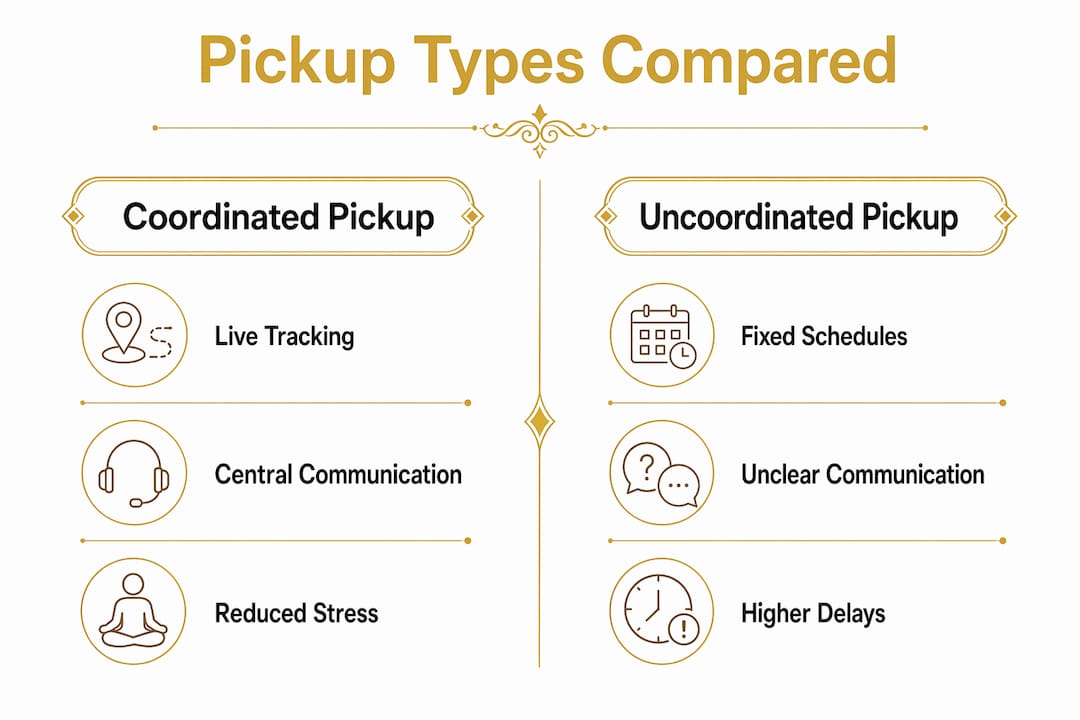
Coordinated transfers break that chain at every link. The service continuously monitors your flight status, not just at the scheduled arrival time. If your flight lands early, the vehicle adjusts accordingly. If it lands late, the driver waits without charging extra. You exit the terminal and your ride is already there.
The benefits increase with the complexity of travel:
- Business travelers avoid the cognitive burden of logistics after a long flight, arriving ready for meetings.
- Families avoid the stress of having to manage their children, luggage, and an unfamiliar pickup area all at once.
- Groups of travelers with staggered flights are picked up at the same time instead of arriving in separate groups.
- International travelers at major airports benefit from concierge-level assistance that guides them from the gate through customs to their vehicle.
Pro Tip: Book a service that explicitly offers flight monitoring, not just a scheduled pickup time. Ask the provider directly: “Do you track live flight data?” If the answer is vague, the coordination is likely passive.
How does real-time flight monitoring actually work?
The mechanics of coordinated airport pickups are based on three operational pillars: real-time flight tracking, centralized communication, and proactive vehicle scheduling.
Live flight tracking means the service monitors your actual flight status through aviation data feeds, not just the scheduled arrival time. Active, real-time adjustments to vehicle timing—rather than static schedules—ensure predictable pickups. A driver dispatched based on the scheduled arrival time will often be wrong. A driver dispatched based on live data will almost always be right.
Centralized communication means that a single point of contact manages all information. This is especially critical for group pickups. Transitioning from manual calls to centralized, technology-enabled dispatch prevents fragmentation and improves resource allocation. Instead of each driver operating independently, a central dispatcher maintains full visibility of all vehicles and passengers.
Here is a step-by-step guide to how a well-organized, coordinated pickup works:
- Flight data integration. The service connects to real-time aviation feeds and begins monitoring your flight from departure.
- Proactive vehicle dispatch. The driver is dispatched based on the actual arrival time, not the scheduled time.
- Terminal and gate confirmation. Any change to the terminal triggers an immediate update to the driver’s route.
- Meet-and-greet service. The driver will proceed to the correct arrivals exit, where your name will be displayed.
- Backup communication activation. If contact is lost, a secondary phone number or a call from the dispatcher fills the gap.
Pro Tip: When booking, provide both your primary and a secondary contact number. Providing a secondary contact number significantly reduces the risk of a traveler being stranded if the primary number cannot be reached after landing.
Understanding how the Edinburgh Airport pickup service works provides a useful real-world example of how coordinated pickup protocols reduce uncertainty for arriving travelers.
Coordinated vs. uncoordinated pickups: What Actually Changes?
The difference between coordinated and uncoordinated airport pickups is measurable. Standardized coordination protocols can reduce service delays by up to 60 minutes and improve compliance with time benchmarks from 55.7% to 80.1%. This data comes from time-sensitive transfer environments where coordination failures have serious consequences. The principle applies directly to airport pickups, where every minute of delay adds to travelers’ stress.
| Factor | Uncoordinated pickup | Coordinated pickup |
|---|---|---|
| Flight Tracking | Scheduled time only | Live flight data, continuous |
| Delay response | Reactive, often late | Proactive, pre-adjusted |
| Communication | Single driver contact | Centralized Dispatcher |
| Terminal Changes | Driver not detected | Updated instantly |
| Group pickups | Fragmented, high confusion | Single coordinator, synchronized |
| Traveler Experience | Uncertain, stressful | Predictable, calm |
The most common failures in uncoordinated pickups can be summarized as follows:
- The driver arrives at the wrong terminal after a gate change.
- No one monitors the flight, so a 30-minute delay turns into a 30-minute wait at the curb.
- Group members with different flight times are assigned separate drivers who cannot see each other's information.
- The traveler cannot reach the driver because there is no alternate contact.
Each of these issues can be prevented. Coordinated pickups save you time and give you peace of mind by treating the pickup as an active process, not a passive appointment.
Best Practices for Getting the Most Out of Airport Pickup Services
Choosing the right service is only the first step. How you prepare and communicate determines whether the coordination actually works in your favor.
- Confirm that flight monitoring is active. Ask your provider whether they track real-time flight data or rely on scheduled times. The answer tells you everything about their coordination capabilities.
- Please provide your full flight details. Include the airline, flight number, departure city, and expected arrival terminal at the time of booking.
- Set a clear meeting point. Specify the exact arrival exit, not just the airport name. Large airports like Tallinn Airport have multiple exits, and ambiguity causes delays.
- Please provide two contact numbers. Your primary number may be unreachable after landing. A secondary number—or the number of a traveling companion—gives the driver a reliable alternative.
- Designate a single coordinator for each group. Managing group airport transportation as a single project with one point of contact prevents fragmented accountability and missed pickups. One person communicates with the dispatcher. Everyone else follows that person’s lead.
- Plan for airport-specific conditions. Some airports restrict vehicle access to certain zones. Know where your service is permitted to wait, and confirm this with your provider before you land.
Pro Tip: For group travel with staggered arrivals, ask your provider to assign a single group coordinator who shares backup contact information with every driver. This simple step eliminates the most common source of confusion when picking up groups.
The importance of airport pickups increases as your trip becomes more complex. A solo traveler on a direct flight has some leeway. A family of five connecting through two airports and arriving at 11:00 PM has none.
Key Takeaways
Coordinated airport pickups ensure reliable, stress-free arrivals by combining real-time flight tracking, centralized communication, and proactive adjustments to vehicle arrival times.
| Point | Details |
|---|---|
| Coordination is active, not passive | A booked ride is not a coordinated pickup. Active flight tracking and real-time adjustments are what define true coordination. |
| Real-time data prevents delays | Drivers dispatched based on real-time flight data arrive on time far more consistently than those working based on scheduled times. |
| Centralized communication is critical | Having a single dispatcher manage all vehicles and contacts prevents the fragmentation that leads to missed pickups. |
| Group travel requires a single coordinator | Assigning one person to manage all group communications prevents confusion during staggered arrivals. |
| Preparation maximizes the benefits | Sharing complete flight details, two contact numbers, and a clear meeting point provides the coordination team with the information it needs to do its job. |
What I’ve Learned from Watching Airport Pickups Go Wrong
After years of observing how travelers arrive and how service providers respond, the pattern is consistent. The pickups that go wrong aren't the ones with bad drivers. They're the ones where someone assumed the booking took care of everything.

The most common problem I encounter is a traveler who lands, turns on their phone, and discovers that the driver is waiting at Terminal 1 while they went through customs at Terminal 2. No one kept track of the gate change. No one called ahead. The driver followed the original instructions and waited in the wrong place for 25 minutes before anyone realized what had happened.
The solution isn't complicated. It requires a service that treats your pickup as a live event, not a calendar entry. Real-time flight monitoring isn't a luxury feature. It's the basic requirement for any pickup that claims to be coordinated. Services that rely on scheduled times are, by definition, not coordinating. They're just guessing.
My practical recommendation: Before you book, ask one question: “What happens if my flight lands at a different terminal than expected?” A well-coordinated service will describe a specific process. An uncoordinated one will give you a vague answer about “staying in touch.” That answer tells you exactly what your arrival experience will be like.
The airport shuttle protocols that work best share one common trait: they treat communication as a system, not an afterthought.
— Erki
Solidride’s Approach to Reliable Airport Transfers
Travelers who want coordinated pickups without having to figure it out on their own have a direct option in Estonia.

Solidride provides private airport transfers in Tallinn with 24/7 availability, live flight monitoring, and personalized meet-and-greet service. Every booking includes real-time flight tracking so your driver can adjust to your actual landing time, not the scheduled one. The fleet consists of Mercedes-Benz V-Class vehicles, and the service includes luggage assistance, complimentary amenities, and a single point of contact to manage your entire transfer. Whether you’re traveling alone, with your family, or coordinating a corporate group, Solidride treats every pickup as a coordinated logistics operation. Book your transfer at solidride.ee and arrive knowing that everything has already been taken care of.
FAQ
What is a coordinated airport pickup?
A coordinated airport pickup is a professionally managed transfer that uses real-time flight data to ensure the vehicle arrives at the same time you land. It includes centralized communication, real-time adjustments, and confirmed meeting points.
Why is real-time flight tracking important for pickups?
Scheduled arrival times are often incorrect. Real-time flight tracking allows the driver to adjust for early arrivals, delays, and terminal changes before you leave the airport.
How should groups handle airport pickups?
Groups should designate a single coordinator to manage all communication with the transportation dispatcher. Centralized group coordination prevents fragmented accountability and missed pickups during staggered arrivals.
What information should I provide to my pickup service?
Please provide your airline, flight number, departure city, expected terminal, and two contact numbers. Clear instructions on the meeting point reduce the risk of confusion at large airports.
How do coordinated pickups reduce travel stress?
Coordinated transfers eliminate the need to use local transportation or find a driver after landing. The entire process is planned in advance, so when you exit the terminal, your vehicle is already there, waiting for you.
Add a comment