


Group transport in Estonia typically ranges within a few hundred euros for a single transfer, depending on vehicle size and distance, while moving jobs and cargo van bookings usually start with a one- or two-hour minimum charge. The three variables that move a quote up or down are the same every time: how long the job takes, how far you’re going, and how much extra labor or handling the crew has to do. Get those three answers locked in before you request a quote and the number a provider gives you will almost always match what you actually pay.
TL;DR:
- Fixed-route transfers like airport runs are priced per trip, with examples starting from €190 for Tallinn to Pärnu, while flexible routes use hourly rates typically ranging from €45 to €260 depending on duration and vehicle.
- Extra fees such as weekend surcharges, handling costs for oversized items, waiting time, and distance supplements can significantly increase the total price beyond the base rate.
- Accurate quotes depend on providing detailed pickup and drop-off addresses, vehicle and item counts, and access restrictions, as well as clarifying VAT inclusion and waiting policy details upfront.
- Moving or cargo jobs are usually billed hourly with a first-hour minimum, plus per-person loading and distance fees, while fixed rates are more predictable for defined trips like city-to-city transfers.
- Price differences between providers largely stem from chargeable volume versus weight, crew size, waiting time policies, and whether VAT is included; giving detailed information helps prevent quotes from ballooning after booking.
Table of Contents
- Grupitransport Hind by Service Type: Cargo, Moving, and Event Transfers
- Common Extra Fees and When They Apply
- How Providers Actually Calculate a Quote
- Estonia-Specific Price Scenarios You Can Sanity-Check
- How to Request an Accurate Group Transport Quote
- Pricing Trade-Offs: Fixed Rate or Hourly Billing?
- Get a Transparent Group Transfer Quote From Solidride
- Sources
- FAQ
Grupitransport Hind by Service Type: Cargo, Moving, and Event Transfers
Not every “group transport” quote is built the same way, and that’s exactly why two providers can hand you wildly different numbers for what sounds like the same job. Estonian transport pricing generally splits into four billing models, and knowing which one applies to your booking tells you what to expect before you even pick up the phone.
Fixed-route transfers (airport runs, city-to-city trips) are priced per trip, not per hour. This works because the distance and time are predictable. SolidRide, for example, publishes point-to-point rates like Tallinn to Tartu from €270, Tallinn to Pärnu from €190, and Tallinn to Narva from €300, all one-off prices rather than hourly estimates.

Hourly vehicle rates apply when the route or duration isn’t fixed, such as a group event with multiple stops. Hourly rates for airport pickups typically range depending on the vehicle class, with mid-sized luxury vans often used as standard group vehicles.
Moving and cargo jobs in Estonia commonly bundle a vehicle plus crew into a per-hour rate with a first-hour minimum, then add per-person loading charges and per-kilometer fees once you’re outside the city center. Public price lists for this category are rare because loading complexity varies so much job to job.
Custom group or event transport (weddings, corporate outings, photo tours) is quoted individually because vehicle count, timing, and route flexibility change the math entirely.
A few things stay constant across all four models:
- Most Estonian transport providers quote prices with VAT clearly noted as included or added separately, so always confirm which applies before comparing two quotes.
- A first-hour or minimum-distance charge almost always applies, even for short jobs.
- Group transfers involving more than one vehicle are priced per vehicle, not per passenger.
Common Extra Fees and When They Apply
The base rate is rarely the whole story. Surcharges are where budgets go sideways, and most of them are predictable if you know to ask about them upfront.
- Weekend, holiday, and night surcharges. Bookings outside standard weekday hours often carry an uplift, sometimes 10 to 25 percent above the base rate.
- Extra crew or handling fees. Moving jobs that need an additional mover, packing service, or furniture disassembly are typically billed per hour per person on top of the vehicle rate.
- Waiting time. Most providers round waiting time to 15-minute increments, and ambiguous waiting policies are one of the most common sources of billing disputes on multi-stop bookings.
- Distance supplements. Trips that extend beyond a city’s core zone usually add a per-kilometer fee, similar to the destination-dependent pricing used across European road freight routes.
- Special handling. Stairs without elevator access, long carry distances from the truck to the door, or fragile items (pianos, artwork) can add a flat fee or a higher hourly rate.
Pro Tip: Ask specifically how waiting time is billed, in what increment, and whether the first 15 minutes are free. This single question prevents more quote disputes than any other.
How Providers Actually Calculate a Quote
Transport pricing in Estonia isn’t guesswork, but it also isn’t a simple lookup table. Providers weigh a handful of concrete inputs, and understanding them helps you avoid a lowball estimate that balloons once the crew shows up.
The biggest misunderstanding is around chargeable weight versus volume. A load’s price often depends on whichever measurement is higher: its actual weight or the cubic space it occupies. This is why groupage and partial-load pricing usually isn’t published as a fixed list. A single bulky wardrobe can cost more to move than three boxes of books that weigh twice as much, because it eats up cargo space a heavier, denser item wouldn’t.
Providers typically ask for:
- Exact pickup and drop-off addresses, including floor number and elevator access
- Number of stops and any time windows you need to hit
- Vehicle type needed (van, minibus, larger transfer vehicle)
- Parking or loading access constraints at each address
- Approximate volume or item count, especially for moves
A fixed-route calculator works well for standard airport transfers or well-traveled city routes because the variables are already known. Multi-stop events, corporate group bookings, or moves with unusual access issues need a custom quote instead, since no calculator can account for a fourth-floor walk-up with no elevator.
Estonia-Specific Price Scenarios You Can Sanity-Check
Real numbers help more than percentages here, so here are a few grounded examples based on published Estonian rates.
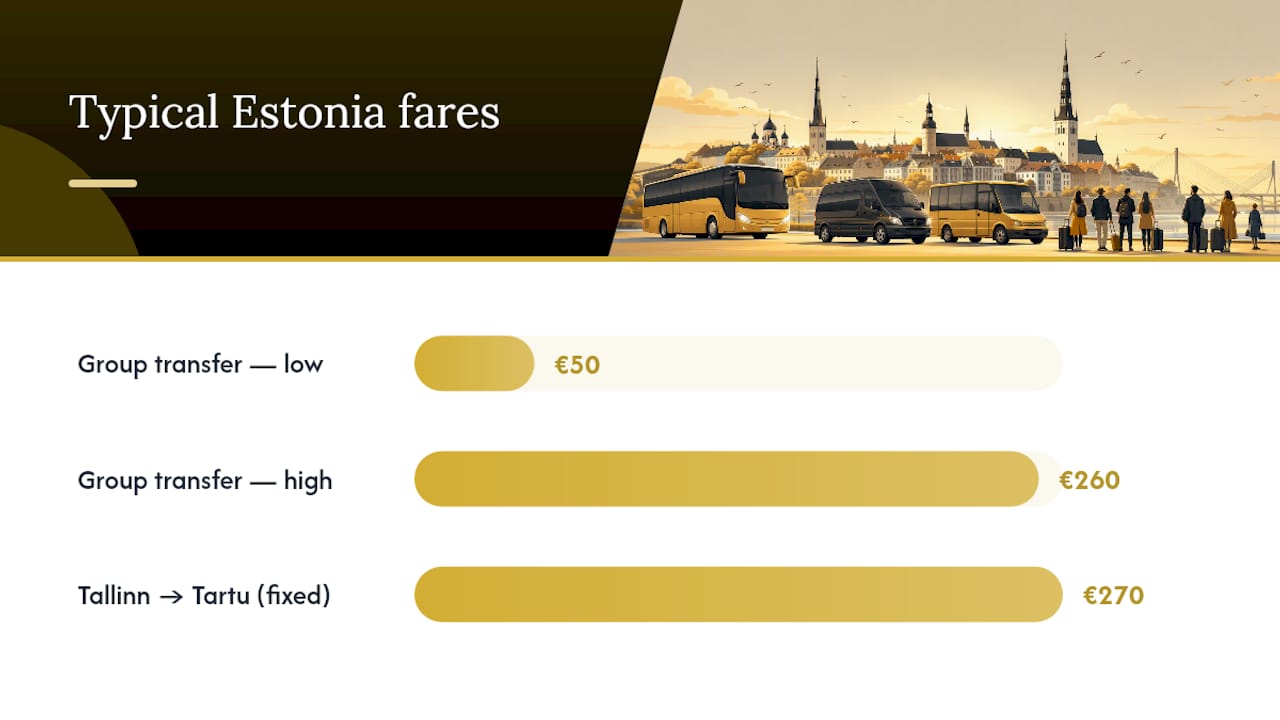
A 6 to 8-person group transfer within Tallinn, using a Mercedes-Benz V-Class at €45 per hour, typically lands in the €50 to €260 range depending on duration and distance, a range SolidRide publishes directly for its group transfer service.
A small apartment move (studio or one-bedroom, no elevator issues) usually falls into a lower hourly bracket, but expect the first-hour minimum plus per-person loading fees to apply even for short jobs.
A fixed Tallinn to Tartu transfer price often starts from around €270, which can be more predictable than hourly bookings when considering total drive time both ways.
- If your dimensions are standard (a few suitcases, a handful of boxes), a calculator-based quote is usually accurate.
- If you’re moving oversized or irregularly shaped items, expect the quote to shift once the provider factors in chargeable volume rather than weight alone.
Treat every number above as an example, not a locked-in price. Actual quotes depend on your specific date, distance, and load.
How to Request an Accurate Group Transport Quote
The fastest way to get a quote you can trust is to hand the provider everything they’d otherwise have to ask for. Skipping this step is the single biggest reason estimates change after booking.
- Send exact addresses and time windows for pickup and drop-off, not approximate neighborhoods.
- State passenger or item counts precisely, including dimensions for anything unusually large.
- Flag access issues upfront: stairs, narrow driveways, limited parking, or elevator restrictions.
- Ask directly whether the quoted price includes VAT, how many crew members or drivers are included, and what the cancellation policy looks like.
- Request the waiting-time policy in writing, including the billing increment.
Pro Tip: Ask for an itemized quote, not just a bottom-line total. A provider who breaks down the base rate, surcharges, and VAT separately is almost always easier to compare against a competitor’s number.
Pricing Trade-Offs: Fixed Rate or Hourly Billing?
Fixed pricing wins for anything with a defined start and end point: airport runs, a single city-to-city transfer, a wedding pickup. You know the total before you book, and there’s no incentive for the driver to take the slow route.
Hourly billing makes more sense when the job has genuine uncertainty, like a move where loading time depends on how many boxes fit through a narrow doorway. Premium providers justify higher hourly ranges through real amenities: flight monitoring so nobody sits at arrivals waiting on a delayed plane, invoice-ready billing for corporate clients who need clean paperwork, and crews who show up with the right vehicle the first time.
My practical advice: underquoting almost always traces back to vague information at booking. Give the provider real numbers, and the fixed-versus-hourly decision usually makes itself.
— Erki
Get a Transparent Group Transfer Quote From Solidride
Solidride is the alternative to guessing at moving-company estimates or juggling three vague quotes for a corporate event in Tallinn: published group transfer ranges from €50 to €260, invoice-ready billing for business clients, and a Mercedes-Benz V-Class fleet built specifically for group work rather than a repurposed cargo van.

To get a fixed quote, send your pickup and drop-off addresses, passenger count, preferred vehicle, and time window through the group transfer pricing page. Corporate clients booking recurring transfers can request EMTA-ready invoicing directly, which removes one more back-and-forth from the process. If your event needs multiple stops or a custom itinerary, mention that upfront so the quote reflects the actual route rather than a generic estimate. Request your quote today and get a number you can plan a budget around, not one that changes after the crew arrives.
Sources
For a deeper look at how groupage and partial-load pricing works across Europe, see Neele-Vat’s cost breakdown. Girteka offers useful context on how route length and destination zones shape freight pricing at scale. For Estonia-specific group transfer ranges, Solidride’s own pricing page lays out current rates.
FAQ
What Is a Typical Grupitransport Hind in Estonia?
Group transfers in Estonia typically range from €50 to €260 per trip, depending on distance, vehicle size, and duration, a range Solidride publishes directly for its Mercedes-Benz V-Class group service. Moving and cargo jobs usually add an hourly rate on top of a first-hour minimum.
Does the Quoted Price Include VAT?
It depends on the provider, so always confirm before comparing quotes since some list VAT-inclusive prices while others add it separately. Ask for this in writing as part of your itemized quote request.
What Information Do I Need to Give for an Accurate Quote?
Providers need exact pickup and drop-off addresses, time windows, passenger or item counts, and any access issues like stairs or limited parking. Skipping these details is the most common reason an initial estimate changes after booking.
How Much Does a Tallinn to Tartu Transfer Cost?
A fixed Tallinn to Tartu transfer with Solidride starts from €270 as a one-off price rather than an hourly rate. This is often more predictable than booking the same route hourly, since drive time both ways gets factored into the flat price.
Why Do Two Providers Quote Different Prices for the Same Job?
Pricing usually comes down to chargeable weight versus volume, meaning bulky but light items can cost more to move than compact heavy ones. Differences in crew size, waiting-time policies, and whether VAT is included also explain most quote gaps between providers.
Lisa kommentaar