


TL;DR:
- Integrating transfers into travel packages boosts perceived value and simplifies logistics for agencies. Agencies can use dynamic packaging APIs or embed booking forms to add transfers effectively, depending on their technical resources. Partnering with Destination Management Companies ensures reliable local operations, reducing risks and enhancing client satisfaction.
Integrating transfers into travel packages is defined as the process of combining ground transportation with flights and accommodations into a single, bookable itinerary using dynamic packaging technology or embedded booking tools. Travel planners who master this process gain a direct advantage: packages with transfers included command higher perceived value, protect margins through bundled pricing, and reduce the coordination burden on both agency staff and clients. The most effective approach combines dynamic packaging APIs for high-volume operators with white-label booking forms for smaller agencies, backed by Destination Management Company (DMC) partnerships for on-the-ground execution. Getting all three layers right is what separates a polished all-inclusive package from a loose collection of vendor confirmations.
How to integrate transfers into travel packages using dynamic packaging APIs
Dynamic packaging APIs are software connections that pull live pricing and availability from multiple suppliers, including airlines, hotels, and transfer providers, and bundle them into a single checkout. The client sees one price. The agency controls the markup. This is the technical foundation of modern package building.
The core benefit is margin protection. Dynamic packaging increases margins by concealing individual component discounts and enlarging the total basket value. A client who sees a $1,400 package does not know the airport transfer cost $45 wholesale. That opacity is a feature, not a flaw.
Choosing your API connection model
Agencies have two main paths: connecting through an aggregator or building direct supplier connections. Aggregators like travel technology platforms give access to hundreds of transfer suppliers through one integration. Direct connections offer better rates and more control but require more development time and ongoing maintenance.
The practical steps for API-based integration look like this:
- Define your package scope. Decide which transfer types to include: airport pickups, inter-city routes, or hotel-to-attraction transfers.
- Select an aggregator or direct supplier. Evaluate based on geographic coverage, vehicle class options, and real-time availability feeds.
- Map the data fields. Align passenger count, luggage volume, pickup time, and flight number fields between your booking engine and the transfer supplier’s API.
- Set markup rules. Configure your pricing layer so transfer costs are absorbed into the package total, not displayed as a line item.
- Test edge cases. Simulate late-night arrivals, flight delays, and group bookings before going live.
Pro Tip: Build your API integration to accept flight number inputs automatically. This enables real-time flight monitoring, so the transfer supplier adjusts pickup times without manual intervention from your team.
The main challenge with API integration is data consistency. Transfer suppliers update vehicle availability and pricing frequently. Your system must handle failed API calls gracefully, with fallback messaging that does not expose the client to a broken booking flow.
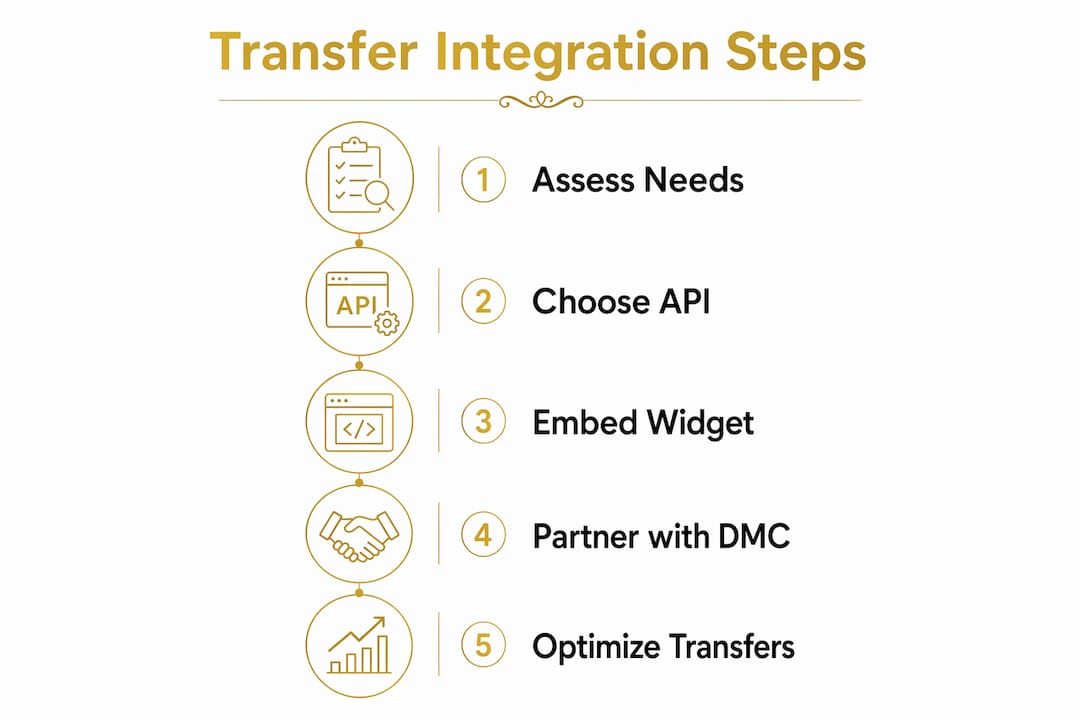
How can agencies add transfers without heavy technical resources?
Not every agency has a development team. Smaller operators can still add private transfers to their packages by embedding a white-label booking form directly on their website. This approach requires no custom API work and no plugins.
Embedding a transfer booking form via a code snippet enables immediate live booking with no complex development. The supplier provides a short block of HTML or JavaScript. The agency pastes it into their website. Clients book directly, and the agency earns a commission or applies a markup through the supplier’s partner portal.
The implementation process follows four clear steps:
- Register as a partner with a transfer provider that offers a white-label booking widget. Confirm they cover your destination markets and vehicle classes.
- Customize the widget. Most providers allow color, font, and logo adjustments so the form matches your brand. This matters for client trust.
- Embed the code snippet on your package detail pages or a dedicated transfer booking page. Place it close to the itinerary so clients see it as part of the package, not an afterthought.
- Test the full booking flow. Complete a test booking, check confirmation emails, and verify that cancellation and amendment processes work correctly before promoting the feature.
The trade-off is control. Embedded forms give the supplier more visibility into your client data and limit your ability to customize the booking logic. For agencies building high-volume or luxury packages, the API route eventually becomes worth the investment. For agencies handling fewer than 50 transfer bookings per month, the embedded form is the right starting point.
Pro Tip: Place the transfer booking widget immediately below the flight and hotel summary in your package layout. Clients who see the full itinerary in one view are significantly more likely to add the transfer than those who encounter it on a separate page.
What is the role of Destination Management Companies in transfer integration?
DMCs are local operators who manage ground logistics within a specific destination. For travel agencies, they function as the operational arm of the package. DMCs provide local supplier networks and operational teams that reduce coordination complexity for agencies handling transfers across multiple destinations.
The practical value of a DMC relationship goes beyond just having a local contact. DMCs negotiate volume rates with transfer suppliers, manage driver scheduling, handle last-minute changes, and carry local liability. An agency in Tallinn working with a DMC in Lisbon does not need to vet individual drivers or track local traffic patterns. The DMC absorbs that operational risk.
Key benefits of DMC partnerships for transfer integration include:
- Single point of contact for all ground logistics, reducing the number of supplier relationships an agency must manage.
- Pre-vetted vehicle fleets with known quality standards, eliminating the guesswork of sourcing transfers in unfamiliar markets.
- Emergency mediation when drivers cancel, vehicles break down, or clients miss connections.
- Local knowledge on traffic patterns, airport procedures, and seasonal demand that affects transfer timing and pricing.
“While agencies promise the overall travel experience, DMCs and transfer providers are the operational backbone, responsible for punctuality and problem resolution. The client remembers the driver who was late, not the booking platform that worked perfectly.”
This insight reframes how agencies should think about DMC contracts. A DMC is not a cost center. It is a brand protection investment. When a transfer fails, the client blames the agency, not the local supplier they never heard of.
How to design transfer options that meet diverse traveler needs
Matching the right vehicle to the right trip stage is the most underrated skill in package design. Combining transport modes matched to trip stages meets traveler needs more effectively than a single vehicle type applied across an entire itinerary.

The table below shows how vehicle selection maps to common package scenarios:
| Traveler segment | Recommended vehicle | Best use case |
|---|---|---|
| Solo or couple, business | Executive sedan | Airport to city hotel, short routes |
| Family of 4–6, leisure | Mercedes-Benz V-Class or SUV | Airport transfers, day trips |
| Group of 10–20, corporate | Luxury minibus or coach | Conference transfers, multi-stop tours |
| VIP or honeymoon | Premium luxury vehicle | Private tours, special event transport |
Contract structure matters as much as vehicle type. Locking volume-based contracts early avoids seasonal price spikes in transfer costs. For high-demand routes like airport pickups during peak travel months, allocation contracts guarantee vehicle availability and fix your cost basis. Freesale arrangements work for low-volume or experimental routes where you cannot predict demand.
For agencies building diverse transfer options into their packages, the most effective multi-modal combinations pair a private airport transfer on arrival with a shared or scheduled service for day trips, then return to private for departure. This structure balances cost with the moments that matter most to the client: arrival and departure impressions.
Pro Tip: Offer two transfer tiers within the same package: a standard option and a premium upgrade. The upgrade converts at a surprisingly high rate when positioned as a small addition to an already significant trip investment.
What operational challenges arise in transfer integration?
Transfers are the most operationally fragile component of travel packages. Traffic, driver reliability, and vehicle maintenance create variables that no booking system can fully control. Agencies that treat transfers as a simple logistics checkbox consistently face the highest client complaint rates.
The risks break down into three categories:
- Supplier reliability. A driver who cancels 30 minutes before pickup creates a crisis. Agencies must confirm that every transfer supplier has a backup driver protocol and can communicate changes in real time.
- Contract exposure. Freesale agreements shift operational risk away from agencies but reduce control over vehicle quality. For premium packages, allocation contracts provide the guaranteed vehicle type and service standard that luxury clients expect.
- Communication gaps. When a flight is delayed and the driver is not informed, the client arrives to an empty pickup zone. Real-time flight monitoring, a feature that transfer providers like Solidride build into their service, eliminates this failure point entirely.
Selecting transfer suppliers who guarantee punctuality and emergency mediation maintains brand reputation and protects client satisfaction scores. The transfer provider functions as the operational arm of the travel experience. Its reliability standards become your reliability standards.
The most effective mitigation strategy combines allocation contracts for core routes, a vetted DMC relationship for local backup, and a supplier with real-time monitoring capabilities. Agencies that build this three-layer safety net report fewer escalations and stronger repeat booking rates.
Key Takeaways
Integrating transfers into travel packages requires combining the right technology layer with reliable supplier partnerships and clear contract structures to protect both margins and client experience.
| Point | Details |
|---|---|
| Use dynamic packaging APIs | APIs bundle transfers with flights and hotels, hiding component costs and protecting agency margins. |
| Embed forms for quick starts | White-label booking widgets let smaller agencies add live transfer booking without custom development. |
| Partner with DMCs | DMCs provide local supplier networks, backup plans, and emergency support that agencies cannot replicate remotely. |
| Match vehicles to traveler segments | Sedans, V-Class vans, and coaches each serve different trip stages; mixing them improves client satisfaction. |
| Lock allocation contracts early | Fixed-rate contracts on high-demand routes prevent seasonal cost spikes and guarantee vehicle quality. |
What I’ve learned about transfer integration after years in the industry
The agencies that struggle most with transfer integration are not the ones with the worst technology. They are the ones that treat transfers as the last item on the package checklist rather than a core design decision.
I have watched agencies invest heavily in flight and hotel APIs, then patch in transfers with a freesale agreement and a prayer. That approach works until it does not. One missed airport pickup in front of a first-time luxury client can undo months of relationship building.
The shift I recommend is simple: design the transfer experience first, then build the rest of the package around it. Arrival and departure are the moments clients remember most vividly. A driver holding a name sign, a clean Mercedes-Benz V-Class waiting at the curb, a bottle of water in the console. These details cost relatively little to arrange and carry disproportionate weight in post-trip reviews.
On the technology side, I am skeptical of agencies that chase full API integration before they have consistent transfer volume. The embedded form route is underrated. It gets you to market faster, generates real booking data, and tells you which routes and vehicle classes your clients actually want before you commit to a complex integration.
The future of transfer integration sits at the intersection of real-time data and local human expertise. Dynamic packaging handles the transaction. The DMC or local supplier handles the execution. Neither works well without the other. Agencies that invest in both sides of that equation will consistently outperform those that bet entirely on technology.
— Erki
Solidride’s private transfers for your travel packages
Travel agencies building packages that include Estonia deserve a transfer partner with the reliability and vehicle quality their clients expect.
Solidride operates 24/7 private chauffeur transfers across Tallinn, covering airport, railway station, seaport, and hotel pickups in Mercedes-Benz V-Class vehicles. Real-time flight monitoring, meet-and-greet service, and luggage assistance come standard. For agencies seeking a dependable ground partner in Estonia, Solidride offers direct booking and partnership arrangements that fit neatly into existing package workflows. Visit the Solidride partner program page to learn how to add premium Estonian transfers to your packages today.
FAQ
What does integrating transfers into a travel package mean?
Integrating transfers means combining ground transportation with flights and hotels into a single bookable package, typically through a dynamic packaging API or an embedded booking form.
How do dynamic packaging APIs improve transfer margins?
Dynamic packaging APIs bundle transfer costs into a single package price, hiding individual component discounts and increasing the total value clients pay without revealing wholesale rates.
Can small agencies add transfers without API development?
Yes. Smaller agencies can embed a white-label transfer booking widget using a simple code snippet, enabling live bookings with no custom development or plugins required.
What is the role of a DMC in transfer logistics?
A DMC provides local supplier networks, pre-vetted vehicle fleets, and emergency backup support, acting as the operational backbone for transfer services within a destination.
Why are allocation contracts better than freesale for premium transfers?
Allocation contracts guarantee specific vehicle types and service standards, while freesale agreements reduce agency control over quality, which is a critical risk for luxury travel packages.
Lisa kommentaar