


For Tallinn cruise passengers, the fastest, most reliable option is a pre-booked private transfer with luggage assistance and meet-and-greet at the pier. Public buses and taxi ranks work fine if you’re traveling light and have time to spare, but if your ship docks at 7 a.m. and your flight leaves at 1 p.m., a private car removes the two things that actually ruin cruise days: unpredictable wait times and hauling suitcases across a terminal.
Three things make the private option worth the price difference. First, a driver who tracks your ship’s arrival will already be parked and waiting when you clear customs, not circling for a spot. Second, luggage handling means you’re not wrestling three bags up a gangway ramp by yourself. Third, door-to-door service skips the transfer-to-transfer shuffle that public transit sometimes requires with bulky luggage.
Book your transfer 2 to 6 weeks ahead if you’re arriving during peak cruise season (May through September), since premium vehicles like the Mercedes V-Class sell out fast on the busiest port days. Before you book anything, confirm three details with the operator: your ship’s name and terminal, exact passenger count, and total luggage pieces.
- Reserve early in the busiest months to ensure availability of a premium vehicle
- Confirm ship name, terminal, and passenger/luggage count before booking
- Ask about real-time arrival monitoring so your driver can adjust to delays
Основные выводы
Booking a private, pre-monitored transfer with luggage assistance is the single most reliable way to protect a tight cruise schedule in Tallinn.
| Пункт | Подробности |
|---|---|
| Book early in peak season | Reserve 2 to 6 weeks ahead from May through September to secure a Mercedes V-Class or similar vehicle. |
| Confirm the essentials | Share ship name, terminal, passenger count, and luggage total with your operator before travel. |
| Budget realistic transfer time | Plan for 20 to 40 minutes to clear the ship and reach your driver, plus 5 to 20 minutes of driving. |
| Groups save on per-vehicle pricing | Splitting one vehicle fare among three or more passengers usually beats separate taxi fares. |
| Solidride handles the full pier-to-door leg | Mercedes V-Class fleet, meet-and-greet, luggage assistance, and real-time arrival monitoring run 24/7 out of Old City Harbour. |
Содержание
- Tallinna Kruiisireisija Transport: A Quick Booking Checklist
- Which Vehicle Fits Your Group and Luggage?
- How Does Tallinn’s Cruise Terminal Actually Work?
- What Booking Details Actually Prevent Confusion?
- What Does Private Transfer Pricing Actually Look Like?
- How Long Does the Transfer Actually Take?
- Getting From the Terminal to Tallinn’s Top Spots
- What Goes Wrong (and How to Handle It)
- Are Local Taxis a Realistic Alternative?
- How Do Groups Save on Transfers?
- Is It Safe to Use Transport Services After Disembarkation?
- Solidride: How We Handle Tallinn Cruise Transfers
- Book Your Tallinn Cruise Transfer With Confidence
- Why the “Just Grab a Taxi” Advice Undersells the Real Risk
- Sources
Tallinna Kruiisireisija Transport: A Quick Booking Checklist
Booking a Tallinn cruise transfer isn’t complicated, but the order you do things in matters. Reserve too late in July or August and you’ll find yourself choosing between a minivan you didn’t want or a taxi queue at the terminal. Here’s the sequence that avoids both problems.
- Check your sailing dates against peak season. May through September brings the heaviest cruise traffic to Old City Harbour, so reserve 2 to 6 weeks out if you want a specific vehicle class, particularly a Mercedes V-Class or similar premium option.
- Gather your exact details before contacting an operator. You’ll need the ship name, terminal or berth number if known, scheduled arrival or departure time, passenger count, and number of luggage pieces.
- Flag anything non-standard at the time of booking. Child seats, pets, oversized luggage, or wheelchair access should be mentioned upfront, not at the curb.
- Build in a buffer for fly-and-cruise days. If you’re flying into Tallinn and boarding the same day, or disembarking and catching a flight, add at least a 60 to 90 minute cushion between transport legs.
- Confirm the operator monitors arrivals in real time. This matters more for cruise passengers than almost anyone else, since disembarkation timing shifts constantly based on customs flow and berth assignment.
Pro Tip: If you’re booking a same-day fly-and-cruise transfer, tell the operator your flight number as well as your ship details. A driver who tracks both can adjust pickup timing without you lifting a finger.
Which Vehicle Fits Your Group and Luggage?
Vehicle choice comes down to two numbers: how many people, and how many bags. Get both right and the rest of the transfer takes care of itself.
- Executive sedan: Comfortable for one or two passengers with one large suitcase each, best for solo cruisers or couples traveling light.
- Mercedes V-Class: The standard premium choice for small groups of up to five or six passengers with a full set of cruise luggage. This is where most Tallinn cruise transfers land, since it balances comfort with real cargo space, and it’s the vehicle Solidride runs most often for pier pickups.
- Van: Fits larger families or groups of six to eight, useful when luggage volume exceeds what a V-Class trunk can absorb.
- Minibus: Built for group transfers, ten or more passengers, common for shore excursion groups or multi-cabin family bookings traveling together.
A Mercedes V-Class earns its reputation on cruise days specifically because gangway luggage tends to run heavier than airport luggage. Passengers pack for multiple ports, and that means more bags per person than a typical flight.
Beyond seat count, ask about the add-ons that actually matter for cruise transfers: child seats if you’re traveling with young kids, pet-friendly setup if your animal is joining you, extra waiting time built into the quote rather than charged as a surprise fee, and small comforts like bottled water or Wi-Fi for a longer ride to the airport or a hotel outside the city center.

How Does Tallinn’s Cruise Terminal Actually Work?
Old City Harbour is Tallinn’s main passenger harbour and the busiest cruise terminal in Estonia, with terminals A and D handling the bulk of cruise ship traffic. Both sit close enough to the Old Town that walking is genuinely an option for a passenger with a single carry-on, and tram T2 connects the port directly to the city center, running from roughly 5:30 a.m. until midnight with a €2 single fare payable by contactless card.
Meet-and-greet at A and D terminals works like this in practice: drivers wait in designated pickup zones just outside the terminal building, holding a name sign, and walk in to help with bags once you’ve cleared the exit doors. Port data on Tallinn puts the distance from the piers to downtown at roughly 1 kilometer, short enough that private drivers rarely need more than a few minutes to reach the terminal curb once your ship clears customs.
Berth reassignments happen, gangway walks run longer than expected on bigger ships, and security checks at busier terminals can add 15 to 30 minutes you didn’t plan for. A few habits reduce the stress:
- Text your driver the moment you’re through customs, even if you’re still walking.
- Ask in advance which terminal building (A or D) your driver defaults to if your berth changes last minute.
- Don’t assume the closest exit is the one your driver is watching. Confirm the pickup point by name, not just “outside the terminal.”
What Booking Details Actually Prevent Confusion?
Missed pickups on cruise days almost never come down to bad luck. They come down to one missing detail: the wrong terminal, an unconfirmed berth number, or no direct phone contact for the driver. Give your operator everything up front and this problem disappears.
Here’s what to hand over at booking time:
- Ship name and the scheduled arrival or departure time
- Terminal or berth number, if your cruise line has confirmed it
- Passenger count and your direct phone number
- Hotel address, or onward transport details if you’re heading to Tallinn Airport or the rail station
- Any special requests: child seats, pet transport, extra luggage, mobility needs
A local contact number and confirmed terminal are the two details experienced cruise travelers say matter most, since getting either wrong is the single most common reason a pickup gets missed entirely. Real-time monitoring, where the operator tracks your ship or flight rather than just a fixed time slot, is what lets a driver adjust automatically when disembarkation runs late.
Pro Tip: Ask specifically what “waiting allowance” your operator includes free of charge. Anything beyond 30 to 45 minutes of delay sometimes carries a fee, and you want that number before you’re standing at the curb, not after.
What Does Private Transfer Pricing Actually Look Like?
Private transfers are typically priced per vehicle rather than per passenger, which flips the math for groups. Three or four people splitting one V-Class fare usually comes out cheaper per person than three or four separate taxi rides or shuttle tickets, especially with luggage in the mix.
Before you confirm a booking, get clear answers on:
- How the quote is structured: per vehicle, per route, one-way versus round trip
- The waiting time allowance included in the base price, and what triggers an extra charge
- The cancellation window, since cruise itineraries shift and you want to know how many hours’ notice avoids a fee
- Whether amendments (a later pickup time, an added passenger) are free or come with a change fee
Locking these down at booking time avoids the two most common cost surprises: a delay fee for a late disembarkation that wasn’t actually your fault, and a cancellation charge for a schedule change the cruise line made, not you.
How Long Does the Transfer Actually Take?
From the moment you step off the ship to the moment you’re settled at your hotel or airport gate, most Tallinn cruise transfers run somewhere between 15 minutes and just over an hour, depending entirely on where you’re headed.
A hotel in the Old Town or city center sits close to Old City Harbour, often a 5 to 10 minute drive once you’re actually in the car. The bottleneck almost never happens on the road. It happens between disembarkation and reaching your driver: customs clearance, the walk down the gangway and through the terminal, and locating your pickup point can eat 20 to 40 minutes on a busy port day with multiple ships in.
Tallinn Airport sits a short drive from the port, making a fly-and-cruise connection workable if your flight allows sufficient time after your ship docks. The rail station runs similarly close, a 10 to 15 minute drive from the terminal.
Add it up and a realistic total transfer estimate looks like this: 20 to 40 minutes to clear the ship and reach your driver, then 5 to 20 minutes of driving depending on the destination. Budget 45 minutes to just over an hour total for anything within Tallinn itself, and closer to 90 minutes if you’re catching a flight the same day and want a comfortable buffer instead of a sprint through security.
Getting From the Terminal to Tallinn’s Top Spots
Once you’re off the ship, here’s how the different routes actually break down, whether you’re taking a private car or figuring out public transit on your own.
To Old Town: This is the shortest hop in the entire city. It’s close enough to walk in 15 to 20 minutes if you’re traveling light, or a 5 minute drive if you have luggage or limited mobility. A private driver drops you directly at your hotel entrance instead of the nearest street the tram can reach.
To Tallinn Airport: Board tram T2 near the port (fare €2, contactless card accepted) and connect to the airport via the city’s tram network, a route that works but typically takes 30 to 45 minutes with a transfer point. A private transfer runs closer to 15 to 20 minutes, direct, which matters if your flight window is tight.
To Balti Jaam (rail station): Public tram or bus gets you there in roughly 20 to 30 minutes with one possible connection. A direct transfer takes about 10 to 15 minutes.
To hotels outside the center: This is where public transport starts costing you real time, often 40 minutes or more with a transfer, versus a direct 15 to 25 minute private ride.
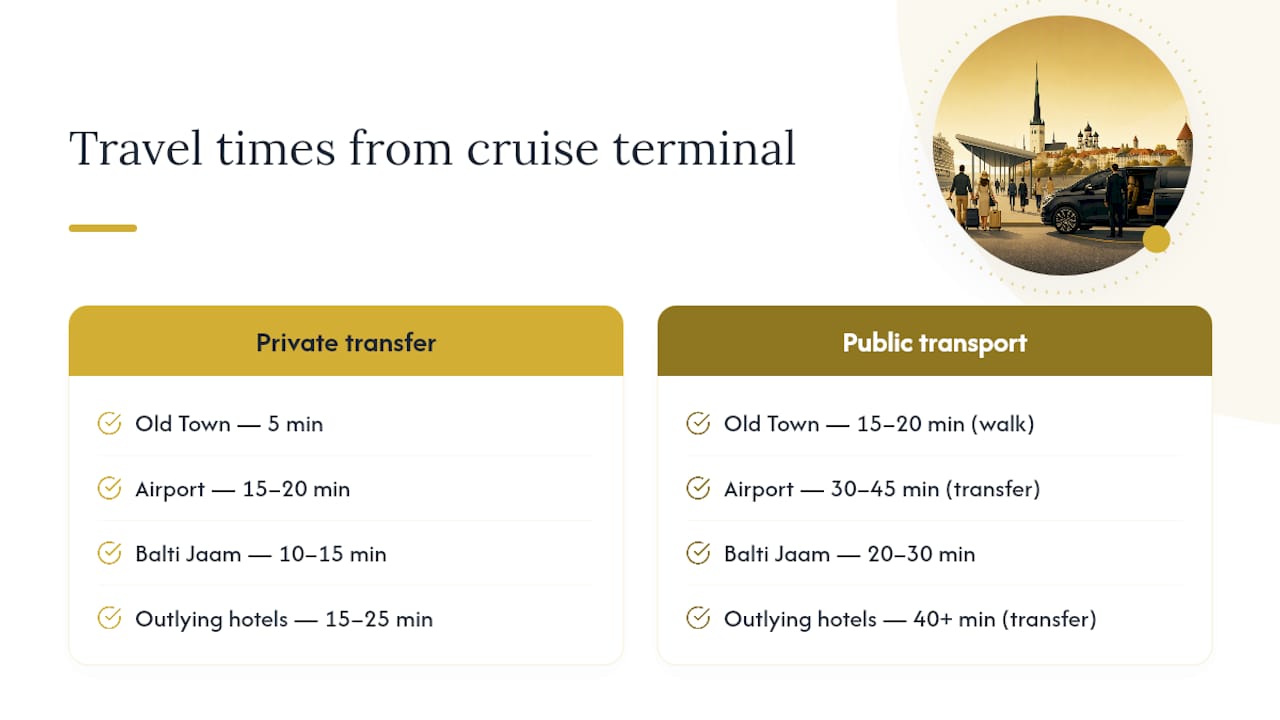
The pattern holds across every route: public transit works when your destination is Old Town and your bags are light. Everywhere else, particularly the airport or outlying hotels, a direct transfer saves 20 minutes or more and spares you from lugging suitcases onto a tram.
What Goes Wrong (and How to Handle It)
Most transfer problems on cruise days trace back to a handful of predictable issues, not bad luck.
Berth changes. Your ship gets reassigned from terminal A to D, or vice versa, sometimes with only a few hours’ notice. Confirm with your operator ahead of time which terminal they’ll default to checking, and text them the moment you know your actual berth.
Disembarkation delays. Customs and immigration processing on a full ship can run 30 minutes past what your cruise line printed on your disembarkation card. An operator that tracks ship arrivals in real time adjusts automatically. One that doesn’t will either be waiting unnecessarily long or, worse, not there yet when you clear the terminal.
Luggage mismatches. Booking for four passengers but showing up with six suitcases and two carry-ons is a common surprise for drivers. State your real luggage count when booking, including duty-free purchases you’re likely to pick up onboard.
Language barriers at the curb. Not every driver in Tallinn speaks fluent English, and a rushed pickup zone is a bad place for confusion. Confirm your operator uses multilingual drivers if this matters to your group.
Wrong pickup point. Terminal buildings have multiple exits. Get the exact meeting spot by name from your operator, not a vague “outside the terminal.”
Handling all five comes down to one habit: communicate the moment something changes, rather than assuming your driver already knows.
Are Local Taxis a Realistic Alternative?
Taxis are usually available at Old City Harbour when multiple ships are in port, lined up in a designated rank near the terminal exit. For a solo traveler with one bag heading straight to Old Town, a taxi is a perfectly reasonable choice, quick to flag and inexpensive over such a short distance.
The tradeoffs show up on busier days. When two or three large ships dock simultaneously, which happens regularly in peak season, taxi demand at the rank spikes and wait times stretch. Taxis also don’t track your ship’s arrival, so if your disembarkation runs late, you’re back at square one searching for an available car rather than finding your name already waiting on a sign. Luggage assistance isn’t standard either. Most taxi drivers will pop the trunk, but don’t expect help carrying bags from the terminal door.
For a single passenger without checked luggage and a destination inside the Old Town, a taxi is fine. For anyone with more than one or two bags, a group of three or more, or a tight onward connection to the airport or rail station, a pre-booked private transfer removes the guesswork entirely. You know your driver is coming, you know the price before you leave the ship, and nobody’s standing in a rank hoping the next taxi has room for four suitcases.
How Do Groups Save on Transfers?
Since private transfers are priced per vehicle, the math favors groups almost automatically. Three friends sharing one V-Class fare split a single price instead of paying for three separate taxi rides or shuttle seats, and the per-person cost usually lands lower once you do that division.
A few practical moves stretch the savings further:
- Combine cabins traveling to the same destination. If two cabins on your ship are both heading to hotels in the same part of town, one shared van fare beats two separate bookings.
- Book round trip instead of two one-way transfers. Operators frequently offer a modest discount when arrival and departure are booked together at once.
- Choose a minibus for groups of eight or more rather than splitting into two smaller vehicles, since a single larger vehicle fare is typically less than two van fares combined.
- Book early for the vehicle size you actually need. Waiting until the week before often means settling for whatever’s left, usually at a higher last-minute rate.
Group transfers work particularly well for shore excursion parties or multi-cabin families who all want to land at the same hotel or the same onward connection, since one coordinated pickup replaces what would otherwise be a scramble of separate rides.
Is It Safe to Use Transport Services After Disembarkation?
Safety on a cruise transfer comes down to a few practical checks, most of which take thirty seconds and prevent real problems.
Confirm your driver’s identity before getting in. A reputable operator provides a name and vehicle description ahead of time, and a driver holding a visible name sign at the pickup point. Never accept an unmarked ride from someone approaching you inside the terminal with an unsolicited offer, a scam that still shows up at busy ports.
Have your ID ready when you disembark. Port of Tallinn passenger guidance confirms passengers need valid identification during check-in and terminal procedures, so keep it accessible rather than buried in checked luggage.
On general health protocols, standard hygiene practices, hand sanitizer availability, and reasonable spacing in shared vehicles remain sensible baseline habits for any cruise passenger moving through a busy terminal, though specific cruise line and port health requirements can change between sailings. Check your cruise line’s current guidance before departure, since protocols are set by the cruise line and port authority rather than by transfer operators themselves.
Vehicle cleanliness is worth asking about directly if it matters to you. Reputable operators clean and sanitize vehicles between passengers as standard practice, and there’s no harm in confirming this when you book.
Solidride: How We Handle Tallinn Cruise Transfers
Solidride runs Mercedes V-Class vehicles for cruise transfers between Old City Harbour and hotels, the airport, or Balti Jaam, built specifically around the luggage load and unpredictable timing that cruise days bring. Drivers meet passengers at the terminal exit with a name sign, handle bags from the door to the vehicle, and track ship arrivals in real time so a delayed disembarkation doesn’t leave you standing at an empty curb.
The operation runs 24/7, with multilingual drivers and online booking that lets you lock in ship name, terminal, passenger count, and luggage details ahead of time, the exact information that prevents missed pickups. That combination, meet-and-greet plus active monitoring plus luggage handling, is what actually cuts down on the two things that ruin a cruise transfer: a driver who isn’t where you expect, and bags you’re left carrying yourself.
Book Your Tallinn Cruise Transfer With Confidence
Solidride specializes in exactly the transfer this article describes: private, pre-booked, luggage-assisted rides between Old City Harbour and your hotel, Tallinn Airport, or the rail station, run with a Mercedes V-Class fleet built for cruise-sized luggage loads. Where a taxi rank leaves you competing with two other docked ships, Solidride locks in your vehicle, your driver, and your price before you even board your cruise.

Booking takes a few minutes through the online form, where you enter your ship name, terminal, passenger count, and luggage details so the driver arrives already briefed. Multilingual drivers, real-time arrival monitoring, and 24/7 availability mean the plan holds even if your disembarkation runs late or your berth changes. If you’re traveling with a group, check the private transfer booking checklist first to confirm you have every detail the operator needs, then reserve your Mercedes V-Class or larger vehicle directly through the high-end transfer booking checklist before your peak-season dates fill up.
Why the “Just Grab a Taxi” Advice Undersells the Real Risk
Most travel forums treat the terminal-to-hotel leg of a cruise as an afterthought, a five-minute logistics footnote compared to picking the right shore excursion or dining package. That’s backwards. The transfer is the one part of your cruise day with zero flexibility built in: your ship docks when it docks, your flight leaves when it leaves, and nobody at the taxi rank cares that you booked a 1 p.m. departure.
What gets underestimated is how much of the actual risk lives in the gap between “off the ship” and “in a vehicle,” not in the drive itself. A driver circling for parking, a taxi rank overwhelmed because three ships came in together, a pickup point that turns out to be the wrong terminal exit. None of that is about traffic. It’s about information, or the lack of it, moving between the passenger and the driver before anyone leaves home.
That’s also why the conventional cost comparison, private transfer versus taxi, misses the point for anyone traveling with more than a carry-on. The real comparison isn’t price per ride. It’s certainty versus chance on a day when you genuinely cannot afford to guess wrong.
— Эрки
Sources
- Old City Harbour — Wikipedia
- Visit Tallinn — Arrival & departure / transport
- CruiseBaltic — Tallinn port details
- Port of Tallinn — Passenger FAQ
Добавить комментарий