

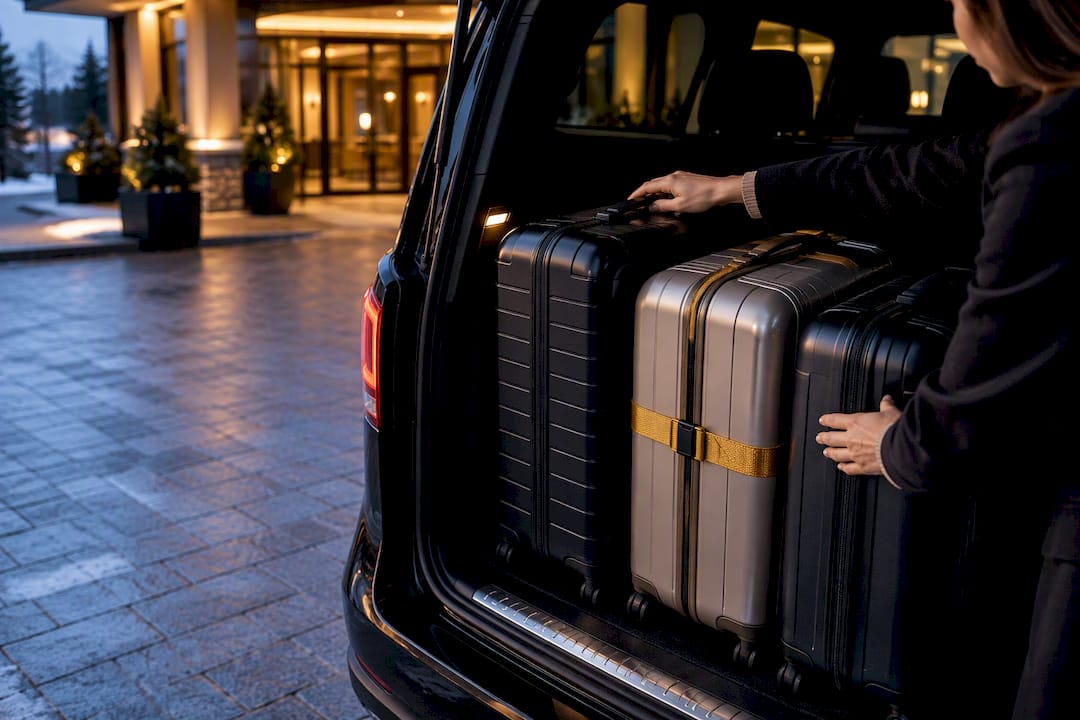
Short verdict: the Mercedes-Benz V-Class handles standard family luggage well for groups of up to five to seven passengers, as long as you match the seating layout to your bag count. The van comes in different lengths, and how many rows you keep upright changes the usable cargo area more than the brochure numbers suggest. The exact figures, and what they mean for real suitcases, follow below.
TL;DR:
- A Mercedes-Benz V-Class Long typically fits around three large suitcases and a few cabin bags with all seats up, while the Extra Long offers more overall space.
- Folding or sliding the third row of seats significantly increases cargo capacity, often enough for two or three additional large suitcases, especially for groups of five or fewer.
- Sitting five to seven people with light luggage is feasible, but seven full suitcases with all seats occupied are rarely manageable without folding or removing seats.
- Bulky gear like skis or bikes requires larger vehicles or roof attachments, as they occupy disproportionate space compared to their weight.
- Booking a V-Class is ideal for groups of four to six with typical luggage; larger groups or bulky gear usually need a minibus or bigger van for comfort and practicality.
Содержание
- The real numbers: boot volume and what it means in suitcases
- How seat configuration changes your usable cargo space
- What the brochure numbers do not tell you
- Four family scenarios that show what actually fits
- Loading tips that make the most of the space you have
- Choosing between a V-Class and a larger vehicle class
- Traveling with young children: seats, strollers, and space
- How SolidRide runs V-Class transfers day to day
- When a V-Class is the right call and when it is not
- How to book a V-Class transfer that fits your luggage
- Selected sources and further reading
- Часто задаваемые вопросы
The real numbers: boot volume and what it means in suitcases
Buyers researching v-class pagasimaht usually start with litre figures, but litres alone do not tell you much until you convert them into bags. With all seats in place, the V-Class Long offers a substantial cargo space and the Extra Long offers more, based on figures used by transfer operators and vehicle spec explainers describing pagasi paigutus autos with all rows occupied. Those numbers assume a fully seated configuration, not a van stripped down for cargo duty.
In practical terms, that space translates roughly to:
- The Long body typically swallows around three large suitcases plus a few cabin bags when all seats stay up.
- The Extra Long can usually fit several large suitcases plus several cabin bags in the same configuration.
- Both figures shrink once child seats, strollers, or bulky sports gear enter the mix.
Transfer operators often describe capacity as a suitcase count rather than a litre figure, since it is easier for travelers to picture than a cubic measurement. That habit is worth keeping in mind when you compare quoted numbers between sources, since the underlying assumptions rarely match exactly.
How seat configuration changes your usable cargo space
The V-Class advantages that matter most for luggage come down to how the seats move, not just how big the van is. Most versions ship in a 7-seat, 6-seat, or 5-seat layout, and each one trades passenger room for cargo room differently.
- Seven seats up gives you maximum passenger capacity but leaves only the boot well behind the last row for bags, which suits families with light packing or short trips.
- Sliding or folding the third row flat opens up a substantial extra block of floor space, often enough for two or three more large suitcases, while still keeping the second row for passengers.
- Removing a row entirely (where the model allows quick-release seats) turns the rear into a nearly flat load bay, ideal for groups of five or fewer traveling with heavy luggage, strollers, or sports equipment.
The trade-off is comfort and safety. Folding a row reduces where passengers can sit and may limit rear visibility or access to seatbelts if done incorrectly. Removing seats takes time and tools, and reinstalling them at the destination is not always practical for a one-way transfer. For most family holidays, sliding the last row forward or folding it flat strikes the better balance between people and pagasimaht options without turning the van into a cargo-only vehicle.
What the brochure numbers do not tell you
Published cargo figures describe a box shape, but a van’s rear is rarely a clean rectangle. Wheel arches, seat wells, and the slope of the tailgate all eat into that quoted litre count, so the number on a spec sheet is closer to a theoretical ceiling than what you can realistically stack in a hurry.
Common gotchas to watch for:
- Litre figures usually assume bags are stacked to the roofline, not left accessible for mid-trip use.
- Measurement methods vary between manufacturers, so a Long and an Extra Long figure from different sources are not always directly comparable.
- Seat wells and wheel housings reduce the flat, usable footprint even when the quoted volume looks generous.
Pro Tip: Before booking a vehicle for a specific trip, ask the operator how many large suitcases they have actually loaded with all seats occupied, not just what the spec sheet claims.
Four family scenarios that show what actually fits
Numbers only mean so much until you picture them against a real trip. Here is how four common travel patterns play out in a V-Class.
- Couple plus two kids, one-week holiday: two large suitcases, two medium ones, and a couple of backpacks fit comfortably with the third row up, leaving the middle row free for the children and a stroller folded flat against the seat backs.
- Five to seven adults, short trip: with every seat filled, prioritize cabin-sized bags over large suitcases. Expect to negotiate space, since seven passengers and seven full suitcases rarely fit without folding at least part of the last row.
- Bulky gear like skis, bikes, or golf bags: these items eat disproportionate space compared to their weight. When more than a couple of oversized pieces are involved, it usually makes sense to book a larger vehicle class or add a roofbox rather than remove seats mid-trip.
- Airport transfer with 4 to 6 suitcases: the most common use case for a V-Class booking, and the one it handles most comfortably, since passenger count and luggage count are both moderate.
A quick packing checklist: count your large suitcases first, then cabin bags, then anything irregularly shaped like strollers or ski bags, and match that total against the seating layout you plan to keep.
Loading tips that make the most of the space you have
How you pack matters almost as much as how much space you have. A few habits consistently free up room:
- Favor soft duffel bags and packing cubes over hard-shell suitcases, since soft luggage compresses into gaps around wheel arches and seat frames that rigid cases cannot use.
- Load the largest, flattest items first against the back seat, then build upward and forward, filling irregular corners with soft bags last.
- Keep frequently needed items, like a diaper bag or medication, near the door rather than buried under stacked suitcases.
Pro Tip: Load heavier bags low and centered over the rear axle rather than piled high behind the tailgate, since uneven weight distribution affects handling more than most travelers expect.
Roof rails or a roofbox are worth adding when you are carrying skis, bikes, or more bags than the cabin can hold without blocking rear visibility through the tailgate window. A trailer is the better call when the group size and luggage both scale up, rather than forcing everything into a van that was never meant to carry it.
Choosing between a V-Class and a larger vehicle class
The V-Class sits in a sweet spot between a large SUV and a full-size minibus, and knowing where that spot ends helps you avoid a cramped trip.
- Modular seating, sliding doors, and passenger comfort make it well suited to families and small groups who need flexibility without the bulk of a minibus.
- Its main limits are interior height in some parking structures and a cargo floor that is not a perfect rectangle, which affects how neatly large suitcases stack.
- An SUV suits smaller groups with lighter luggage; an MPV or minibus suits larger parties or bulky gear that would otherwise force seat removal in a V-Class.
Planner-level guidance for larger passenger vans and minibuses often uses a rough allowance of about 8 cubic feet per rider when scaling beyond van-sized transfers, a useful reference when deciding if your group has outgrown a single V-Class.
If your group tops seven people or your luggage regularly includes bulky sports equipment, it is worth checking a minibus or Sprinter-class option before committing to a smaller van.
Traveling with young children: seats, strollers, and space
Child seats change the math more than most parents expect. A rear-facing infant seat and a forward-facing toddler seat both take up passenger space that would otherwise fold flat for cargo, so the trade-off between rows and bags gets tighter with every child seat added.
Practical points to plan around:
- Install child seats in the second row where possible, keeping the third row available to fold or slide for extra cargo room.
- Store strollers and diaper bags where they are reachable without unloading the whole rear compartment at every stop.
- Double-check that folding a row for luggage does not compromise a child seat’s anchor points or seatbelt routing.
A quick safety check before departure: confirm every child seat is still properly secured after any seat folding, and keep bulky items from shifting toward the rear doors during transit.
How SolidRide runs V-Class transfers day to day
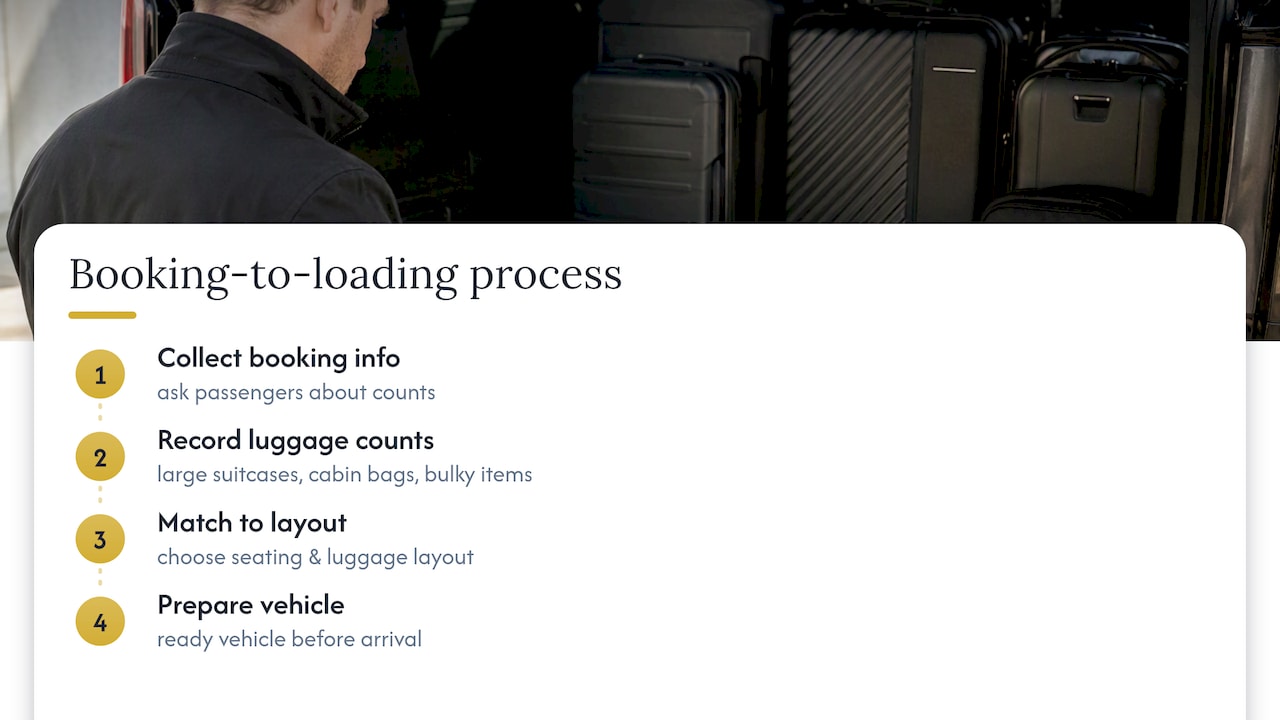
SolidRide schedules V-Class vehicles for airport pickups and group transfers across a range of party sizes, and the guidance given to clients centers on matching seat count to luggage before the vehicle arrives. Passengers booking a transfer are asked how many large suitcases, cabin bags, and any bulky items like strollers or golf bags they are bringing, so the right layout is ready on arrival.
Pricing for a V-Class transfer runs at €45 per hour, with route-based transfers such as Tallinn to Tartu priced from €270 one-off. Group bookings that need a different vehicle size are quoted individually, since luggage volume and passenger count both affect the right fit. Full luggage assistance guidance is available for travelers who want to plan loading before the day of travel.
When a V-Class is the right call and when it is not
A V-Class fits families and small groups of four to six who are traveling with a normal mix of suitcases and one or two bulky items, since it balances comfort and cargo room better than a smaller vehicle without the overhead of a full minibus. It stops being the right choice once your group tops seven people or your gear runs to multiple oversized pieces like bikes or ski bags. In those cases, adding a roofbox or stepping up to a larger vehicle class solves more problems than trying to force everything into one van. Checking the group transport pricing guide before booking helps set expectations either way.
— Эрки
How to book a V-Class transfer that fits your luggage
A V-Class booking through SolidRide comes with meet-and-greet service, luggage assistance on arrival, and a vehicle choice you can adjust once you know your bag count. That last part matters more than most people realize: telling us your passenger count, suitcase count, and any bulky items like strollers or ski bags before the trip means the right vehicle is waiting, not a scramble to fit everything in on the curb.

What to include when requesting a quote:
- Total passenger count and whether any child seats are needed.
- Number of large suitcases, cabin bags, and any oversized items.
- Pickup and drop-off points, since route pricing (like Tallinn to Pärnu from €190) differs from hourly transfer rates.
Standard V-Class transfers run at an hourly rate, and larger or unusual luggage loads receive a custom quote rather than a guess. Check current pricing and vehicle options or use the booking checklist to confirm your details before you request a transfer.
Selected sources and further reading
- SolidRide pricing and vehicle options: current rates for V-Class and other transfer vehicles.
- SolidRide luggage assistance guide: practical packing and handling advice for transfers.
- Sprinter van capacity guidance: cargo geometry reference for larger passenger vans.
- Map placemark reference: location and fleet-view context.
Часто задаваемые вопросы
How many suitcases fit in a Mercedes V-Class?
With all seats up, a Long V-Class typically fits around 3 large suitcases plus a couple of cabin bags, while an Extra Long can usually hold 4 to 5 large suitcases. Folding or sliding the third row adds noticeably more room for either version.
Does folding the third row seat significantly increase cargo space?
Yes, sliding or folding the last row flat opens up enough additional floor space for two or three more large suitcases in most cases. It works best for groups of five or fewer who can spare that row for cargo instead of passengers.
Is the V-Class big enough for a family of five with luggage?
A family of five traveling with a normal mix of suitcases and a stroller generally fits well in a V-Class, especially with the third row slid forward for extra room. Bulky extras like ski bags may require folding a row or adding a roofbox.
What is the price for booking a V-Class transfer?
A V-Class transfer through SolidRide costs €45 per hour, with fixed routes like Tallinn to Saaremaa priced from €210 one-off. Larger or unusual luggage loads receive a custom quote based on passenger and bag count.
When should I choose a larger vehicle instead of a V-Class?
Once your group exceeds seven passengers or your luggage includes multiple bulky items like bikes or ski equipment, a minibus or Sprinter-class vehicle handles the load more comfortably. Planner guidance for larger vans often allows about 8 cubic feet of cargo per rider as a rough scaling reference.
Добавить комментарий