


TL;DR:
- Booking a return transfer combines both trip legs under one fixed-price reservation, ensuring reliability and saving stress. It locks in costs at booking and automatically adjusts for flight delays, providing peace of mind for travelers. Always book both legs simultaneously and verify total costs to avoid hidden fees and scheduling issues.
A return transfer booking is defined as a single reservation that covers both legs of a trip, outbound and return, under one confirmed arrangement. The industry term is “round-trip private transfer,” and it differs from two separate one-way bookings in one critical way: pricing and pickup times are locked in at the moment you book. Industry best practices recommend booking both legs together for fixed pricing and reliability, protecting travelers against last-minute stress. Solidride, a private chauffeur service operating 24/7 across Estonia, offers this format as a standard booking option, with real-time flight monitoring built into every return leg.
What is a return transfer booking and how does pricing work?

A return transfer booking combines your arrival pickup and your departure drop-off into one confirmed reservation. You pay a fixed rate for both legs at the time of booking, and that rate does not change based on traffic, time of day, or demand spikes later. This is the defining difference between a round-trip private transfer and an on-demand ride.
Pricing for return transfers is calculated using six key variables: road distance, vehicle class, time-of-day fees, tolls, holiday surcharges, and waiting time allowances. Each variable is factored into a locked quote before you confirm. That locked quote is what separates a private transfer from a metered taxi or an app-based estimated fare.
Here is how the three main fare types compare:
| Fare type | How it’s calculated | Price certainty |
|---|---|---|
| Fixed private transfer | Distance, vehicle class, surcharges | Locked at booking |
| Metered taxi | Running meter based on time and distance | Unknown until arrival |
| App-based estimated fare | Algorithm using real-time demand | Can surge at pickup |
The fixed model protects you from two common travel-day problems: traffic delays that inflate metered fares, and surge pricing that spikes when demand is high. A return transfer booking removes both risks from the equation.
Pro Tip: When you enter your flight number during booking, flight tracking integration allows the system to automatically adjust your return pickup time if your flight is delayed or rescheduled. This is one of the most underused features in private transfer bookings.
What are the benefits of booking return transfers?
Pre-booking both legs of your trip shifts your travel from reactive to planned. You are not searching for a ride after a long flight or scrambling for transport on the morning of your departure. The vehicle and driver are confirmed before you leave home.
The practical advantages of a return trip transfer include:
- No surge pricing. Your rate is locked at booking, regardless of demand on travel day.
- No vehicle unavailability. You are not competing with other travelers for limited cars during peak hours.
- Flight monitoring. Return pickups adjust automatically when flights are delayed.
- 24/7 support. Schedule changes are handled by the operator, not left to you to solve.
- Reduced waiting time. Pre-booked drivers track your arrival and meet you at the terminal.
The reliability factor is especially significant on the return leg. Missing a departure flight because your ride fell through is a far more expensive problem than the cost of a pre-booked transfer.
“Booking both ways transforms a stressful journey into a smooth experience. The peace of mind that comes from knowing your return transport is confirmed is something travelers consistently undervalue until they’ve experienced the alternative.”
Solidride’s coordinated airport pickup model reflects this directly. Drivers monitor flight data, meet travelers with a name sign, and assist with luggage, all confirmed before the trip begins.
What nuances and pitfalls should you watch for?
The return leg of any trip carries more time risk than the outbound leg. Missing your arrival pickup is inconvenient. Missing your departure pickup can mean a missed flight, rebooking fees, and a ruined schedule. Experts recommend scheduling return pickups 30–60 minutes earlier than you think you need, specifically to buffer against unexpected delays.
Hidden costs are the second major pitfall. A low advertised base fare often excludes:
- After-hours fees for early morning or late-night pickups
- Toll charges on specific routes
- Waiting time beyond the included free window
- Payment surcharges for credit cards
- Holiday or peak-season rate increases
Total fare calculation includes the base fare plus all of the above. Travelers who compare options by base fare alone consistently underestimate the actual cost difference between providers.
Vehicle size is another variable that travelers misjudge. A group of four adults with checked luggage and carry-ons often needs a larger vehicle than a standard sedan provides. Solidride’s luggage and vehicle guidance covers this directly, with Mercedes-Benz V-Class vehicles available for groups and families with significant baggage.
Pro Tip: Always verify the cancellation and change policy before confirming. A return transfer booking that cannot be adjusted without a penalty is a liability, not a convenience, especially when travel plans shift.
A higher flat rate often delivers better overall value than a low advertised fare once all surcharges are included. Judging by total expected cost, not base fare, is the smarter approach.
How to book a return transfer effectively
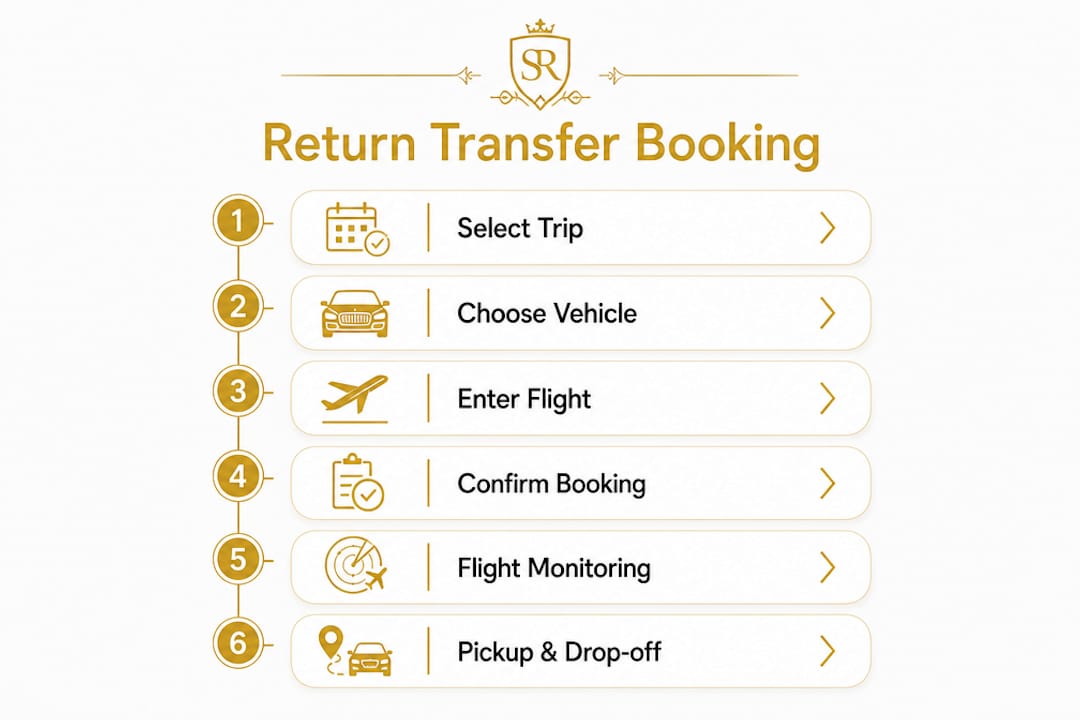
The most effective time to book your return transfer is at the same moment you book your outbound trip. Booking both legs simultaneously locks in the per-kilometer rate and activates flight monitoring for the return pickup. Waiting until you arrive at your destination to arrange the return leg exposes you to higher prices and reduced availability.
Follow this five-step checklist when booking:
- Confirm total price. Ask for a quote that includes all fees, tolls, surcharges, and waiting time. Do not accept a base fare only.
- Enter your flight number. This activates automated flight tracking and protects your return pickup from schedule changes.
- Choose the right vehicle. Account for the number of passengers and the total luggage count, not just the headcount.
- Check the change policy. Confirm how far in advance you can adjust pickup times and whether changes carry a fee.
- Save operator contact details. Store the driver’s number and the booking reference before you travel, not after.
After booking, reconfirm your details 24–48 hours before travel. Plans change, and a quick confirmation call or message catches errors before they become problems on travel day.
Additional tips for handling delays and changes:
- Contact the operator as soon as you know your flight is delayed, even if flight tracking is active.
- Request a written confirmation of any time changes, not just a verbal agreement.
- Keep your booking reference accessible on your phone, not only in your email inbox.
Pro Tip: The return trip booking workflow at Solidride allows you to book both legs in a single form, with vehicle selection and additional services confirmed in one transaction. This eliminates the risk of mismatched details between your arrival and departure bookings.
Основные выводы
A return transfer booking is the most reliable and cost-transparent way to secure ground transportation for both legs of any trip, with fixed pricing, flight monitoring, and confirmed availability protecting travelers from the most common travel-day failures.
| Пункт | Подробности |
|---|---|
| Definition of return transfer | One reservation covers both outbound and return legs with a locked price. |
| Pricing is fixed at booking | Six variables set the rate upfront, protecting you from surges and meter inflation. |
| Return leg carries more risk | Schedule pickups 30–60 minutes early to buffer against missed flights. |
| Hidden fees inflate base fares | Always request a total cost quote including tolls, surcharges, and waiting time. |
| Book both legs simultaneously | Booking together locks pricing and activates automated flight tracking for returns. |
Why I always book the return transfer first
Most travelers book their outbound transfer and treat the return as something to sort out later. I have seen that approach fail more times than I can count, and it almost always fails at the worst possible moment: the morning of a departure flight, when options are limited and prices are high.
The return leg is where the real risk lives. Your arrival pickup being late is annoying. Your departure pickup being late is a missed flight. Those are not equivalent problems, and they should not be treated as equivalent when you plan your transport.
What changed my thinking was watching a traveler at Tallinn Airport spend 40 minutes trying to arrange a last-minute ride on a busy Friday evening in december. Every on-demand option was either unavailable or priced at a premium. A pre-booked return transfer would have cost less and been waiting at the curb. The math was obvious in hindsight.
Flight tracking integration is the feature that makes return transfers genuinely reliable, not just convenient. When your flight number is in the system, the driver knows about your delay before you do. That is not a minor detail. That is the difference between a driver who is waiting when you land and one who has moved on to another job.
My recommendation: treat the return transfer booking as the first thing you confirm after your flights, not the last. The airport transfer booking process is straightforward when you approach it with a checklist. The cost of getting it wrong is not.
— Эрки
Solidride’s round-trip private transfer service
Solidride operates private chauffeur transfers 24/7 across Estonia, with a booking system that handles both outbound and return legs in a single form.

Every return booking includes real-time flight monitoring, meet-and-greet service, and luggage assistance. Vehicles are Mercedes-Benz V-Class, suited for individuals, families, and small groups with full luggage. Pricing is fixed at the time of booking, with no hidden surcharges added at pickup. If you want to understand why premium transfers outperform on-demand options for round-trip travel, the difference becomes clear the moment your flight lands and your driver is already waiting. Book your Tallinn private transfer directly through Solidride and confirm both legs before your trip begins.
Часто задаваемые вопросы
What does a return transfer booking include?
A return transfer booking covers both your arrival pickup and your departure drop-off under one reservation with a fixed price. Most providers include flight monitoring, meet-and-greet service, and luggage assistance in the confirmed booking.
How far in advance should I book a return transfer?
Book your return transfer at the same time as your outbound trip to lock in pricing and activate flight tracking. Experts recommend scheduling the return pickup 30–60 minutes earlier than you think necessary to buffer against unexpected delays.
Why is a fixed-price return transfer better than a metered taxi?
A fixed price locks your rate at booking, so traffic delays and demand surges do not increase your fare. Metered taxis and app-based estimated fares can change significantly based on real-time conditions.
What hidden fees should I check before confirming a return transfer?
Verify that your quote includes tolls, after-hours fees, waiting time charges, and any payment surcharges. A low base fare that excludes these costs often ends up more expensive than a higher all-inclusive flat rate.
Can I change my return transfer pickup time after booking?
Most private transfer providers allow time changes with advance notice, but policies vary. Always confirm the change and cancellation terms before booking, and request written confirmation of any adjustments you make.
Добавить комментарий