


A privacy-focused transfer is a chauffeur-driven private transfer that prioritizes passenger confidentiality, low visibility, and minimal personal-data exposure from booking to drop-off. If you’re a VIP, executive, diplomat, or private individual who can’t afford to be photographed at arrivals or have your itinerary circulate beyond a single trusted contact, this is the service you need.
Three trust signals tell you immediately whether a provider is serious: vetted and trained drivers, unmarked or low-profile vehicle options, and a written privacy policy or NDA available on request. Without all three, you’re paying a premium for a standard car service with a fancier name.
Immediate steps to take:
- Confirm the provider offers discreet vehicle options (no livery, no public name signs)
- Ask for a named single point of contact for your booking
- Request an NDA or confidentiality clause before sharing any itinerary details
- Verify driver vetting procedures in writing
Pro Tip: For last-minute bookings, call the dispatcher directly and state “discreet service required” at the start of the conversation. Providers who understand the request will know exactly what that means; those who don’t are a red flag.
Key Takeaways
A privacy-focused transfer is only as strong as its weakest link, and that link is almost always personnel or data handling, not the vehicle.
| Point | Details |
|---|---|
| Definition | A privacy-focused transfer combines a discreet vehicle, vetted driver, and contractual confidentiality from booking to drop-off. |
| Top vetting questions | Ask about driver background checks, NDA availability for subcontractors, and what data the driver actually receives. |
| Lead time matters | Private terminal access and NDA execution typically require at least 48 hours’ notice; Solidride and similar providers generally expect 48 hours for private terminal pickup or bespoke NDA arrangements. Last-minute bookings reduce options. |
| Fixed pricing is non-negotiable | Always get an all-inclusive written quote before travel; surge or per-minute pricing is incompatible with discreet planning. |
| Solidride for Estonia | Solidride offers unmarked vehicle options, private terminal pickup, flight monitoring, and NDA arrangements for transfers across Estonia. |
Table of Contents
- What sets a privacy-focused transfer apart from a standard private hire?
- Who actually needs a privacy-focused transfer, and when?
- How a privacy-focused transfer works from booking to drop-off
- How to vet a privacy-focused transfer provider before you book
- What you should expect to pay and how lead time affects your options
- Privacy and legal considerations for U.S. travelers booking transfers abroad
- What most privacy guides get wrong about discreet transfers
- Solidride covers the privacy-focused transfer checklist
- Sources
What sets a privacy-focused transfer apart from a standard private hire?
The gap between a standard private transfer and a genuinely privacy-focused one comes down to three layers: operational protocol, personnel training, and contractual commitment. Most premium car services cover the first layer adequately. Very few cover all three.
Operational features that distinguish the service:
- Meet-and-greet inside the arrivals hall, not curbside where cameras and crowds concentrate
- Flight monitoring by flight number, so the driver adjusts without you needing to communicate in public
- Fixed, all-inclusive pricing confirmed before travel, with no surge variables
- Driver details shared with the passenger before pickup, never posted publicly
- 24/7 dispatcher contact and a named backup driver on standby
Privacy-specific features:
- Unmarked vehicles with no company livery or roof signs
- No public name boards at arrivals; identification by phone call, discreet logo card, or agreed signal only
- Vehicle staged away from high foot-traffic areas when possible
- Booking details shared only on a need-to-know basis within the operator’s team
Industry service standards recommend activating discreet service explicitly at booking with a phrase like “Discreet service required,” which triggers the full protocol rather than leaving it to driver discretion.
Personnel and process:
Professional chauffeur training treats privacy as a core operational responsibility. Trained chauffeurs learn to recognize when conversation is welcome, avoid probing questions, disengage during sensitive discussions, and follow internal limits on what booking data is visible to them. NDA availability and device controls round out the personnel layer.

| Attribute | Standard private transfer | Privacy-focused transfer |
|---|---|---|
| Vehicle identification | Company livery, name board | Unmarked, discreet staging |
| Meet-and-greet location | Curbside or arrivals exit | Inside arrivals hall |
| Data handling | Booking details shared with driver | Need-to-know only |
| Contractual privacy | None standard | NDA or confidentiality clause available |
| Backup driver | Rarely confirmed | Named backup, confirmed in writing |
Who actually needs a privacy-focused transfer, and when?
The clearest candidates are high-profile executives, celebrities, diplomats, and private individuals whose movements carry security or reputational risk. But the category is broader than that. A corporate lawyer traveling with deal documents, a family managing a public estate matter, or a tourist who simply doesn’t want their hotel or schedule known to strangers all have legitimate reasons to book discreetly.
Concierge-grade accounts at luxury hotels routinely require no name disclosure, NDAs for principal movements, and SLAs that include flight tracking and named backup drivers. That standard has filtered down to anyone booking through a high-end property or travel manager.
Use cases mapped to discrete features:
- Airport-to-hotel for a high-visibility arrival: private terminal pickup, unmarked vehicle, inside meet-and-greet, no name board
- Corporate negotiation travel: single point of contact, NDA in place, driver limited to initials only, route kept confidential
- Event arrivals and departures: staged vehicle away from press areas, discreet boarding, confirmed departure window
- Multi-stop confidential itinerary: multi-stop planning with privacy measures applied across each leg, single dispatcher throughout
- Personal safety concern: contingency routing, backup driver confirmed, driver communication protocols in writing
For high-visibility arrivals specifically, private terminal pickup reduces public exposure at the point where it’s hardest to control.
How a privacy-focused transfer works from booking to drop-off
- Booking. Provide minimal identifying data. State “discreet service required” explicitly. Request an NDA or confidentiality clause if your itinerary is sensitive. Confirm a single named point of contact.
- Pre-trip confirmation. The dispatcher sends driver details (initials, vehicle description, contact number) through a secure channel. Flight and gate monitoring begins. Vehicle is assigned; backup driver confirmed.
- Arrival and staging. The vehicle is positioned away from main taxi ranks and high-traffic exits. The driver monitors your flight in real time, adjusting for delays without requiring you to call.
- Meet-and-greet. The driver meets you inside the arrivals hall using an agreed identification method: a discreet logo card, a phone call, or a pre-agreed signal. No public name board. Luggage is handled quietly.
- In transit. Quiet-cabin policy applies unless you initiate conversation. The driver does not discuss your identity, destination, or route with third parties. Alternate routing is available if the primary route is compromised or observed. Business travelers typically confirm driver communication protocols in writing before departure.
- Drop-off. The vehicle stages discreetly at the destination. Hand-off is low-key. On request, the operator confirms data deletion or limited record retention within a stated period after the trip.
Pro Tip: Ask the dispatcher to route any written confirmation of your itinerary through encrypted messaging rather than plain email. A provider who can’t accommodate that request is worth reconsidering.
How to vet a privacy-focused transfer provider before you book
Ask these questions directly, and expect written answers:
- What background checks do drivers pass, and how recently?
- Is an NDA or confidentiality clause available, and does it cover subcontractors?
- What data does the driver receive, and in what form?
- How is flight monitoring handled, and who contacts you if there’s a delay?
- What is the backup driver protocol, and is it confirmed in writing?
- What are your cancellation and modification terms for discreet bookings?
Trust signals to expect in writing:
- A published or shareable privacy policy
- SLA terms that name a backup driver and confirm written notification for any on-the-day changes
- Clear cancellation and modification rules specific to discreet bookings (these often differ from standard terms)
- Confirmation that driver data is limited to initials in public-facing communications
Red flags:
- Vague or verbal-only answers about data handling
- Insistence on a public name board at arrivals
- Driver receives full passenger name and hotel address as a matter of routine
- No written confirmation available for discreet measures
- Single driver with no named backup
Operational verification steps:
- Request driver initials only, not a full name, in any public-facing communication
- Ask for a vehicle description rather than a license plate when confirming pickup in a public space
- Insist on a single point of contact throughout the booking
Pro Tip: Before your first booking with a new provider, request a short signed confidentiality commitment, even a one-page letter, covering your name, itinerary, and the fact of service use. A professional operator will have a template ready.
What you should expect to pay and how lead time affects your options
Privacy-focused transfers carry a premium over standard private hire. The main cost drivers are vehicle class, unmarked or low-profile fleet requirements, NDA and contracting work, staffing a named backup driver, and any private terminal or FBO fees.
Lead time matters more than most travelers expect. Private terminal access, multi-stop confidential itineraries, and NDA execution generally require at least 48 hours’ notice. For private terminal pickup with Solidride and comparable providers, 48 hours’ notice is generally expected for bookings requiring this level of discretion or contract support. Last-minute bookings often reduce your discreet options and push the price higher, since the operator has less flexibility to stage vehicles and assign vetted personnel.
Always ask for a fixed, all-inclusive quote confirmed in writing before travel. Per-minute or surge-pricing models are incompatible with the predictability a discreet booking requires. Executive airport transfers that combine real-time monitoring, backup vehicles, and contingency routing are priced as a package, not assembled on the day.
When to expect surcharges:
- FBO or private terminal access fees
- Overtime for extended staging or delayed flights beyond a stated window
- Cross-border or city-zone permits for international legs
- NDA drafting or legal review if you require bespoke contract language
- Last-minute booking premium when discreet fleet options are limited
For staging and access control at pickup points, low-visibility vehicle positioning depends on the facility’s own access rules. Confirm this with your provider when booking private terminal or secured-lot pickups.
Privacy and legal considerations for U.S. travelers booking transfers abroad
U.S. travelers arranging transfers internationally face a short checklist of practical legal points worth confirming before signing anything.
Contract basics: Your NDA should define “Confidential Information” to include your itinerary, your identity as a passenger, and the fact that you used the service at all. A definition that covers only “business information” leaves the most sensitive details unprotected.
Flow-downs: Meaningful NDAs for executive travel require subcontractors and drivers to sign flow-down agreements or joinder clauses. If the operator subcontracts any leg, your confidentiality obligation must follow the chain.
Technical controls: Ask whether itinerary files are encrypted at rest and in transit (AES-256 and TLS 1.2+ are the current reference standards), whether staff devices are managed with mobile device management and remote wipe capability, and whether access to passenger details is restricted by role.
Operational practicalities:
- Limit who receives the full itinerary to one named contact
- Use initials or call signs in any public-facing communication
- Request certified deletion or destruction of records within a stated period after the trip
- Confirm the operator’s procedure if compelled by law to disclose your details
What most privacy guides get wrong about discreet transfers
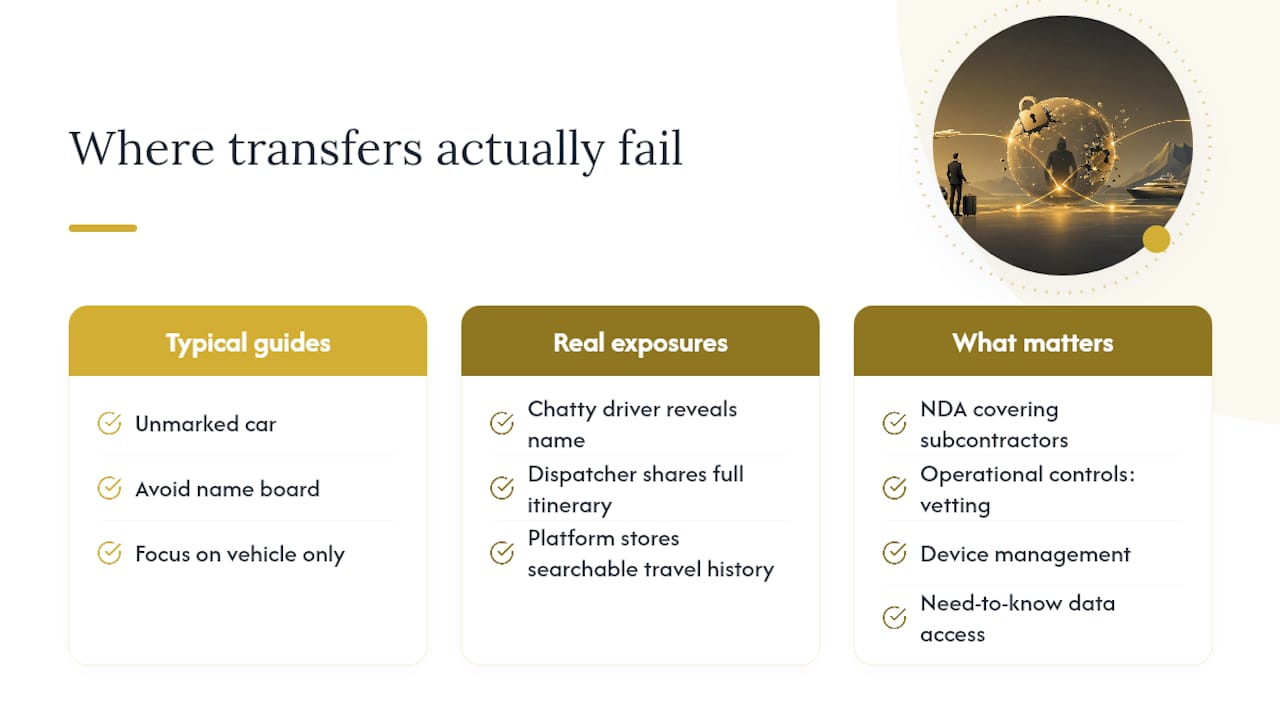
The standard advice focuses almost entirely on the vehicle: get an unmarked car, avoid a name board, done. That framing misses where most confidentiality failures actually happen.
The real exposure points are personnel and data, not the car. A driver who mentions a passenger’s name to a hotel doorman, a dispatcher who sends a full itinerary to three people who don’t need it, a booking platform that stores your travel history in a searchable database — these are the gaps that matter. An unmarked Mercedes with a chatty driver is not a privacy-focused transfer.
The second thing most guides underweight is contractual follow-through. An NDA that doesn’t cover subcontractors is nearly useless in a market where operators regularly subcontract legs to local affiliates. The operational controls (vetting, device management, need-to-know data access) are what give the contract teeth. Without them, you have a signed document and no enforcement mechanism.
For travelers in Estonia, the practical implication is straightforward: ask the provider to walk you through their data chain, not just their vehicle fleet. The answer tells you more than any brochure.
Solidride covers the privacy-focused transfer checklist
Solidride operates luxury chauffeur transfers across Estonia with the specific service elements a discreet booking requires: real-time flight monitoring, personalized meet-and-greet, multilingual drivers, Mercedes-Benz vehicles, and 24/7 availability. Private terminal pickup is available as a specialized option for arrivals that require reduced public exposure.

For discreet bookings, Solidride provides a single named point of contact, driver details shared securely before pickup, and NDA or confidentiality arrangements available on request. The fleet includes unmarked vehicle options, and the dispatcher operates around the clock to handle flight delays and contingency routing without requiring you to make public calls.
To book a discreet transfer with Solidride:
- Use the high-end transfer booking checklist to confirm your requirements before submitting a request
- State “discreet service required” in your booking message
- Include your flight number, preferred meet-and-greet method, and any NDA or data-handling requirements
- Allow at least 48 hours for private terminal access or bespoke confidentiality arrangements
Contact Solidride directly at Solidride to request a fixed-price quote and confirm discreet service options for your transfer.
Sources
- Service Standards — Driver, Discretion, Communication & SLA for Executive Transfers (IQPD)
- How Chauffeurs Maintain Discretion and Client Privacy | NJ Luxury Rides
- Why Business Executives Need Discreet LAX Airport Transfers
- Europe’s Palace Hotels: The Chauffeur Partnership Standard
- How NDAs Work for Travel: What Executives Must Negotiate | Experience Life PMA
Lisa kommentaar