


Agencies handle group transfer logistics by treating every move as an operations problem, not a booking. That means locking down scope and an exact passenger manifest, matching vehicles to real luggage and mobility needs, building in schedule buffers, watching flights and trains live, and keeping a standby vehicle ready before anything goes wrong. A provider like Solidride builds its entire group process around this same sequence, with real-time flight monitoring feeding dispatch decisions and a firm 60-minute buffer contingency rule protecting the schedule when something upstream slips.
The five control points that separate a smooth group transfer from a chaotic one:
- Scope and manifest — exact headcount, arrival windows, luggage volume, accessibility needs, pets
- Schedule and buffers — pickup windows built backward from hard deadlines, with at least one true 60-minute cushion
- Vehicle allocation — sized to luggage and passenger profile, not just seat count
- Live dispatch and contingency — flight tracking, standby vehicles, escalation rules
- Client communication — manifests, confirmations, and a single point of contact throughout
Inhaltsverzeichnis
- Defining scope and building the passenger manifest
- Sequencing pickups and building in the 60-minute buffer
- Matching vehicle class to the group’s real needs
- How agencies run the day: live tracking and dispatch
- Staffing roles and the meet-and-greet protocol
- What tools actually reduce risk on the day
- Pricing structure and contract terms to request
- Where group transfers break down, and how to stop it
- How SolidRide.ee applies this in practice
- When to hand group logistics to a turnkey provider
- Frequently asked questions
- Sources
Defining scope and building the passenger manifest
Every group transfer plan starts with five data points: group size, arrival and departure schedule, luggage volume, pickup location, and final destination. Skip any one of these and the rest of the plan is a guess. Charter a Coach’s group transfer framework treats this as the non-negotiable starting point, and for good reason. A vehicle sized for 12 people with carry-ons falls apart fast if six of those passengers show up with golf bags and a service dog.
Scope goes beyond headcount. Agencies also need to know the trip type (airport run, hotel loop, multi-stop event shuttle), whether timings are hard (a flight departure) or soft (a dinner reservation with flex), and whether any passengers need wheelchair access, car seats, or pet accommodations. VIPs get flagged separately, since they often need a dedicated vehicle rather than a shared shuttle slot.
The manifest is where all of this becomes usable. A workable one includes:
- Passenger name and mobile number
- Flight or train number and scheduled time
- Pickup terminal, door, or hotel entrance
- Luggage count and any oversized or fragile items
- Special needs (mobility, medical, dietary, pets)
- On-site contact or group leader designation
My Private Transfers calls this a one-page transfer brief, and it’s the single most effective coordination tool in group logistics. Once headcount goes past seven or eight, generic rideshare categories stop being an option anyway, so a purpose-fit vehicle plan becomes necessary rather than optional. Agencies also distinguish between soft numbers (an estimate at booking) and firm numbers (confirmed 48 to 72 hours out), often tying deposits to that confirmation window so vehicle capacity isn’t held on a guess.
Sequencing pickups and building in the 60-minute buffer
Once the manifest is locked, agencies work backward from the hard deadline. If an event starts at 6:00 PM, the last shuttle needs to depart with enough margin for traffic, loading time, and one unplanned stop. The rule of thumb: departure planning gets tighter buffers than arrival planning, because a late flight can be absorbed by a flexible pickup window, but a late arrival at a fixed-start event cannot.
This is where the 60-minute buffer becomes the backbone of the schedule. Agencies planning for groups of any real size reserve at least one true 60-minute contingency window somewhere in the day, whether that’s between the last pickup and the event start or built into the return-trip departure time. Without it, a single delayed bag claim turns into a missed window for everyone downstream. Industry veterans are blunt about this: a perfectly timed schedule is a myth, and the plans that actually hold up are the ones that assume something will run long.
Routing decisions follow a similar logic. When arrivals are spread across several hours, staggered pickups with smaller vehicles usually beat waiting for one consolidated run, since nobody sits idle in an arrivals hall for two hours. When arrivals cluster tightly, one larger vehicle or a coordinated fleet departure is more efficient. Hosts Global’s event transportation guidance also points out that grouping arrivals into defined time windows and using shuttle loops where appropriate cuts both cost and unnecessary vehicle idling.
A sample conversion from flight data to a working shuttle schedule looks like this:
Matching vehicle class to the group’s real needs
Vehicle allocation isn’t about counting seats. It’s about matching the vehicle to the trip’s outcome, whether that’s speed and direct terminal access for a small executive group or efficient consolidation for a larger event crowd. A Mercedes-Benz V-Class comfortably seats a small executive party with room for standard luggage, but the same group traveling with ski equipment, musical instruments, or a pet crate needs a different configuration entirely.

Agencies size up based on luggage and special items, not just passenger count. Count every checked bag, flag oversized items in advance, and confirm pet-friendly configurations before the day of travel rather than discovering the conflict curbside.
| Vehicle Class | Typical Passenger Range | Luggage Guidance |
|---|---|---|
| Executive sedan/SUV | 1–3 | Standard carry-ons only |
| Mercedes-Benz V-Klasse | 4–7 | Full-size luggage for each passenger |
| Minibus | above seven or eight | Moderate luggage, limited oversized items |
| Coach | more than eight | High luggage volume, dedicated storage bays |
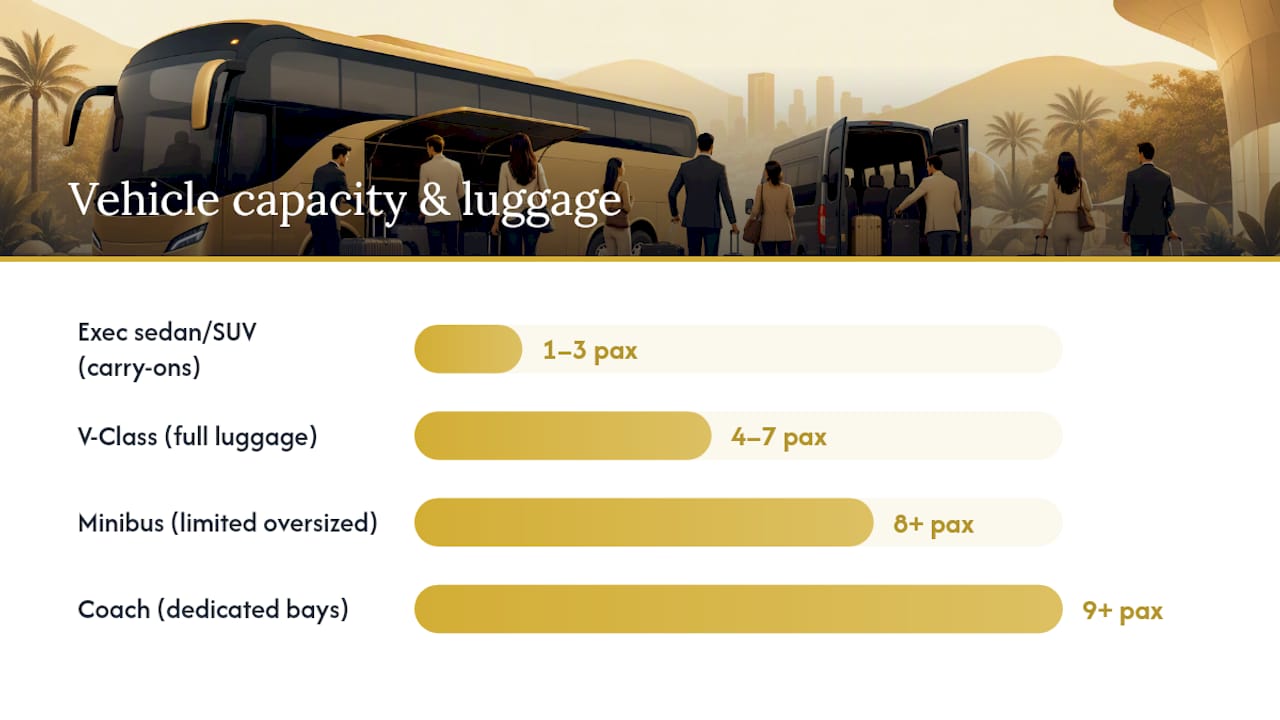
Amenities matter more than most planners initially budget for. Wi-Fi and reclining seats make sense for a long airport run; a restroom becomes relevant for multi-hour coach trips; luggage racks and pet crates need to be confirmed, not assumed. Ask any executive transport provider directly whether pet transport and oversized cargo are standard or an added request.
How agencies run the day: live tracking and dispatch
Real-time flight and rail tracking is what turns a printed schedule into a live operation. Dispatch software pulls flight status feeds directly, so a driver knows a plane landed 25 minutes late before the passenger even reaches customs. The dispatch workflow generally runs in this order:
- Delay detected. The tracking feed flags a flight or train running behind schedule.
- Threshold check. Dispatch checks whether the delay exceeds the built-in buffer (commonly the 60-minute window).
- Decision point. If the delay stays inside the buffer, the driver waits. If it exceeds it, dispatch reassigns the driver to another pickup and activates a standby vehicle.
- Passenger notification. A coordinator sends a short status update directly to the passenger or group leader.
- Confirmation and log. Timestamps, vehicle assignment, and passenger check-in get logged for the post-trip report.
A centralized command setup, combining live tracking, group messaging, and on-ground coordinators, cuts down the chaos of drivers fielding one-off calls mid-route, according to Hosts Global’s event logistics research. That single detail, a driver who isn’t juggling phone calls while navigating an unfamiliar drop-off zone, is often the difference between a smooth transfer and a stressed one.
Staffing roles and the meet-and-greet protocol
Group transfers need defined roles, not just bodies. A typical structure includes a dispatch coordinator managing the whole day, drivers assigned to specific routes, an on-site lead physically present at high-traffic pickup points, and at least one backup driver on call.
Before wheels turn, drivers get briefed on the route, the full manifest, any VIP or medical notes, luggage handling expectations, and language requirements for the group. My Private Transfers’ research on large-group logistics found that a terminal meet-and-greet for larger groups, rather than curbside-only pickup, saves time and significantly cuts confusion.
- Assign a physical representative inside the terminal for groups over eight passengers.
- Hold signage and mobile contact details visible from baggage claim, not just the curb.
- Route incident reports through one channel: driver flags the issue, dispatcher triages, backup vehicle or route change follows, and the planner gets notified last but promptly.
- Never rely on a venue name alone; confirm exact entrance, loading dock number, and curb-access time limits in advance.
What tools actually reduce risk on the day
The technology stack behind a group transfer isn’t complicated, but each piece removes a specific point of failure. A booking and quotation system handles the manifest intake. A dispatch and route optimization tool assigns vehicles and adjusts on the fly. Live flight or rail tracking feeds both of those systems automatically. Passenger messaging tools send status updates without tying up a phone line, and a reporting layer captures the day’s timestamps for after-action review.
The value shows up in the integrations, not the individual tools. A flight-tracking feed that pushes updates straight into the dispatch dashboard means a driver doesn’t need a phone call to know a flight landed. A confirmation system that texts passengers directly cuts the volume of “where’s my driver” calls dramatically. When evaluating a provider, ask specifically whether they support automatic flight status updates, two-way passenger messaging, and driver telemetry, since these three integrations account for most of the friction reduction in day-to-day operations. Multi-stop routing tools matter here too, particularly for event shuttle loops with several drop points.
Pricing structure and contract terms to request
Group transfer pricing usually breaks into a base rate, fuel surcharge, parking or toll fees, driver overtime for extended days, overnight accommodation if the driver stays over, and a cancellation window that determines refund eligibility.
QuatroBus’s group travel planning guide recommends requesting quotes from at least three providers and comparing every line item side by side, since a quote that looks cheaper upfront can hide costs in overtime or surcharges that only appear on the final invoice.
Beyond price, the contract itself should specify:
- Guaranteed vehicle class, not “similar or better”
- Standby vehicle terms and response time commitments
- Liability and insurance coverage limits
- Precise cancellation and refund windows, in writing
Reasonable SLAs to build into any proposal include an on-time arrival percentage target, a maximum response time for urgent day-of changes, and a post-event satisfaction report.
Where group transfers break down, and how to stop it
Most group transfer failures trace back to five recurring problems: a delayed flight that cascades into every later pickup, a passenger who can’t find the driver because of a vague meeting point, more luggage than the vehicle was sized for, a venue that denies vehicle access at the loading zone, and a staffing gap when one driver calls out sick.
Every one of these has a documented mitigation. A standby vehicle list absorbs delay without collapsing the rest of the day. A 60-minute buffer window keeps one late arrival from wrecking three other pickups. An arrival packet with the exact entrance name, loading dock number, and curb-access time limit prevents the day-of refusal that ruins a schedule at the last minute. A pre-confirmed luggage count avoids the moment a driver realizes eight suitcases don’t fit in a five-seat sedan.
Pro Tip: Build your buffer where the risk actually concentrates, usually the first pickup of the day, not evenly across the whole schedule. A 60-minute cushion at 7:00 AM protects everything downstream far more than the same 60 minutes split into three 20-minute pads later on.
How SolidRide.ee applies this in practice
SolidRide.ee’s group transfer process follows the same operational sequence outlined above, applied specifically to Estonia-based airport, hotel, and event transfers. Real-time flight monitoring feeds directly into dispatch decisions, multilingual drivers handle international groups without a language gap at the curb, and the fleet includes Mercedes-Benz V-Class vehicles for smaller executive groups plus minibuses for larger parties, with meet-and-greet and luggage assistance included as standard rather than an add-on.
When evaluating any provider for a group booking, including SolidRide.ee, ask for direct confirmation on these points:
- Do they monitor flights in real time, or rely on the passenger to report delays?
- Will a representative meet the group at baggage claim for parties over eight?
- What is their standby vehicle policy, and how fast can a backup deploy?
- Do they provide a written manifest confirmation before the travel date?
- What are their airport access credentials for terminal pickups?
My Private Transfers’ research recommends asking providers these exact questions before booking, and SolidRide.ee’s corporate transfer vendor selection checklist walks through each one in a ready-to-use format for planners running an RFP. The 60-minute buffer isn’t a marketing phrase here; it’s the standard contingency window built into every group quote, with the standby vehicle policy specified in writing rather than left as a verbal assurance.
Why contingency beats a perfect schedule every time
The instinct among newer planners is to build the tightest, most efficient schedule possible, minimizing dead time between every pickup and drop. That instinct is backward. The plans that actually survive contact with a real travel day are the ones built with slack, not the ones built with precision.
A flight delayed by 40 minutes doesn’t ruin a transfer plan that has a 60-minute buffer sitting between the last pickup and the event start. The same delay wrecks a plan with zero margin, because it cascades into every vehicle behind it. Automation helps here, flight feeds and dispatch dashboards catch the delay faster than a phone call would, but the actual save comes from a human coordinator who can make a judgment call: hold the vehicle, send the standby, or notify the client that the timeline shifted by fifteen minutes.
One practice worth insisting on regardless of provider: a single named coordinator for the entire event, reachable through one channel, who sends a final confirmation message the day before travel. That one message, more than any dashboard or app, is usually what prevents the “nobody told me the pickup moved” phone call at 6:00 AM.
When to hand group logistics to a turnkey provider
Coordinating a group transfer in-house works fine for a dozen people going to one hotel. It stops working once you’re juggling multiple flight arrivals, a VIP who needs a separate vehicle, and an event start time that can’t move. That’s the point where a turnkey provider earns its cost, because the coordination overhead of tracking six arrival times and two vehicle types by spreadsheet outweighs whatever you’d save doing it yourself.

SolidRide.ee runs group transfers with 24/7 support, meet-and-greet service, and a fleet that scales from a single Mercedes-Benz V-Class to a full minibus, with SLAs built around the buffer and standby policies covered throughout this guide. If you’re planning a group arrival, corporate event shuttle, or multi-vehicle transfer in Estonia, the high-end transfer booking checklist gives you a ready template to compare against any quote you’ve already received, and you can request a tailored quote directly from there.
What to demand from any transfer proposal
Agencies that handle group logistics well share a specific operational discipline: they treat the manifest, the buffer window, and the standby vehicle as fixed requirements, not optional upgrades.
| Punkt | Details |
|---|---|
| Require a full manifest | Names, flight numbers, luggage counts, and special needs should be confirmed in writing before travel day. |
| Insist on a written buffer policy | A 60-minute contingency window should be specified in the contract, not assumed. |
| Confirm standby vehicle terms | Ask for the response time commitment if a backup vehicle needs to deploy. |
| Verify live flight tracking | Dispatch should track arrivals automatically rather than waiting on passenger calls. |
| Compare SolidRide.ee’s checklist | Its vendor selection checklist covers each of these points in a format built for RFPs. |
Frequently asked questions
How do agencies handle group transfer logistics for last-minute headcount changes?
Agencies build in a confirmation window, usually 48 to 72 hours before travel, where the passenger count converts from soft to firm. Changes after that window typically trigger a vehicle reassignment fee or a shift to a larger vehicle class if capacity allows.
What’s the difference between a soft number and a firm number in a group manifest?
A soft number is the estimated headcount at booking, often used to reserve provisional vehicle capacity. A firm number is the confirmed count that locks in vehicle assignment and pricing, usually required a few days before the transfer date.
Why is the 60-minute buffer specifically called out instead of a shorter window?
Thirty minutes rarely absorbs a real flight delay or customs backlog, especially at larger airports. A 60-minute window gives dispatch enough room to make a genuine decision, hold the vehicle or send a standby, rather than reacting under pressure.
Do smaller private groups need the same logistics rigor as large event transfers?
The scale is smaller, but the same fields matter: exact headcount, luggage volume, and a confirmed pickup point. A four-person executive transfer in a Mercedes-Benz V-Class still benefits from flight tracking and a named coordinator, just without the multi-vehicle staging.
Sources
Planners building their own logistics checklist from scratch can pull directly from these operational guides:
- How to Build a Group Airport Transfer Plan – Charter a Coach
- How to Arrange Transport for Large Groups to & From Airports | My Private Transfers
- Group Transportation Checklist: 9 Smart Event Planning Tips
- How to Plan Group Travel by Bus: 6-Step Guide | QuatroBus
Einen Kommentar hinzufügen