


Ootetund transfeer means your booked private transfer can carry a billed waiting hour once a free allowance runs out. Most Estonian providers offer a short grace period, then charge hourly. Before you book, confirm the included waiting allowance in writing and choose a provider that tracks your flight in real time, since that single detail decides whether a delay costs you nothing or costs you dearly.
TL;DR:
- The free waiting allowance included in Estonia transfer bookings varies by provider, typically from 30 minutes to one hour, after which ootetund charges apply.
- Lower-cost taxi services usually charge around 12€ per hour for ootetund, while premium operators may charge over 25€ per hour with flight monitoring to prevent delays from incurring charges.
- Confirm your flight details, including delays and actual landing time, in writing before booking, and ensure your provider tracks your flight in real time to avoid unexpected charges.
- Additional costs such as ferry tickets, parking, driver overnight stays, or extra stops require explicit upfront written agreement to prevent surprises on the invoice.
- Using a premium provider with automatic flight tracking and meet-and-greet services significantly reduces the risk of ootetund charges caused by delays or miscommunications.
Inhaltsverzeichnis
- What Does Ootetund Mean in an Estonia Transfer Booking?
- Types of Transfer Services in Estonia and Which Suit Your Trip
- How to Book in Estonia Without Ootetund Surprises
- How Ootetund Is Billed: Local Rate Ranges and Worked Examples
- Pickup Expectations: Flight Tracking, Meet-and-Greet, and Arrival Timing
- Common Extra Charges That Show Up Alongside Ootetund
- Tips to Avoid Ootetund Surprises on Your Next Trip
- Erki’s Perspective: How SolidRide Handles Waiting-Time Edge Cases
- Book a Transfer With Ootetund Terms Spelled Out Upfront
- Sources
- FAQ
What Does Ootetund Mean in an Estonia Transfer Booking?
Ootetund is Estonian for “waiting hour,” and it shows up on nearly every transfer and taxi tariff page in the country. It refers to the per-hour fee a driver charges once your delay pushes past the free waiting time built into your booking.
The number itself varies a lot depending on who you book with. Standard taxi services tend to charge lower ootetund rates, with some examples listing around 12€ per hour. Premium and long-distance transfer operators charge more, with some sample fee pages listing +25€ per hour once the grace period ends.
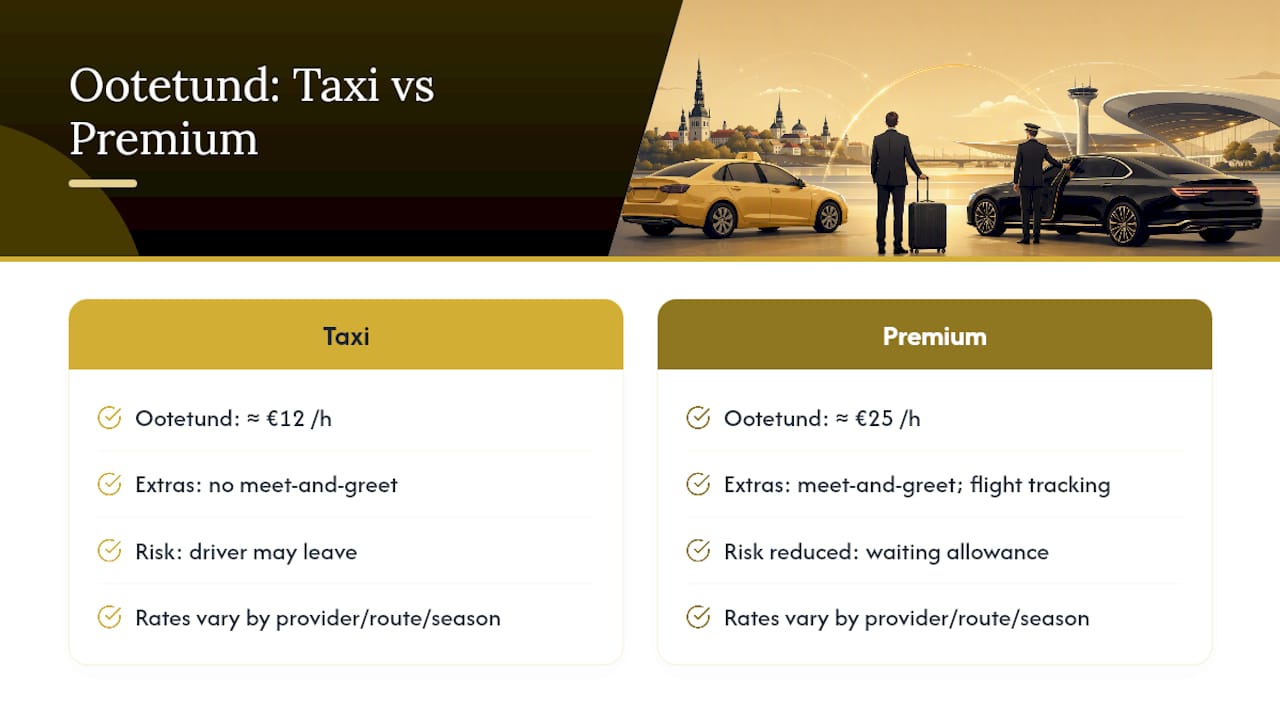
That gap matters more than it looks. A taxi’s low ootetund rate often comes with no meet-and-greet, no flight monitoring, and no guaranteed vehicle, so the “cheaper” wait can still cost you the transfer altogether if the driver leaves. A premium transfer with a proper waiting allowance and live flight tracking is built specifically to prevent that scenario. The pricing and booking notes at SolidRide spell out exactly how waiting time and extras get handled, which is the kind of clarity worth checking before you commit to any provider.
Types of Transfer Services in Estonia and Which Suit Your Trip
Estonia’s transfer market splits into a few clear categories, and picking the wrong one is usually what triggers ootetund frustration in the first place.
- Fixed point-to-point transfers work best for airport pickups, hotel runs, and city-to-city trips with a known start and end point. Pricing is set upfront, and any delay beyond the included allowance triggers the ootetund rate.
- Hourly or charter bookings suit multi-stop days, business meetings, or photo tours where the itinerary shifts. You pay for the driver’s time directly, so there’s technically no separate “waiting” charge since it’s already priced in.
- Group and minibus transport, including MB Sprinter service, fits events, corporate teams, or larger families where a sedan won’t cut it.
- Vehicle class matters too. A Mercedes-Benz V-Class handles groups and extra luggage; an E-Class or S-Class suits solo executives or couples who want a quieter, faster ride.
Long-distance island and border routes, such as trips toward Saaremaa or Narva, almost always run as fixed quotes rather than hourly, since the driver’s return trip and downtime need pricing upfront.
How to Book in Estonia Without Ootetund Surprises
A clean booking checklist prevents almost every ootetund dispute before it starts. Providers can only honor a free waiting allowance if they know your actual arrival details, so treat this exchange as non-negotiable.
- Give the provider your flight number, scheduled arrival time, passenger count, luggage volume, and any pets traveling with you.
- Share a live phone contact so the driver can reach you the moment you land, not twenty minutes later.
- Ask for the included waiting allowance in writing, along with the exact per-hour ootetund rate that applies after it expires.
- Request a full list of exclusions, such as parking, ferry costs, or driver overnight stays, so nothing appears as a surprise line item.
- Confirm the cancellation policy before you pay, especially if a deposit or full prepayment is required.
Payment timing affects this more than most travelers realize. Faster methods clear almost instantly, while standard ACH or bank transfers can take one to three business days depending on the bank and cutoff time. If your booking date is close, a slow transfer method could leave your reservation unconfirmed right when you need it locked in.
Pro Tip: Ask the provider to email your quote as an itemized breakdown, not a single total. A single number hides ootetund and extra fees; an itemized quote forces them into the open before you pay a cent.
For a printable version of this process, SolidRide’s private transfer booking checklist for Estonia travel walks through the same steps in a format you can screenshot before your trip.
How Ootetund Is Billed: Local Rate Ranges and Worked Examples
Ootetund billing in Estonia follows a fairly consistent pattern: a short grace period, then an hourly charge that starts ticking the moment that window closes. The size of the grace period and the rate that follows depend heavily on who you booked with.
- Standard taxi services often list ootetund at around 12€ per hour, reflecting their lower overall pricing structure.
- Some transfer operators charge +25€ per hour once free waiting time runs out, a rate that also tends to include extra fees for ferries or driver accommodation on longer routes.
- Premium services with flight monitoring built in tend to size the free allowance around actual arrival patterns, cutting the odds you ever pay ootetund at all.
Picture a flight delayed by 90 minutes past its scheduled arrival. If your transfer includes a 30-minute grace period, you’d owe roughly one hour of ootetund. At a 12€ rate, that’s about 12€. At a 25€ rate, closer to 25€. Neither figure is disastrous on its own, but stack a delay with a missed connection, extra stops, or a group waiting on late luggage, and the total climbs fast.
Market rate ranges shift by season and route, and providers set their own numbers, so treat any figure not tied to a specific rate page as a general estimate rather than a fixed cost. SolidRide’s own hinnakiri pricing page lists rates by vehicle class, which is the more reliable way to budget than relying on averages.
Pickup Expectations: Flight Tracking, Meet-and-Greet, and Arrival Timing
The single biggest lever against ootetund charges isn’t the rate itself. It’s whether the driver actually knows your flight is late before you do.
- Real-time flight monitoring lets a driver adjust pickup timing automatically, so a delayed landing doesn’t start the waiting clock at the originally scheduled time.
- Meet-and-greet service, typically included with premium transfers, means a driver holds a sign inside the arrivals hall rather than waiting curbside where you’d have to find them yourself.
- Where the driver waits changes the math: an arrivals-hall meet-and-greet usually starts the clock from your actual landing, while a curbside pickup can start it from your scheduled time regardless of delays inside customs or baggage claim.
- Ferry, train, and late-night arrivals carry more risk since public transit delays are less predictable than flight tracking. Confirm ahead of time whether the provider adjusts pickup windows for these routes.
Ask directly where your driver will be standing and what happens if your flight lands early or late. That one question resolves most disputes before they happen.
Common Extra Charges That Show Up Alongside Ootetund
Ootetund rarely travels alone. Several other variable costs tend to appear on the same invoice, and none of them should surprise you if you asked the right questions upfront.
- Ferry crossings for island routes toward Saaremaa or Hiiumaa often carry a separate ticket cost passed through to the client.
- Parking fees at airports, ports, or downtown pickup points add small but real charges over a full trip.
- Driver overnight accommodation applies to long-distance or multi-day routes where the driver can’t return same-day.
- Additional stops beyond the agreed itinerary, plus late-night or holiday premiums, can shift the final total noticeably.
Long-distance routes such as Tallinn to Narva or Tallinn to the Koidula border crossing typically require this kind of separate arrangement built into the fixed quote rather than bolted on afterward. The clearest way to avoid disputes is a direct question: “Does this quote include parking, tolls, and any ferry costs, or are those billed separately?” Get the answer in writing before you pay a deposit.
Tips to Avoid Ootetund Surprises on Your Next Trip
A few habits separate travelers who never think about ootetund again from those who argue about it at the curb.
- Get your included waiting allowance and the exact ootetund rate confirmed in writing, not just quoted verbally.
- Request a final all-inclusive price that names every excluded item explicitly, rather than assuming “the quote covers everything.”
- Share a working phone number and confirm whether the driver prefers a call, text, or WhatsApp message on arrival.
- Notify the provider the moment your schedule changes, even by 20 minutes; flight tracking helps, but a heads-up helps more.
- Choose a premium provider with flight monitoring and meet-and-greet built in whenever your itinerary has any uncertainty, like a connecting flight or a tight event schedule.
Pro Tip: If you’re arranging a group airport pickup, confirm ootetund terms per vehicle, not per booking. Multi-vehicle group trips sometimes have inconsistent waiting allowances across cars unless you specifically ask for matching terms.
For questions worth asking before you sign anything, SolidRide’s guide on avoiding ootetasu surprises covers six specific questions built for this exact situation.
Erki’s Perspective: How SolidRide Handles Waiting-Time Edge Cases
Most ootetund disputes I’ve seen trace back to one thing: nobody wrote down the waiting allowance before the trip. SolidRide’s standard process ties pickup timing to flight monitoring, so a delayed landing adjusts the driver’s schedule automatically instead of triggering a waiting charge from the original slot.
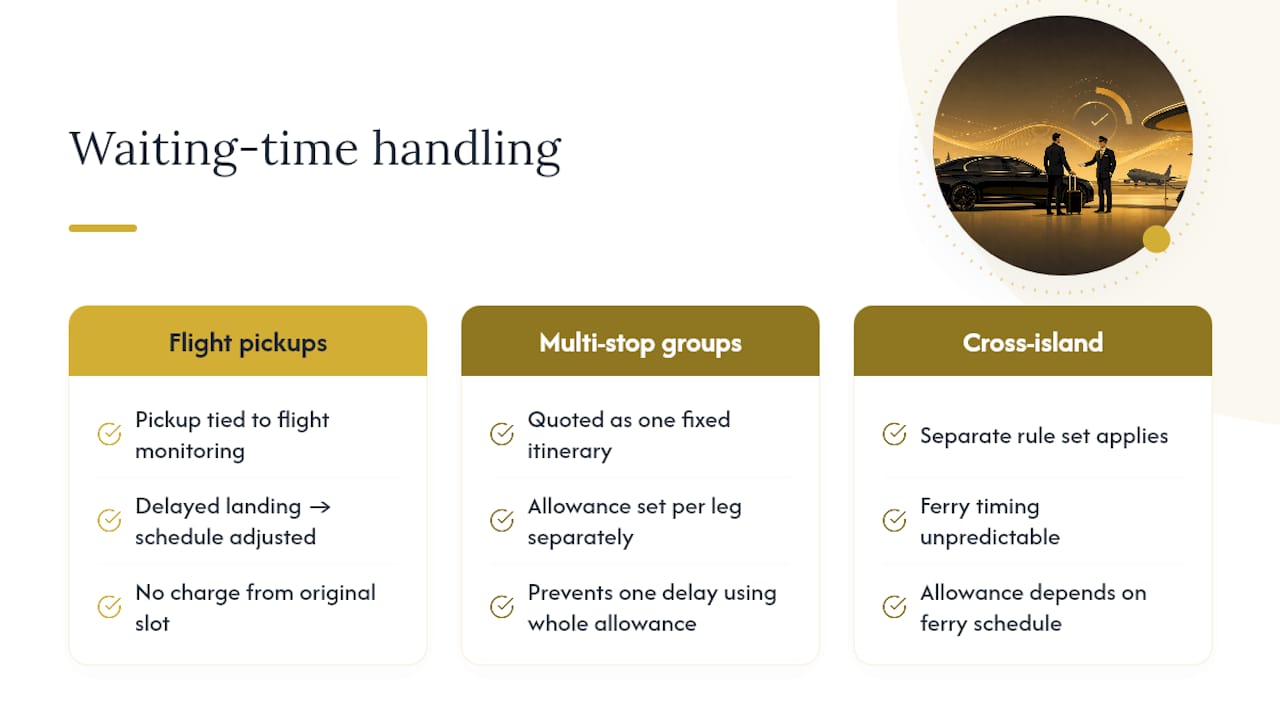
Multi-stop group itineraries are trickier. When a group needs an airport pickup plus a mid-route stop plus a cross-island leg, we quote it as one fixed itinerary with the waiting allowance built into each leg separately, not averaged across the whole trip. That avoids the awkward situation where one delayed passenger burns the group’s entire allowance.
Cross-island transfers toward Saaremaa or Hiiumaa carry their own logic too, since ferry timing is genuinely unpredictable.
— Erki
Book a Transfer With Ootetund Terms Spelled Out Upfront
Solidride is the fixed alternative to guessing at taxi rate pages or hunting through fine print on unfamiliar operator sites. Every vehicle class, from the Mercedes-Benz E-Class to the V-Class and S-Class, carries its own published hourly rate on the SolidRide pricing page, so you see the ootetund terms before you ever hand over a deposit.

Booking works the same way whether you need a one-way airport run, a return trip, a group transfer in an MB Sprinter, or a custom itinerary for a photo tour. You choose the vehicle, confirm passenger and luggage details, and get a quote that names the included waiting allowance and any extras like ferry costs or driver accommodation, rather than discovering them on the invoice. If your trip needs something outside the standard routes, Solidride’s booking page takes custom requests directly. Request your fixed quote now and ask specifically for the included waiting allowance in writing before you confirm.
Sources
FAQ
What Does Ootetund Mean Exactly?
Ootetund is the Estonian term for a billed waiting hour, charged once a transfer’s free waiting allowance expires. Rates vary by provider, with standard taxis often listing around 12€ per hour and some transfer operators charging +25€ per hour.
How Much Free Waiting Time Comes With a Standard Transfer?
Free waiting allowances vary by provider and route, and there’s no single fixed number across the market. Always confirm the specific allowance in writing before booking, since this detail determines when ootetund charges start.
Does SolidRide Charge Ootetund?
SolidRide’s pricing page lists rates by vehicle class along with notes on waiting time and extra charges. Confirm your specific allowance and rate directly through the pricing page or your booking confirmation before your trip.
What Extra Costs Usually Come With Long-Distance Transfers?
Long-distance and cross-island routes can include ferry fees, driver overnight accommodation, and tolls, depending on the trip. Request an all-inclusive quote that names these items explicitly so nothing appears unexpectedly on your final invoice.
Should I Pay a Deposit or the Full Amount Upfront?
Payment practices vary by provider, and the method you use affects timing. Faster payment methods clear almost instantly, while standard bank transfers can take one to three business days, so choose a method that confirms your booking well before your travel date.
Einen Kommentar hinzufügen