


Any corporate transfer vendor worth contracting must prove six things before you sign: current insurance certificates naming your organization as additional insured, documented 24/7 dispatch with live flight tracking, verified driver background checks and NDAs, consolidated invoicing mapped to your GL codes, a measurable on-time SLA of 95% or higher, and a written backup-vehicle protocol. A vendor that hesitates on any of these is not corporate-ready, regardless of how polished their website looks.
Use this checklist in your next RFP or vendor call:
- Insurance: Certificate of Insurance (COI) on file with appropriate commercial liability coverage for standard accounts and higher coverage recommended for executive-level travel; client named as additional insured
- 24/7 operations: Live human dispatch confirmed, not a call center that routes to voicemail after 9 PM
- Flight tracking: Automated monitoring with driver notification on delays, not manual check-ins
- Driver vetting: Background check within the last 12 months, commercial license, drug screening, signed NDA
- On-time SLA: Written commitment of 95%–99% on-time arrival with documented measurement methodology
- Backup vehicles: Standby unit available in market, escalation tree with named contacts and response times
- Invoicing: Consolidated monthly invoice with line-item detail by traveler, department, and cost center
- Account management: Named account manager with direct contact, not a general inbox
Solidride operates on exactly this model, covering airport, seaport, rail, and hotel transfers with private transfer benefits documented for corporate buyers.
Key Takeaways
A corporate transfer vendor must prove insurance, SLA performance, driver vetting, and invoicing capability before any contract is signed.
| Point | Details |
|---|---|
| Insurance floor | Require COI with $10M coverage for executive accounts; name your org as additional insured. |
| On-time SLA | Demand a written 95%–99% on-time commitment backed by a 30-day performance report. |
| Driver vetting | Background check, MVR, drug screening, and signed NDA are non-negotiable minimums. |
| Billing readiness | Consolidated monthly invoice with GL/cost-center detail is the corporate standard. |
| Solidride | Meets corporate-tier standards with 24/7 ops, flight tracking, NDAs, and named account management. |
Table of Contents
- Who should use this checklist and when?
- What service scope and operational capabilities should you verify first?
- Which fleet and passenger experience standards should you require?
- What driver vetting and insurance documents should you demand?
- What pricing, billing, and commercial terms should you confirm?
- Which contract clauses should you require before signing?
- How should you handle contingency and event coordination?
- How do you score vendor responses and run the final selection?
- What timeline and costs should you expect?
- What does onboarding look like after you select a vendor?
- What do real programs reveal that checklists miss?
- Solidride for corporate transfer programs
Who should use this checklist and when?
Four roles typically share ownership of a ground-transport vendor evaluation: the travel manager leads the operational assessment, the procurement lead owns commercial terms and contract review, the executive assistant or office administrator validates day-to-day booking workflows, and the event planner stress-tests contingency and group-movement capabilities.
Split the checklist accordingly. Route insurance and indemnity clauses to legal. Send invoicing and payment-term questions to finance. Keep driver vetting and SLA verification with travel operations.
Two practical approaches work well. The first: use the checklist as a phone-screening tool to cut a long list of eight vendors to three before issuing a formal RFP. The second: embed the checklist as a mandatory response section inside the RFP itself, requiring vendors to answer each item in writing with supporting documentation.
Pro Tip: Call the vendor’s dispatch line at 11 PM on a Sunday before shortlisting them. A genuine 24/7 operation answers with a live person who can pull up a booking. An automated system or a voicemail tells you everything you need to know.
What service scope and operational capabilities should you verify first?
Start with coverage, because a vendor that cannot serve your actual routes is disqualified before any other check matters.
Required service types to confirm:
- Airport pickups and drop-offs with flight monitoring
- Hotel-to-office and office-to-hotel transfers
- Seaport and rail station pickups
- Hourly chauffeur and full-day rates
- Event shuttles and group transfers with manifest management
- Team airport pickups for arriving delegations
For geographic coverage, ask whether the vendor operates directly or through affiliates. Direct operations give you cleaner accountability. Affiliate networks are acceptable only if the vendor can produce a written affiliate validation process and at least one recent affiliate audit report. Vague answers like “we have partners everywhere” are a red flag.
On dispatch: confirm that live flight tracking feeds directly to the driver’s device, that a human dispatcher is reachable at all hours, and that a documented escalation path exists when a driver goes unreachable. Request the contingency plan in writing.
Pro Tip: Ask the vendor to walk you through what happens when a flight diverts to an alternate airport at 2 AM. The quality of that answer tells you more than any marketing deck.
Which fleet and passenger experience standards should you require?
Vehicle age matters more than most buyers realize. For premium corporate accounts, request vehicles no older than three model years. The standard mix for a corporate-capable fleet covers executive sedans for solo travelers, premium SUVs for small groups or VIPs, and V-class minibuses for groups of five or more. Confirm luggage capacity in writing, not just seat count.
| Requirement | What to ask | Pass/fail signal |
|---|---|---|
| Vehicle age | Maximum model year on fleet | 3 years or newer for premium |
| Accessibility | WAV or ramp-equipped unit available | Confirmed unit, not “on request” |
| Pet-friendly | Dedicated vehicle option | Written policy, not verbal |
| Meet-and-greet | Name-board, lobby wait, baggage assist | Documented SOP |
| Driver language | English proficiency minimum | Verified, not assumed |
Meet-and-greet standards separate corporate operators from consumer services. The driver should be in the arrivals hall with a name board before the traveler clears customs, not circling the pickup zone. Baggage assistance and a low-profile pickup for executives requiring discretion should be standard, not an upsell. Review the vendor’s client-facing transfer protocols to understand what a documented standard looks like.
What driver vetting and insurance documents should you demand?
Insurance first. Request the COI before any other conversation. Confirm the policy is active, not expired, and that the coverage type matches ground transportation. Consumer auto policies do not cover commercial passenger operations. The corporate floor for executive-level accounts is $10 million combined single limit; $5 million is the minimum for standard business travel.
Driver vetting checklist:
- Criminal background check completed within the last 12 months
- Motor vehicle record (MVR) check, clean driving history
- Drug and alcohol screening on hire and random thereafter
- Valid commercial driver’s license or equivalent for the vehicle class
- NDA signed by the driver and covering dispatch staff
Premium operators report 99%+ on-time arrival rates and will provide documented performance numbers rather than marketing claims. Ask for a 30-day SLA report, not a testimonial page.
Pro Tip: Request the COI by email during the first vendor call and note how long it takes to arrive. A corporate-ready vendor sends it within 24 hours. Anything beyond 48 hours signals that documentation is not a priority.
Ask these three questions on every vendor call:
- “How often do you re-screen drivers, and can you share your screening policy?”
- “Are all drivers and dispatch staff covered by NDA? Can we see the template?”
- “What is your process when a driver fails a random drug test mid-contract?”
What pricing, billing, and commercial terms should you confirm?
Three pricing models are standard in corporate ground transport: flat-rate point-to-point for airport transfers, hourly chauffeur with a stated minimum (usually two hours), and event or day rates with volume discounts for multi-day programs. Understand fixed-rate transfer pricing before entering any negotiation.
Billing requirements to confirm:
- Consolidated monthly invoice, not per-trip receipts
- Line-item detail by traveler name, department, and GL/cost-center code
- Net-30 payment terms as the default; card billing as an option, not a requirement
- Integration with SAP Concur or equivalent corporate travel platform
Commercial red flags:
- Surge pricing applied without prior notice or contractual cap
- Fees added after booking (fuel surcharges, tolls, waiting time) not disclosed upfront
- Inability to produce a sample invoice on request
- Pressure to pay by consumer credit card rather than corporate account
If a vendor cannot show you a sample invoice within 48 hours of request, their finance operations are not built for corporate accounts. Consolidated invoicing with GL-code detail is a standard expectation for corporate accounts and directly reduces your finance team’s reconciliation burden.
Which contract clauses should you require before signing?
Contract essentials:
- COI naming your organization as additional insured, with current policy evidence attached at signing
- Indemnification clause covering vendor negligence, driver conduct, and third-party claims
- Force majeure clause with defined notification windows and service-recovery obligations
- Data retention and privacy terms covering traveler PII and itinerary data
- NDA scope explicitly covering chauffeurs and dispatch staff
Enforceable SLA terms:
- On-time arrival defined as driver present X minutes before scheduled pickup (typically 10–15 minutes)
- Billing accuracy SLA with a remediation credit if invoices contain errors above a defined threshold
- Written escalation path with named contacts and response-time commitments
Pro Tip: For sensitive accounts, ask whether the vendor offers restricted-access dispatch, meaning only named dispatchers can view the traveler’s itinerary. This is standard practice for C-suite programs.
Numbered clause checklist to paste into your MSA:
- Additional insured endorsement on COI, renewed annually
- On-time SLA of 95%+ with financial credit for breach
- NDA binding all drivers and dispatch staff
- Data privacy terms aligned with applicable law (CCPA, state equivalents)
- Termination for cause with 30-day cure period
- Quarterly performance review obligation
How should you handle contingency and event coordination?
For events, the stakes are higher because a single vehicle failure can strand a group of executives. Require written answers to these questions:
- How many standby vehicles do you maintain in market on event days?
- What is your driver redundancy protocol if a chauffeur calls in sick two hours before pickup?
- Who is the named on-site coordinator for events above a defined headcount threshold?
Event coordination requires on-site staff, venue walkthroughs, and manifest controls to keep group movements reliable. A vendor that has never done a site walkthrough before a major event is a liability. For multi-stop group logistics, review what a structured multi-stop transfer operation looks like in practice.
Pro Tip: Require a remote ops review or site walkthrough at least 30 days before any event with more than 20 travelers. Vendors who resist this have not staffed major events before.
Service recovery terms to include: a written incident report within 24 hours of any service failure, a remediation plan within 72 hours, and a quarterly review for accounts above a defined trip volume.
How do you score vendor responses and run the final selection?
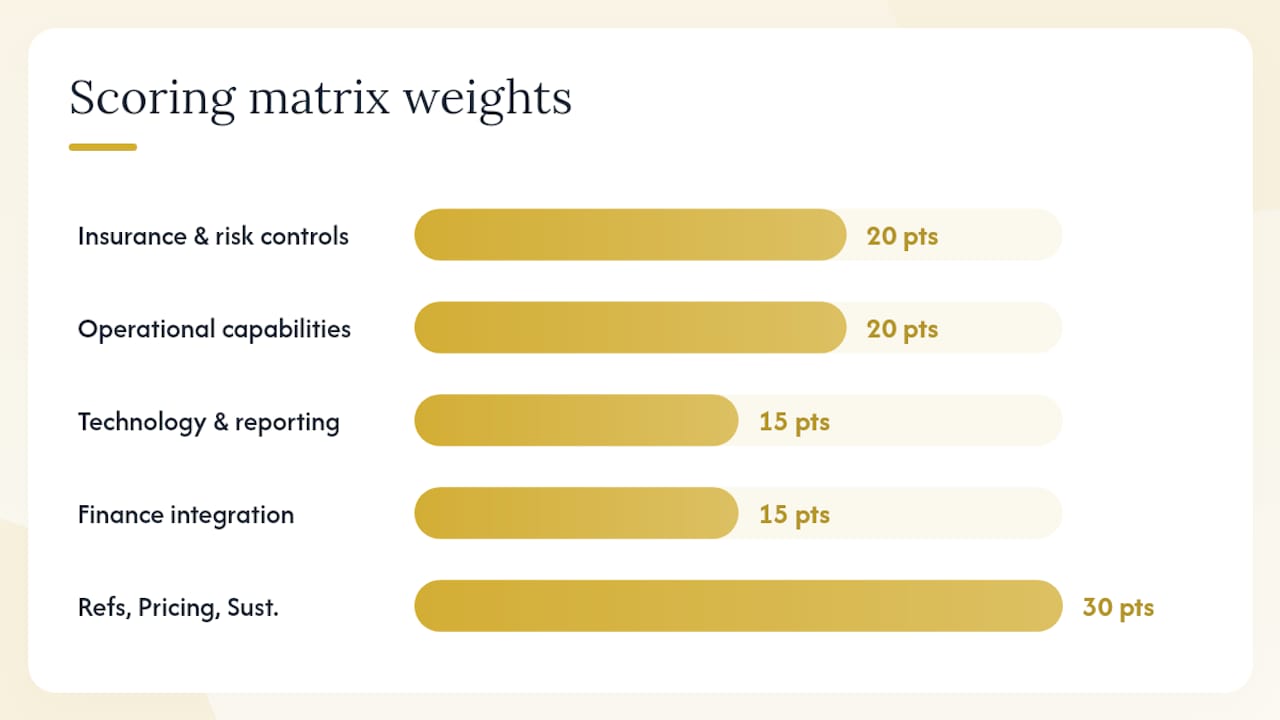
Use a 100-point scoring matrix:
- Insurance and risk controls: 20 points
- Operational capabilities (dispatch, flight tracking, backup): 20 points
- Technology and reporting (tracking, app, dashboards): 15 points
- Finance integration (invoicing, Concur, GL mapping): 15 points
- References and corporate experience: 10 points
- Pricing and commercial terms: 10 points
- Sustainability and other criteria: 10 points
Minimum RFP items to require in writing:
- Service scope and geographic coverage map
- Fleet list with vehicle ages and accessibility units
- Driver vetting policy and screening frequency
- COI and NDA templates
- Sample consolidated invoice
- 30-day on-time SLA report
- Escalation tree with named contacts
| Interview test | What it reveals |
|---|---|
| Night-call dispatch test | Genuine 24/7 vs. partial coverage |
| COI request timing | Documentation maturity |
| Sample invoice turnaround | Finance-system readiness |
| Reference call (3 questions) | Real corporate account experience |
Three reference questions that cut through polished answers: “Describe the last time a driver was late and what the vendor did.” “How does the vendor handle a billing dispute?” “Would you extend the contract?”
A structured RFP for corporate transportation should include scope, fleet requirements, SLAs, pricing templates, insurance documentation, and account management terms.
What timeline and costs should you expect?
Vetting timeline:
- Enterprise RFP with multiple vendors: 4–6 weeks from issue to award
- Regional or single-market evaluation: 2–3 weeks
- Contract terms: typically 1–3 years with annual review clauses
Primary cost drivers:
- Vehicle class (sedan vs. SUV vs. minibus)
- Airport fees, tolls, and parking passed through
- Wait time beyond the grace period (usually 30–60 minutes for flights)
- After-hours and holiday premiums
- Event staffing and on-site coordination fees
- Deadhead mileage for remote pickup locations
What delays vetting most often:
- Missing or expired COI that requires vendor to contact their broker
- Inability to produce a sample invoice in the requested format
- References who are unavailable or give vague answers
- MSA redlines that require multiple legal review cycles
What does onboarding look like after you select a vendor?
Documentation exchange:
- Signed MSA with all SLA and NDA clauses attached
- Current COI naming your organization as additional insured
- W-9 or equivalent tax documentation
- Account manager contact details and escalation tree
Operational setup:
- Configure GL/cost-center mapping in the vendor’s billing system
- Test booking workflow end-to-end with a pilot trip
- Validate that flight tracking updates reach the driver and your travel desk
- Confirm event ramp-up capacity for your first scheduled event
Governance from day one:
- Schedule the first quarterly review before the contract starts
- Define invoice reconciliation cadence (monthly, within five business days of period close)
- Set traveler feedback collection method and review frequency
For agencies and travel managers handling multiple accounts, fleet booking management practices apply directly to vendor onboarding and ongoing program governance.
What do real programs reveal that checklists miss?
The vendor that delivers all documentation within 24 hours of your first request is almost always the vendor that performs well operationally. It is not a coincidence. Document speed reflects internal process maturity, and process maturity is what keeps a driver at the right terminal at 5 AM.
The most common mistake procurement teams make is treating “app-based booking” as a proxy for corporate capability. Consumer ride platforms have apps. What they lack is a named account manager, a COI, consolidated invoicing, and an NDA. Those are the actual differentiators.
Affiliate coverage is the second blind spot. A vendor with a strong home-market operation and an unvetted affiliate network is a liability the moment your traveler lands in a city the vendor does not directly serve. Require the affiliate audit language in the contract, not as a verbal assurance.
Solidride for corporate transfer programs
Procurement teams that have worked through this checklist know what a corporate-ready transfer vendor looks like. Solidride meets that standard directly: 24/7 operations with live flight monitoring, Mercedes-Benz fleet maintained to premium age standards, named account management, consolidated invoicing, and driver NDAs as standard policy.

For event planners, Solidride handles group movements, hotel block transfers, and multi-stop itineraries with on-site coordination. For travel managers, the High-End Transfer Booking Checklist is a ready-to-use template you can adapt for your RFP or onboarding workflow. For buyers evaluating executive transport service types before issuing an RFP, Solidride’s service range covers airport, seaport, rail, and hotel transfers across its operating market.
Request a sample invoice, COI, and account onboarding checklist directly at Solidride.
Add a comment