


A fixed-rate transfer is a pre-booked private ride sold at a single, all-in price confirmed at booking — that fare does not change with traffic, time of day, or minor delays. You know the cost before you leave home. Beyond the price, the booking also reserves a specific vehicle, a named or dispatched chauffeur, and a scheduled time slot. Three operational signals separate a genuine fixed-rate service from a glorified taxi: real-time flight monitoring, a meet-and-greet at the arrival point, and commercial insurance covering the vehicle and passengers.
- Price certainty: The quoted fare is the fare you pay, regardless of road conditions.
- Reserved resources: A vehicle and chauffeur are held exclusively for your trip from the moment you book.
- Operational coverage: Flight tracking, meet-and-greet, and baggage assistance are standard with reputable providers.
Table of Contents
- What does a fixed price for a private transfer actually include?
- How does a fixed-rate transfer compare to taxis and ride-hailing?
- How do providers calculate the fixed price?
- What does the booking process look like, and what should your confirmation include?
- What operational signals tell you a provider is genuinely premium?
- How are delays, flight changes, and cancellations handled?
- Practical booking tips for corporate and luxury travelers
- How Solidride builds a reliable fixed-rate transfer from booking to drop-off
- Key Takeaways
- Why operational certainty is the real product
- Solidride: fixed-rate private transfers across Estonia, ready to book
What does a fixed price for a private transfer actually include?
Fixed-rate pricing typically covers the base fare, tolls, airport or congestion fees, applicable taxes, a meet-and-greet service, a defined free waiting period, and baggage assistance. Many providers also include gratuity in the quoted fare, though some list it as optional.
Standard inclusions:
- Base fare for the reserved route and vehicle class
- Tolls and road fees along the confirmed route
- Airport or terminal access fees
- Applicable taxes
- Meet-and-greet (driver waiting at arrivals with a name board)
- A set free waiting period (commonly 45–60 minutes for international flights, 30 minutes for domestic)
- Baggage assistance
- Flight monitoring for arrival transfers
Common exclusions or optional add-ons:
- Extra stops not in the original itinerary
- Waiting time beyond the included free period
- Oversized luggage, sports equipment, or pet carriers
- Last-minute vehicle upgrades
- Refreshments or in-car Wi-Fi (sometimes included at the luxury tier, sometimes priced separately)
A business-class sedan booking from an international terminal will typically include a longer complimentary wait than a standard vehicle on a domestic route. Always confirm the exact waiting window before you pay.
How does a fixed-rate transfer compare to taxis and ride-hailing?
The core difference is who carries the pricing risk. With a metered taxi or a ride-hailing app, the fare is calculated after the trip ends, and traffic, detours, or surge pricing can push it well above any estimate. A pre-booked fixed-price transfer transfers that risk to the operator.

| Service type | Pricing model | Price Certainty | Private vehicle | Flight Tracking | Best for |
|---|---|---|---|---|---|
| Fixed-rate transfer | All-in flat fare at booking | Guaranteed | Yes | Yes (arrivals) | Scheduled airport, station, port trips |
| Metered taxi | Per mile/minute + extras | None | Shared or private | No | Short, off-peak local hops |
| Ride-hailing app | Dynamic/surge pricing | Low | Shared or private | No | Flexible, unscheduled trips |
| Hourly chauffeur | Per-hour billing | Partial | Yes | Sometimes | Open-ended itineraries, city tours |
For executives catching an early flight or families arriving after a long-haul, the fixed-rate model removes every variable that could derail the schedule. Hourly chauffeur billing suits open-ended days; a metered taxi can work for a short, off-peak local errand. For anything with a fixed departure or arrival time, the flat-fare model is the rational choice.
How do providers calculate the fixed price?
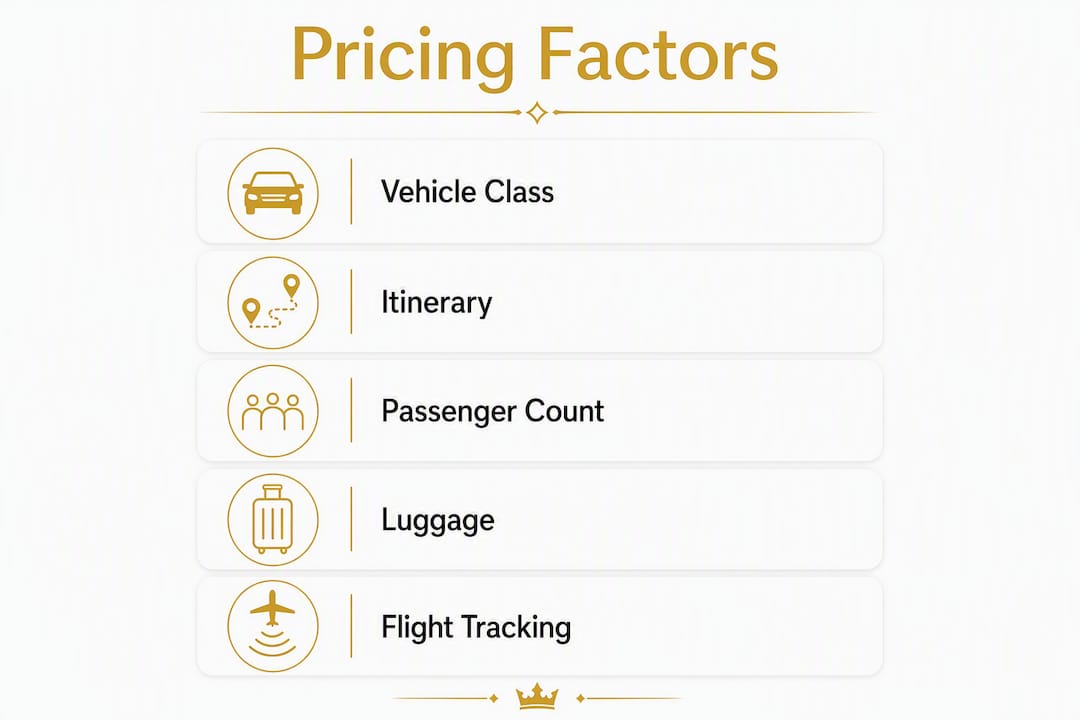
Operators build the fixed rate by estimating route time, expected idle and waiting periods, vehicle assignment, chauffeur labor, commercial insurance premiums, and dispatch overhead. The margin reflects reserving those resources exclusively for your trip, not just covering the miles driven.
Primary cost drivers:
- Distance and drive time on the confirmed route
- Vehicle class (sedan, executive SUV, minibus)
- Passenger and luggage count (affects vehicle size and loading time)
- Airport or terminal fees charged to the operator
- Tolls and local congestion charges
- Peak or holiday surcharges for high-demand periods
- Insurance and dispatch overhead baked into every booking
| Cost factor | Effect on fare | Notes |
|---|---|---|
| Vehicle class upgrade | Moderate to significant increase | Larger vehicle = higher operating cost |
| Extra passengers | Small to moderate increase | May require a vehicle category change |
| Peak/holiday period | Surcharge applied | Varies by provider and market |
| Additional stops | Re-quote required | Original fixed price no longer applies |
| Long waiting time (beyond free window) | Per-minute or per-hour charge | Threshold confirmed at booking |
A fixed itinerary is what makes accurate quoting possible. Operators need flight details, passenger counts, and luggage specifics to price correctly. Vague itinerary data produces vague quotes.
What does the booking process look like, and what should your confirmation include?
A proper fixed-rate booking follows a clear sequence:
- Submit itinerary details — pickup and drop-off addresses, date, time, flight number (for arrivals), passenger count, and luggage.
- Select vehicle class — sedan, executive SUV, minibus, or specialty vehicle.
- Receive and accept the fixed quote — the all-in fare with a breakdown of included components.
- Confirmation issued — a written document with a trip ID, fare breakdown, chauffeur contact or dispatch number, and waiting-time policy.
- Flight monitoring activated — for arrival transfers, the operator tracks your flight from this point.
What a solid confirmation document includes:
- Trip ID and booking reference
- Full itinerary (pickup address, drop-off address, date, time)
- Fixed fare with a line-item breakdown (base, tolls, fees, taxes)
- Free waiting-time allowance stated explicitly
- Cancellation and refund policy
- Chauffeur contact number or 24/7 dispatch line
- Confirmation that flight monitoring is active (for arrivals)
- Meeting point instructions (e.g., arrivals hall, name board)
Save the confirmation number, the driver contact protocol, and the terminal meeting point before you travel. These three details resolve almost every on-the-ground issue.
What operational signals tell you a provider is genuinely premium?
Marketing copy is easy to write. Operational accountability is harder to fake. Accountability is the primary differentiator for premium private transfers: commercial insurance, trained chauffeurs, dispatch oversight, and proactive communication.
Green flags:
- Proof of commercial vehicle insurance available on request
- Licensed, trained chauffeurs (not gig-economy contractors)
- Live flight tracking integrated with dispatch
- Written waiting-time allowance in the confirmation
- 24/7 dispatch line (not just a mobile number)
- Transparent fare breakdown at booking
- Meet-and-greet with a name board at arrivals
Red flags:
- Vague confirmation with no fare breakdown
- No mention of flight monitoring for arrival transfers
- Waiting-time policy buried or absent in the terms
- Meter or surge clauses hidden in the fine print
- Inability to provide insurance or licensing details when asked
Pro Tip: Before booking, ask two direct questions: “Do you monitor flights automatically?” and “What is the exact free waiting window?” A provider that hesitates or gives vague answers on either point is telling you something important.
Coordinated airport pickups depend on backstage logistics, not just a driver showing up. Dispatch oversight and flight tracking are what separate a professional operation from a car with a nice interior.
How are delays, flight changes, and cancellations handled?
High-end providers use automated flight-tracking integrations with their dispatch systems so a delayed flight automatically adjusts the pickup time. You do not need to call anyone. The driver is notified, the schedule shifts, and the fixed fare stays the same.
Common scenarios:
- Short delay (within the free waiting window): No action needed, no extra charge.
- Extended delay beyond the free window: Waiting-time charges apply at the rate stated in your confirmation.
- Flight diversion or significant schedule change: Contact dispatch immediately. The operator re-evaluates logistics; the original fare may be revised if the route or timing changes substantially.
- Passenger-initiated extra stop or route change: This triggers a re-quote. The fixed price applies to the reserved itinerary; a new destination or stop is a new operational commitment.
- Cancellation: Governed by the cancellation policy in your confirmation. Most premium providers offer a full refund for cancellations made well in advance; last-minute cancellations typically incur a fee.
Pro Tip: Confirm the exact free waiting threshold at booking, not at the airport. Knowing whether you have 45 or 60 minutes of covered wait time changes how you plan your exit from the terminal.
Practical booking tips for corporate and luxury travelers
Getting the most from a fixed-rate booking comes down to the details you provide upfront and the questions you ask before you pay.
Before booking:
- Confirm the exact meeting point (arrivals hall, specific gate, hotel lobby)
- Provide accurate passenger and luggage counts — an undercount can mean the wrong vehicle shows up
- Ask whether flight tracking is automatic or requires a manual call
- Request the chauffeur’s contact number or the 24/7 dispatch line
- Verify the free waiting-time window for your specific transfer type
Corporate-specific checks:
- Confirm VAT invoicing or company billing is available before you book.
- Ask for proof of commercial insurance and driver licensing if your company requires compliance documentation.
- Clarify add-on services (in-car Wi-Fi, refreshments, child seats) and whether they are included or priced separately.
- For group travel, verify the vehicle capacity against your actual headcount, including luggage.
Timing:
Book airport transfers at least 24–48 hours in advance. During peak travel periods (holidays, major conferences, summer season), book further ahead. Business travelers who book early also lock in the current fare before any seasonal surcharge applies.
For a private business trip transfer, the confirmation document doubles as a travel record. Keep it.
How Solidride builds a reliable fixed-rate transfer from booking to drop-off
Luxury transfer value comes from operational execution: disciplined coordination, not just a nicer vehicle as explained in this luxury transfer service guide. Solidride’s process illustrates what that looks like in practice.
At booking, Solidride collects the full itinerary — flight number, pickup and drop-off addresses, passenger count, and luggage details. That data drives vehicle assignment (Mercedes-Benz V-Class for most transfers, with minibus options for groups) and activates flight monitoring for arrival trips.
Operational commitments baked into every Solidride booking:
- Real-time flight tracking that adjusts pickup timing automatically
- Meet-and-greet with a name board at the arrivals point
- Baggage assistance from the terminal to the vehicle
- Commercial insurance and licensed, trained chauffeurs
- 24/7 dispatch with proactive communication on delays
- Multilingual drivers for international travelers
- Written confirmation with fare breakdown and waiting-time policy
The workflow from booking to drop-off: itinerary collected → vehicle assigned → flight monitored → driver dispatched ahead of landing → meet-and-greet at arrivals → baggage loaded → fixed-fare ride to destination → written receipt issued. No surprises at any step.
Key Takeaways
A fixed-rate transfer guarantees the fare, the vehicle, and the operational coverage at booking — price certainty and reserved resources together are what distinguish it from every on-demand alternative.
| Point | Details |
|---|---|
| Fixed fare means no surprises | The all-in price is confirmed at booking and does not change with traffic or minor delays. |
| Inclusions vary, so verify | Standard inclusions cover tolls, fees, meet-and-greet, and a waiting window — confirm the exact terms before paying. |
| Operational signals matter most | Check for commercial insurance, live flight tracking, and a 24/7 dispatch line before choosing a provider. |
| Changes trigger re-quotes | Extra stops or route changes after booking are legitimate grounds for a revised fare, not a hidden fee. |
| Solidride delivers the full package | Airport, station, seaport, and hotel transfers in Estonia with Mercedes-Benz vehicles, flight monitoring, and 24/7 dispatch. |
Why operational certainty is the real product
The most common mistake travelers make when comparing fixed-rate providers is treating the vehicle as the differentiator. It is not. Two operators can both put a Mercedes-Benz in front of you. What separates them is what happens before the car arrives: whether dispatch tracked your flight, whether the driver was briefed on your luggage count, whether someone is watching for a gate change at 11 PM.
The fixed fare is a contract for reserved resources and coordinated execution, not just a price cap. When a provider cannot show you proof of insurance, cannot confirm flight tracking is automatic, or cannot tell you the exact waiting-time threshold, the “fixed rate” is just a number on a screen. The operational infrastructure behind it is what makes the guarantee real.
For business travelers especially, the calculus is simple: the cost of a missed connection or a no-show driver far exceeds any fare premium. Book the provider that can prove the backstage work, not just the one with the lowest quote.
Solidride: fixed-rate private transfers across Estonia, ready to book
Solidride offers guaranteed flat-fare transfers between Tallinn Airport, railway stations, seaports, and hotels throughout Estonia, with a Mercedes-Benz fleet and 24/7 availability. Every booking includes real-time flight monitoring, meet-and-greet, baggage assistance, and a written confirmation with a full fare breakdown — the operational standards this guide describes, not just promised in marketing copy.

Corporate clients get VAT invoicing and compliance documentation on request. Groups, events, and custom routes are handled with a personalized quote. If you have read this guide and know what a properly executed fixed-rate transfer looks like, compare what Solidride offers against a standard taxi and see the operational difference in plain terms. Ready to book? Use the private transfer booking checklist to confirm every detail before your trip.
Add a comment