

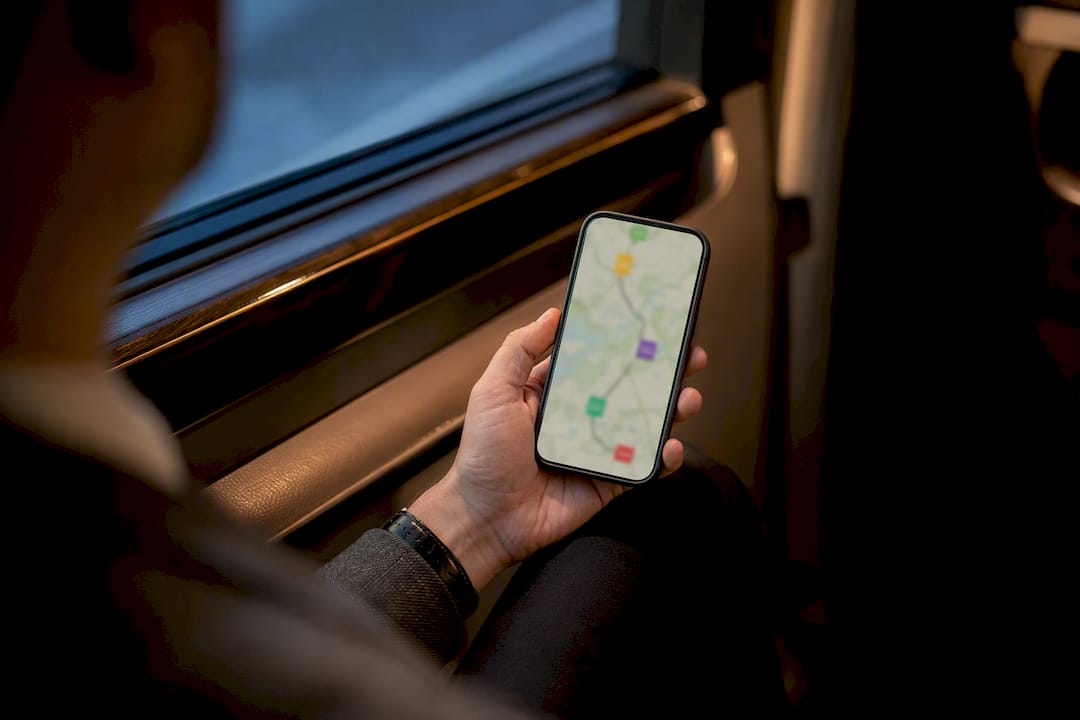
For a private transfer in Estonia where the itinerary has more than one stop, SolidRide is the practical choice: it builds routes around your actual schedule, tracks your flight in real time, and locks in a fixed quote before the Mercedes V-Class pulls up. That combination matters most when your trip has waypoints, not just an origin and destination. The booking checklist below walks through exactly how to request that kind of route and what to confirm before you pay.
TL;DR:
- Custom route transfers in Estonia handle multiple stops, with real-time flight tracking and fixed quotes to prevent unexpected charges.
- Vehicle choice depends on group size and luggage, with the Mercedes V-Class often optimal for up to seven passengers with multiple stops.
- Booking requires detailed waypoint information, flight or train numbers, and specific requests, with at least five to seven days’ lead time for complex trips.
- Prices vary based on vehicle class, distance, stops, surcharges for time/day, and extra services, so always insist on a written fixed quote before travel.
- Reliable providers offer secure online payment, clear cancellation policies, and the ability to issue proper invoices for business clients.
Table of Contents
- What Does a Kohandatud Marsruut Transfeer Actually Include?
- Choosing the Right Vehicle for a Multi-Stop Route
- How Do You Request a Custom Transfer Route?
- What Drives the Price of a Tailored Transfer?
- How Does Flight Tracking Change Pickup Logistics?
- What Should You Verify Before Booking?
- Airport, Seaport, and Train Station Pickups: What Changes by Location
- Group Transfers and Event Transport: Planning for More Than One Vehicle
- Confirming Your Booking: Quotes, Invoices, and What to Expect
- How Do You Evaluate a Transfer Provider Before Booking?
- What Does a Custom Transfer Actually Cost, Fees Included?
- When Should You Book a Custom-Route Transfer?
- Is It Safe to Pay Online for a Transfer Booking?
- When a Tailored Route Actually Pays Off
- Book a Custom Route Transfer With SolidRide
- Where to Verify Route Planning and Transfer Details
- Sources
- FAQ
What Does a Kohandatud Marsruut Transfeer Actually Include?
A kohandatud marsruut transfeer, or custom route transfer, is door-to-door transport built around your stops, not a fixed line between two points. The Estonian phrase is simply the local term for what the industry calls a personalized transfer service: a route designed around your schedule rather than a standard point-to-point fare.
That flexibility covers a specific set of features once you book it:
- Door-to-door pickup and drop-off with multiple waypoints in a single trip
- Scheduled wait times built into the quote, so a stop at a client’s office or a pharmacy doesn’t trigger a surprise fee
- Meet-and-greet at arrivals, with luggage assistance handled by the driver
- Pet-friendly seating and child seats on request
- Coordination for hotel changes, meeting reschedules, or an extra stop added mid-route
Operators translate your requested stops into a live driving route, and that route can shift. Road closures, construction on the Tallinn ring road, or a traffic backup near the port can force a detour. A well-run transfer service builds in buffer time and communicates changes rather than just showing up late. Event planners and photo tour groups tend to lean hardest on custom routing, often requesting scenic detours, extended waits at a venue, or a return leg that swings past a second hotel to collect more passengers.
Choosing the Right Vehicle for a Multi-Stop Route
Vehicle choice depends on group size, luggage volume, and how many stops you’re planning, not just passenger count. A route with five stops and heavy luggage needs more flexibility than a straight airport run, even with the same number of riders.
- Executive sedan: Best for one or two passengers with carry-on luggage and a simple two-point trip.
- Mercedes V-Class: Handles up to six or seven passengers comfortably with full luggage, and gives you the cabin space to make multiple stops without repacking the trunk each time.
- Minibus: Suited to larger groups, wedding parties, or event shuttles where headcount matters more than luxury cabin space.
Confirm three things at booking regardless of vehicle: whether the driver can accommodate a pet carrier, whether a child seat is available and for what age range, and whether the vehicle has step-in access if anyone in your group needs it. A V-Class often wins the multi-stop debate simply because it lets the driver stage luggage and equipment without unloading the whole vehicle at every waypoint.
How Do You Request a Custom Transfer Route?
Getting a route request right the first time saves a round of back-and-forth emails and reduces the odds of a driver missing a stop. Give the operator everything they need up front.
- Pickup address and exact time, including terminal or gate if it’s an airport run
- Every waypoint address, in the order you want them visited
- Passenger count and luggage volume (bags, oversized items, equipment cases)
- Flight, train, or vessel number for arrival tracking
- A working contact phone number and preferred language
- Special requests: pet carrier, child seat, wheelchair access, extra wait time at a stop
State route preferences plainly, whether that’s a scenic coastal road for a photo tour or a maximum drive time between stops. Operators can promise to prioritize your requested sequence, but they can’t promise zero deviation. Route tokens let you plan a sequence in advance, and navigation systems generally honor that plan unless live traffic or a closure forces a change.
Once you submit the request, expect a fixed quote, the driver’s name and vehicle details, and an estimated time of arrival. Flight tracking updates that ETA automatically if your flight is delayed, so the driver adjusts without you having to call.
Pro Tip: If you built your route on a desktop mapping tool before sending it to the operator, list the waypoints in a numbered sequence rather than a screenshot. Google’s own My Maps guidance notes that navigation apps can quietly swap in a faster alternative unless waypoints are explicitly forced, so a clear written order protects the sequence you actually want.
What Drives the Price of a Tailored Transfer?
Six factors set the price on a custom-route transfer, and none of them are fixed until you specify the route.
- Vehicle class (sedan, V-Class, or minibus)
- Total distance and estimated drive time
- Number of stops and how much waiting time each one needs
- Night, early-morning, or public holiday surcharges
- Extra services like child seats, pet accommodation, or multilingual drivers
- Group size, which can push you into a larger vehicle category
A one-stop airport run from Tallinn to the city center prices very differently from a four-stop corporate itinerary that includes a lunch meeting and a return to the airport eight hours later. Insist on a written fixed quote before the trip, especially for multi-stop bookings. A quote that only covers point-to-point mileage leaves room for a waiting-time surcharge to show up on the invoice later, and that’s the most common source of billing disputes on custom routes.
For timing, build in at least 60 to 90 minutes of buffer for international airport pickups to account for customs and baggage claim, and add 15 to 20 minutes per extra waypoint on an intercity run. Trustpilot hosts a running record of customer feedback on SolidRide.ee, which is a useful gut check when you’re deciding how much buffer time a provider’s punctuality track record actually warrants, according to reviews on Trustpilot.
How Does Flight Tracking Change Pickup Logistics?
Flight and train monitoring is what separates a reliable pickup from a guessing game. Share your flight or train number at booking, and the operator’s system watches for delays, gate changes, and early arrivals, adjusting the driver’s ETA automatically instead of leaving you to call and explain.
Meet-and-greet options vary by location and terminal:
- Arrivals hall pickup with a visible name sign
- Private terminal or executive lounge pickup for VIP arrivals
- Curbside pickup for train and seaport arrivals, timed to your scheduled arrival
Even with a planned itinerary, the actual driven route can diverge from what you mapped out. That’s normal, not a service failure. Google’s Navigation SDK documentation explains that route tokens set preferences and objectives, but the system still adapts for live traffic and road conditions. A good driver treats your requested stops as fixed and the road between them as flexible, rerouting around a jam on the Pärnu highway without dropping a single waypoint you asked for.
What Should You Verify Before Booking?
A handful of concrete, checkable facts separate a professional operator from a driver moonlighting with a personal car. Before you hand over a deposit, confirm the following:
- 24/7 availability, not just daytime hours
- A Mercedes V-Class or comparable fleet, not a generic sedan pool
- Real-time flight monitoring built into the booking process
- A fixed quote in writing before the trip, not an estimate that can change on arrival
- Invoicing suitable for business clients (needed if you’re billing this to a corporate travel budget)
- Pet-friendly options if you’re traveling with an animal
Ask specific questions when you book: the driver’s name, the vehicle model and plate number, the policy on wait time before a “no-show” charge kicks in, and the cancellation window on your invoice. SolidRide’s own private terminal pickup guide spells out exactly what meet-and-greet looks like at Estonian airports, which is worth reading before your first booking so you know what to expect at the gate.
Airport, Seaport, and Train Station Pickups: What Changes by Location
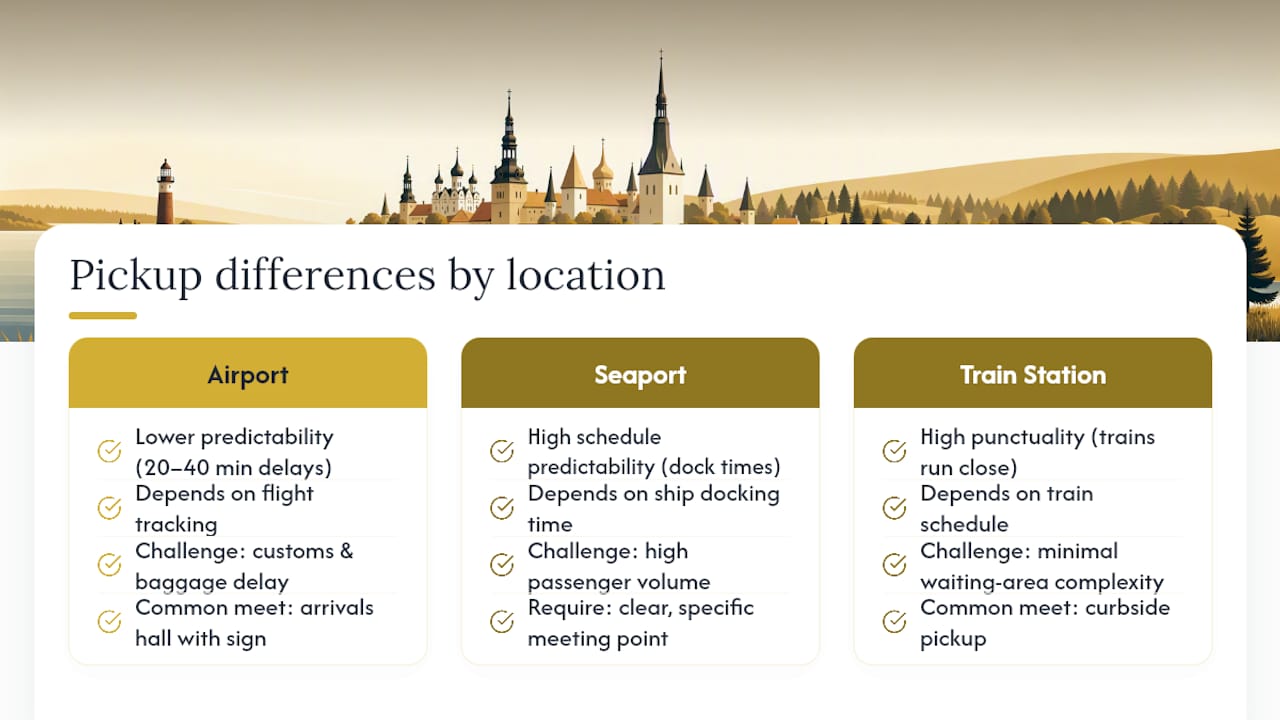
Each pickup location carries its own logistics, and a route built for one doesn’t automatically work for another. Airport pickups depend heavily on flight tracking, since international arrivals routinely run 20 to 40 minutes behind schedule once customs and baggage claim are factored in. A driver holding a name sign in the arrivals hall works for most travelers, but VIP clients or corporate groups often request a private terminal option instead, avoiding the general arrivals crowd entirely.
Seaport pickups, common for cruise passengers arriving in Tallinn, run on a tighter and more predictable schedule since ships dock at set times, but the challenge is volume. Multiple ships can disembark thousands of passengers within the same hour, so a driver needs a clear meeting point, not just a general “port area” instruction.
Train station pickups are usually the simplest of the three. Trains run close to schedule, and curbside pickup at Tallinn’s Baltic Station or a regional stop rarely involves the waiting-area complexity of an airport.
The common thread across all three: give the operator the exact arrival details (flight number, ship name and dock time, or train number) and confirm the pickup point in advance, especially at larger terminals with multiple exits. A multi-stop transfer guide is useful reading if your trip combines two of these, such as a seaport pickup followed by a train station drop-off later the same day.
Group Transfers and Event Transport: Planning for More Than One Vehicle
Group bookings and event transport work differently from a single custom route because they usually involve coordinating multiple vehicles arriving and departing on a shared schedule. A wedding party, a corporate offsite, or a multi-day photo tour with a rotating group of travelers needs a dispatcher’s mindset, not just a single driver following a map.
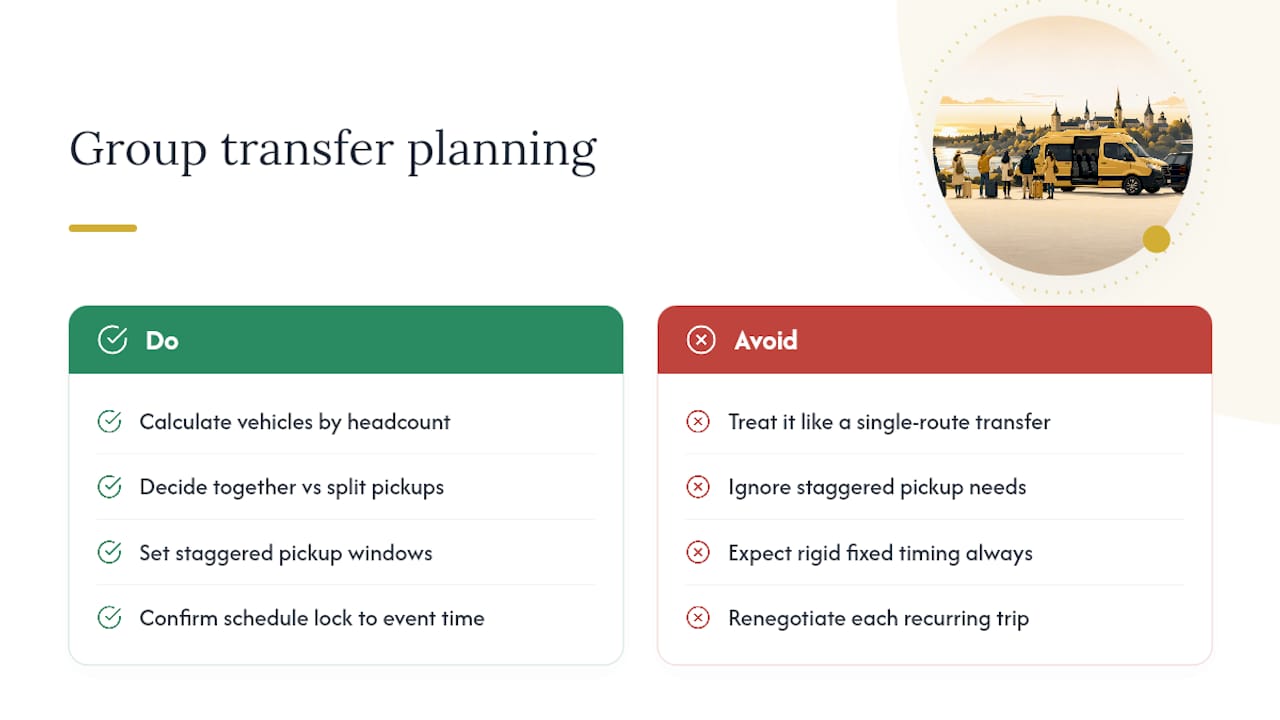
The core planning questions for group transport: how many vehicles are needed based on headcount, whether the group travels together or splits across pickup points, and how tightly the schedule is locked to an event start time. A conference shuttle running guests from three hotels to a single venue needs staggered pickup times so the last vehicle doesn’t leave people standing in a lobby for 30 minutes.
Event-specific transport, including photo tours and guided expeditions, often adds a layer that standard transfers don’t: the vehicle isn’t just moving people from A to B, it’s part of the day’s itinerary, with planned stops for shooting locations or scenic overlooks built into the schedule itself. That requires a driver comfortable with flexible timing rather than a fixed drop-off and pickup.
For corporate clients booking recurring group transport, ask about consistent invoicing across multiple trips rather than negotiating a new price each time. SolidRide’s guide on managing fleet bookings for travel agencies covers how larger bookings get coordinated when a single event needs several vehicles running in parallel.
Confirming Your Booking: Quotes, Invoices, and What to Expect
A completed booking should leave you holding three things: a fixed price, a named driver and vehicle, and a confirmation you can reference if anything goes wrong. Vague verbal pricing is the biggest red flag in this industry, particularly for multi-stop routes where the temptation to add a surcharge later is highest.
For business clients, invoicing matters as much as the ride itself. A transfer booked for a corporate trip needs a proper invoice that a finance department can process, not a handwritten receipt. Confirm before booking whether the operator issues invoices suitable for expense reporting and whether they can bill a company account directly for recurring trips rather than requiring a new payment each time.
The confirmation itself should arrive promptly after you submit your request, typically within a few hours for standard routes, and should include the driver’s name, vehicle model and plate number, and the exact pickup time and location. If your flight number is on file, the confirmation should also note that the pickup time will adjust automatically for delays.
Keep that confirmation accessible on your phone. If a driver is running late or a pickup point is unclear at a large terminal, having the booking reference and driver contact on hand resolves the issue faster than searching through email. SolidRide’s booking workflow guide breaks down exactly what information gets exchanged at each stage, from initial request to final confirmation.
How Do You Evaluate a Transfer Provider Before Booking?
The strongest signal of a reliable provider is whether their claims are checkable, not whether their marketing sounds polished. Anyone can advertise “luxury” and “premium,” but few operators publish specific, verifiable details.
Look for these concrete markers when comparing providers:
- A licensed passenger transport operation, not an unregistered private arrangement
- A specific, named vehicle fleet (model and class, not just “executive cars”)
- Published availability hours, ideally 24/7 rather than business hours only
- Independent customer reviews you can read before booking
- A clear, written pricing structure rather than “contact us for a quote” with no further detail
Independent customer reviews are worth the five minutes it takes to read them. Trustpilot reviews for SolidRide.ee give you a way to check what past customers actually experienced, rather than relying only on the provider’s own marketing copy, based on feedback published on Trustpilot.
Ask direct questions before you commit: What happens if my flight is delayed by three hours? Is there a cancellation fee, and how close to pickup time does it apply? Will the same driver handle both legs of a return trip, or is that assigned separately? A provider that answers these clearly and specifically, rather than deflecting to generic reassurance, is the one worth trusting with a multi-stop itinerary. SolidRide’s comparison of top Estonia transfer providers is a useful reference point if you’re weighing several options side by side.
What Does a Custom Transfer Actually Cost, Fees Included?
A realistic total cost estimate has to include more than the base fare. Beyond the core price driven by distance, vehicle class, and stop count, watch for these common additions: night surcharges for pickups between roughly 11 PM and 6 AM, holiday pricing during major Estonian public holidays, extra-stop fees if you add a waypoint after the quote is issued, and waiting-time charges if a flight is delayed well beyond the buffer built into the original quote.
Cancellation policies deserve the same scrutiny as pricing. Most reputable operators allow free cancellation up to a set window before pickup, often 24 hours for standard trips, with a partial or full charge applying closer to the scheduled time. For multi-stop bookings involving several vehicles, that cancellation window sometimes extends further out, since rescheduling a coordinated group trip takes more logistical effort than canceling a single car.
The safest approach: get every fee in writing before the trip, including what triggers a surcharge and what the cancellation deadline is, rather than assuming verbal terms will hold. SolidRide’s breakdown on why premium transfer beats a taxi covers how fixed-quote pricing on a private transfer compares to the meter-based uncertainty of a standard taxi ride, which is a useful comparison if cost predictability is your main concern.
When Should You Book a Custom-Route Transfer?
Lead time matters more for custom routes than for a standard airport pickup, simply because there’s more to coordinate. For a single-stop transfer, booking 24 to 48 hours ahead is usually enough. For a multi-stop route, a group transfer, or an event with several vehicles, aim for at least five to seven days of lead time so the operator can confirm vehicle availability and, if needed, arrange additional cars.
Peak seasons compress that window further. Summer weekends, major conferences, and holiday periods around Christmas and New Year’s see higher demand across Tallinn’s transfer market, and last-minute requests during those windows are more likely to face limited vehicle choice or a higher price. If your trip falls during one of those periods, book as early as your schedule allows.
For same-day or next-day requests, most operators can still accommodate a standard airport or city transfer, but a complex multi-stop itinerary booked with only a few hours’ notice limits how much customization is realistically possible. If you know your route in advance, even a rough outline of stops submitted early gives the operator time to plan around traffic patterns and confirm timing, rather than improvising the day of.
Is It Safe to Pay Online for a Transfer Booking?
Payment security comes down to two things: how the operator collects payment and what happens if your plans change after paying. Most Estonian transfer services accept card payment through a secured online booking form, with some also offering invoice-based payment for corporate accounts settling after the trip.
Before entering payment details, confirm the booking page uses secure encryption (look for the padlock icon and “https” in the browser address bar) and that the confirmation email includes a clear reference number tied to your specific booking. Avoid any provider that asks for payment through an unsecured link or a direct bank transfer with no invoice or booking confirmation attached.
For business travelers, ask specifically about invoice-based billing rather than upfront card payment, since many corporate travel policies require a formal invoice for expense reporting rather than a personal card charge. A provider that can issue that invoice cleanly, tied to a documented booking, is generally the safer choice for recurring corporate travel. If you’re booking on behalf of a company, SolidRide’s guide on private transfers for business trips covers how invoicing and account-based billing typically work for corporate clients.
When a Tailored Route Actually Pays Off
The travelers who benefit most from a custom route aren’t the ones doing a simple airport run. They’re the business travelers stacking three meetings into one afternoon, the event planners shuttling guests between a hotel and a venue on a tight schedule, and the photographers or tour groups who need the vehicle to wait at a location, not just drop off and leave.
The mistake I see most often isn’t in the booking form. It’s travel planners assuming a driver can “figure it out” once they see the waypoints, rather than specifying the order and timing up front. A route with five stops and no stated sequence invites the exact kind of reshuffling that turns a smooth day into a late one. Write your stops down, in order, with rough timing, before you submit the request. If you’re building a longer multi-stop itinerary, the booking checklist covers the fields worth filling in before you hit submit.
— Erki
Book a Custom Route Transfer With SolidRide
If you’ve made it this far, you already know what a good custom-route transfer needs: a real fixed quote, a driver who tracks your flight instead of guessing at your arrival time, and a vehicle that fits your group without three trips to load luggage. SolidRide runs on Mercedes V-Class vehicles built for exactly that kind of multi-stop flexibility, backs every quote in writing before you travel, and issues proper invoices if you’re billing the trip to a business account.

Booking takes a few minutes: submit your pickup details, waypoints, and flight or train number through the online form, and you’ll get a fixed quote and driver details back before you need to confirm anything further. If your trip has more than one stop or you’re coordinating transport for a group, start with the high-end transfer booking checklist to make sure every detail the driver needs is in the request the first time.
Where to Verify Route Planning and Transfer Details
For readers who want to dig into the mapping side of custom routes, Google’s Navigation SDK documentation covers how route tokens and objectives work, and Lifewire’s My Maps guide explains building multi-stop routes on desktop. For the operational side, this dispatch guide on flight-tracking workflows breaks down how pickup coordination actually works behind the scenes.
Sources
- Plan a route | Navigation SDK for iOS | Google for Developers
- Use Google My Maps to Send a Custom Route to Your Phone
- Trustpilot
FAQ
What Is a Kohandatud Marsruut Transfeer?
It’s a custom route transfer, a private transfer built around your specific stops and schedule rather than a fixed point-to-point route, common for multi-stop trips and event transport in Estonia.
How Far in Advance Should I Book a Custom-Route Transfer?
Book a single-stop transfer 24 to 48 hours ahead, and give multi-stop or group transfers five to seven days of lead time, especially during peak travel seasons.
Does SolidRide Track Flights for Airport Pickups?
Yes, SolidRide monitors flight arrivals in real time and adjusts the driver’s pickup timing automatically if a flight is delayed or arrives early.
What Vehicle Should I Choose for a Multi-Stop Trip?
A Mercedes V-Class typically works best for multi-stop routes with up to six or seven passengers and full luggage, while larger groups should look at a minibus.
Can I Get an Invoice for a Business Transfer Booking?
Yes, business clients can request invoices suitable for expense reporting, and recurring corporate bookings can often be billed to a company account directly.
Add a comment