

Bank links, card payments through Visa and Mastercard, and mobile wallets like Apple Pay and Google Pay are the standard makseviisid transfeeris — the payment methods for transfers — across Estonia today. Cards and wallets give you chargeback protection if a prepaid ride never shows up, while cash still works for small extras but falls under the country’s coin rounding rule. These payment methods cover most transfer providers in Estonia, so the booking steps below apply whether you are arranging one ride or a full itinerary.
TL;DR:
- Card and mobile wallet payments provide a safer dispute process through chargebacks if prepaid transfer services are not delivered as promised.
- Cash transactions are subject to a five-cent rounding rule, which does not affect card or mobile payments, so paying by card ensures accurate charges.
- Most digital transactions in Estonia account for over half of all payments, reflecting a market shift away from cash for standard transfer bookings.
- Confirming the booking domain, saving transaction details, and requesting invoices upfront reduces the risk of fraud and disputes.
- Support for invoices and multiple payment options makes business travel and complex bookings easier, but cash remains only suitable for tips or small extras.
Table of Contents
- 1. Common ways to pay for transfers in Estonia
- 2. What Estonia’s 5-cent cash rounding rule means for you
- 3. Staying safe from fraud and knowing your rights
- 4. A step-by-step checklist for paying safely
- 5. Tips for travelers and residents booking transfers
- 6. Why payment friction matters more than it seems
- 7. Booking a SolidRide transfer and paying with confidence
- Sources
- FAQ
1. Common ways to pay for transfers in Estonia
Internet bank links, known locally as pangalingid, remain a familiar checkout option for Estonian residents. You select your bank, Swedbank, SEB, LHV, or Coop Pank, confirm inside your own banking app, and the payment clears almost immediately. Digital payment methods, including bank links and cards, now account for 57% of transactions in Estonia, according to Eesti Pank’s 2025 payment survey, which reflects how deeply these tools are woven into daily spending, not just travel bookings.
Card payments matter most for visitors without an Estonian bank account. Visa and Mastercard are accepted almost everywhere, and American Express appears less consistently outside major hotels. Paying by card also gives you a paper trail and a dispute route if a prepaid service falls through.
Mobile wallets have grown quickly as a checkout habit. Eesti Pank’s later 2025 research found that Apple Pay and Google Pay usage keeps rising, with a growing share of cardholders defaulting to a wallet tap over a physical card for everyday purchases, according to Eesti Pank. For a quick airport pickup or a scheduled transfer, a wallet tap is often faster than fumbling for a card.
A few other options round out the picture:
- E-invoicing or consumer financing (such as Inbank) sometimes covers larger corporate bookings or split payments.
- Cash still works for tips or small extras, though it is rarely the primary method for a booked transfer.
- Bank links remain a merchant favorite because they settle quickly and carry lower processing costs, as Maksekeskus notes in its overview of Estonian checkout options.
2. What Estonia’s 5-cent cash rounding rule means for you
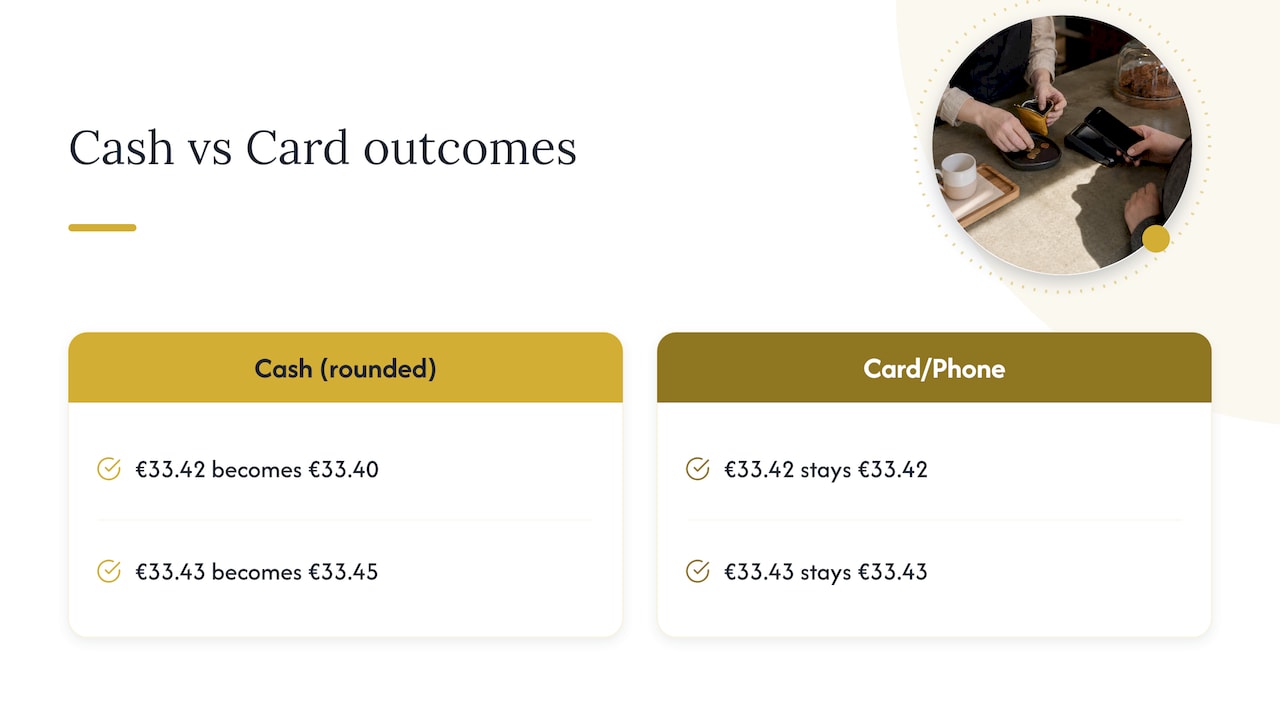
Since January 2025, cash purchases in Estonia round to the nearest five cents at the final till total, a rule that applies only to cash and never touches card or mobile payments, per the official rounding rule leaflet.
Cash totals round to the nearest five cents, while card and wallet payments always charge the exact amount. That single sentence explains most of the confusion travelers run into at checkout.
Say a fare comes to €33.42. Paying cash, the driver rounds it down to €33.40. A fare of €33.43 rounds up to €33.45. If you tap a card or phone instead, you pay the precise €33.42 or €33.43 either way. If you plan to tip a driver in cash, round the amount yourself and ask for a receipt showing the rounded total so your records match what changed hands.
3. Staying safe from fraud and knowing your rights
Card payments give you a real safety net. If you prepay for a transfer that never arrives, you can typically file a chargeback, known locally as tagasinõue, through your card issuer. Estonia’s consumer protection authority, TTJA, advises checking a provider’s payment terms before booking and notes that card payments and platform-level protections give consumers more leverage in disputes, according to TTJA guidance. TTJA also points out that choosing your payment method deliberately, rather than defaulting to whatever is offered first, cuts your dispute risk before a problem even starts.
Eesti Pank’s fraud research echoes the same caution: trust in digital payments is high, but so is concern about scams, which makes basic verification worth the extra minute, according to Eesti Pank.
Before paying for any transfer, run through this short checklist:
- Confirm the booking page’s domain matches the company’s official site.
- Save the transaction ID and payment confirmation the moment it appears.
- Keep screenshots of the booking details, price, and any chat or e-mail correspondence.
Pro Tip: Screenshot the booking confirmation and price breakdown before you close the browser tab, not after a dispute starts.
For a deeper walkthrough, this private transfer booking checklist covers domain verification and payment red flags in more detail.
4. A step-by-step checklist for paying safely
Following the same sequence every time keeps your booking protected and easy to prove later.
- Confirm the provider’s identity, the full price including any extras, and the cancellation or refund policy before entering payment details.
- Ask whether an invoice or VAT receipt is available if you need one for expense claims.
- Choose a supported payment method, a bank link, card, or mobile wallet, and complete the transaction through the official booking page.
- Save the payment confirmation and note the transaction or reference number immediately.
- Check your booking confirmation e-mail, request an invoice if you have not already, and file both away in case you need to dispute a charge or claim expenses.
5. Tips for travelers and residents booking transfers
A little preparation avoids most payment headaches on the day of travel.
- Carry at least one backup payment method, a card or a mobile wallet, in case your first choice is not accepted.
- For prepaid or high-value bookings, pay by card or wallet rather than cash so you keep your dispute options open.
- Ask about receipts and VAT invoicing upfront if the trip is a business expense.
Pro Tip: Foreign cards sometimes carry currency-conversion fees at checkout, so check your bank’s terms before booking a large prepaid transfer.
Business travelers who need documentation for expense reports may find this guide to arranging transport for business meetings useful for understanding what invoicing options typically look like.
6. Why payment friction matters more than it seems
Most guides treat payment methods as an afterthought, a checkbox at the end of the booking form. That gets it backward. The payment method you choose determines what happens if something goes wrong, not just how fast the checkout screen loads. A cash payment for an airport pickup gives you almost no recourse if the driver never appears. A card payment does, because a chargeback exists as a formal process, not a favor from the company.
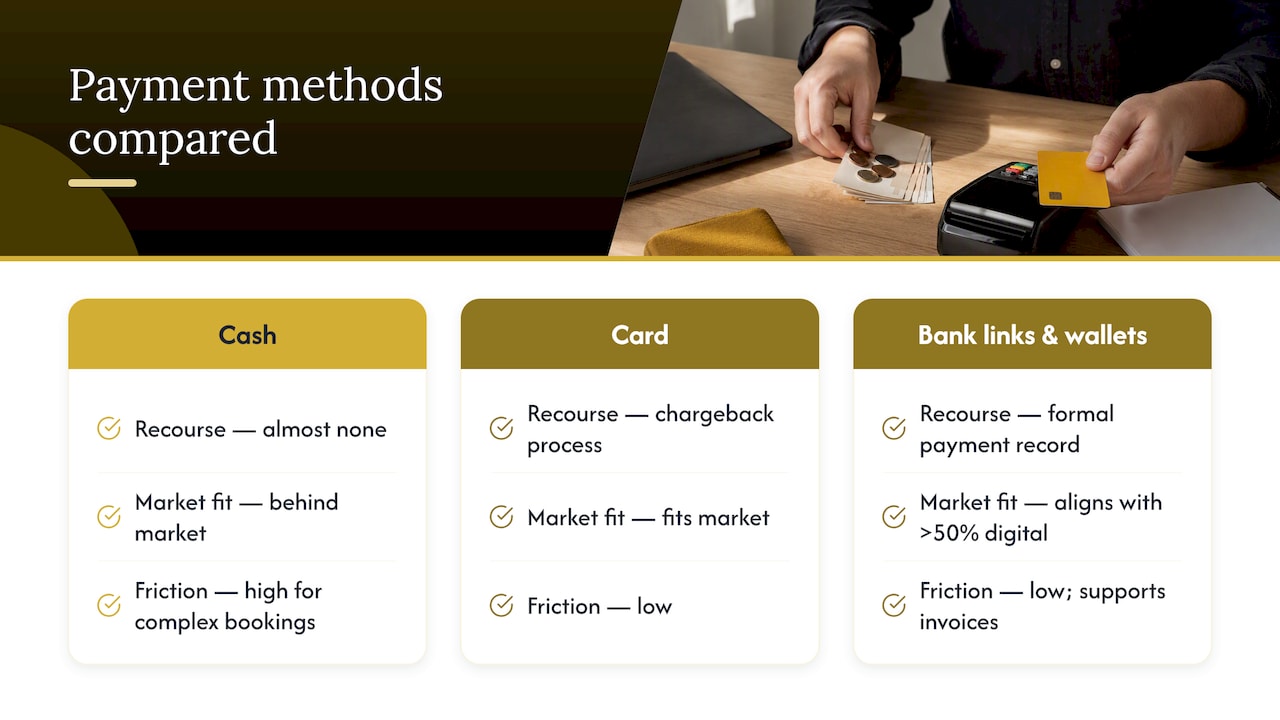
Travelers also tend to overestimate how universal cash still is here. Estonia’s digital payment share sits well above half of all transactions, and that shift changes what a professional transport provider should expect from its own booking system, not just from the customer. A transfer service that only takes cash on arrival is behind where the market already sits.
Many transfer services accept standard bank links, card payments, and mobile wallets, and some can issue invoices on request for corporate expense claims, which helps keep payment friction low for complex bookings including flight tracking and luggage handling.
— Erki
7. Booking a SolidRide transfer and paying with confidence
This provider supports bank links, Visa and Mastercard payments, and mobile wallets, offering choices between convenience and a paper trail. Bookings are open around the clock, and rides can include real-time flight monitoring so pickup times adjust automatically for flight changes.

Vehicle classes range from the Mercedes-Benz E-Class up through the S-Class and V-Class, with full pricing listed on the SolidRide pricing page. If you need an invoice for a business trip, request one when you book, and SolidRide will issue a receipt suited to expense claims. Group travel, pet-friendly rides, and custom projects are also available through the main service page, so whether you are arranging a single airport pickup or a recurring corporate schedule, the payment side stays simple.
Sources
- Uuring: Eestis kasutatakse maksmisel enim digitaalseid maksevahendeid | Eesti Pank (press release)
- Rounding rule leaflet (Eesti Pank / government leaflet)
FAQ
What are the most common payment methods for transfers in Estonia?
Bank links, card payments through Visa and Mastercard, and mobile wallets like Apple Pay and Google Pay are the standard options. Digital methods now make up 57% of transactions in Estonia, according to Eesti Pank, which reflects how rarely cash comes up as the primary choice for a booked service.
Does the 5-cent rounding rule apply to card payments?
No, the rounding rule applies only to cash purchases in Estonia and leaves card and mobile wallet payments unaffected, charging the exact amount instead. Since January 2025, cash totals round to the nearest five cents at checkout, per the official leaflet.
Can I get a refund if a prepaid transfer does not show up?
Paying by card gives you access to a chargeback, or tagasinõue, through your card issuer if a prepaid service is not delivered. TTJA advises checking payment terms before booking and keeping correspondence and receipts to support a dispute, according to TTJA guidance.
Does SolidRide accept card and mobile wallet payments?
Yes, SolidRide supports standard bank links, Visa and Mastercard payments, and mobile wallets, with pricing listed on its pricing page. Invoices are available on request for travelers who need documentation for business expense claims.
Is cash still accepted for transfer bookings in Estonia?
Cash is still accepted for small extras like tips, but it is rarely the primary way to pay for a professional, prepaid transfer booking. Card and mobile wallet payments are generally preferred because they give you a transaction record and dispute options that cash does not.
Add a comment