


Cancel your Estonia airport transfer through the provider’s booking interface or by contacting support directly with your booking reference. Whether you get money back depends entirely on the fare class you bought at checkout. Standard fares often carry no refund past a set deadline, while flexible fares allow changes closer to pickup time. Always request written cancellation confirmation and check your order card for the exact deadline that applies to you.
TL;DR:
- Cancel your transfer as soon as possible before the deadline listed in your booking confirmation, and always request written cancellation proof.
- Refunds usually process within 5 to 7 business days, but delays of up to 60 days can occur in complex cases involving intermediaries or card networks.
- Always check if your fare is refundable at checkout; standard fares often limit refunds after a set deadline, while flexible fares provide more leeway.
- When requesting a refund, include all relevant details such as your booking reference, flight number, scheduled pickup, and desired outcome to avoid delays.
- Confirm whether your cancellation is handled directly by the provider or through an aggregator, as responsibility for refunds may vary and affect processing times.
Table of Contents
- Lennujaamatransfeeri Tühistamine: Steps to Cancel Correctly
- How Long Does a Transfer Refund Take in Estonia?
- What to Check in Your Cancellation Terms
- Documentation Checklist: Evidence to Keep
- Rescheduling and Other Alternatives to Cancelling
- Cancelling Because of COVID-19 or Other Emergencies
- Who to Contact and When
- Real Cancellation Scenarios: What Actually Happens
- Late Cancellation Penalties and Fees
- Cancelling Through Third-Party Booking Platforms
- What Good Cancellation Handling Actually Looks Like
- How SolidRide Handles Cancellations and Changes
- Sources
- FAQ
Lennujaamatransfeeri Tühistamine: Steps to Cancel Correctly
Getting a lennujaamatransfeeri tühistamine right comes down to speed and paperwork. Miss the deadline on your confirmation, and you lose the fare category argument before you’ve even started. Here’s the order that actually works.
- Pull up your booking confirmation first. Find the cancellation channel (app, website, or e-mail address) and the exact deadline stated on your specific order, not a generic policy page.
- Use the provider’s website or app if one exists. Self-service cancellation usually logs a timestamp automatically, which becomes useful evidence later.
- If there’s no self-service option, e-mail support with your booking reference. Ask explicitly for written confirmation of the cancellation and state whether you want a refund, credit, or reschedule.
- Follow up by phone within a few hours. E-mail can sit in a queue during peak travel periods, and a call confirms someone actually received your request.
- If the airline cancelled your flight, attach the airline’s cancellation notice to your message. Ask the transfer provider to re-evaluate the refund on those grounds, since airline cancellations don’t automatically override a provider’s standard deadline.
Include four things in every cancellation message: your booking reference, flight number, scheduled pickup time, and the outcome you want. Vague messages (“please cancel my ride”) slow everything down because support has to chase details you could have supplied up front.
Pro Tip: Screenshot the cancellation confirmation the moment you receive it. Support inboxes get busy, and a saved screenshot with a timestamp beats a “we’ll get back to you” e-mail that goes unanswered.
How Long Does a Transfer Refund Take in Estonia?
Refunds after a clean cancellation typically land within 5 to 7 business days, though that’s the fast lane, not the guarantee. Complex cases, especially those involving card networks or intermediary booking platforms, can stretch to 30 to 60 banking days before the money actually reappears on your statement.
The gap happens because the provider approving your refund and the bank processing it are two separate steps. A merchant can approve your refund the same day you cancel, but the card network and your bank still need to post the reversal, which is where the delay usually creeps in.
What you get back also depends on the refund type:
- Cash refund to your original card — slowest but simplest to prove if a dispute arises later.
- Voucher or credit toward a future booking — often issued faster, but check the expiry date before accepting.
- Partial refund minus an administrative fee — common when you cancel inside a penalty window but outside the no-refund zone.
If your refund is late, contact the provider first and ask for a written status update. No response within a reasonable window is grounds to open a dispute with your card issuer, or to contact TTJA for consumer guidance if the provider stops responding altogether.
What to Check in Your Cancellation Terms
Most disputes over airport transport refund eligibility trace back to one thing: nobody read the fare label at checkout. Standard fares are frequently non-refundable past a set cutoff, while flexible fares cost more upfront but allow cancellation closer to departure with fewer penalties.
Before you assume anything about your booking, check these:
- The fare name on your confirmation — “standard,” “flexible,” or similar labels determine your entire refund position.
- The deadline shown on your specific order, not a general policy page. Platforms often display a default cancellation window, but the operator handling your actual route can set a different deadline that overrides it.
- Administrative fees that apply even to refundable fares, sometimes quietly subtracted before the balance is returned.
- Coupon-only refund clauses, where the fine print only ever promised a voucher, never cash.
- No-show consequences, which differ depending on whether the driver or the passenger failed to show. A driver no-show usually guarantees a full refund; a passenger no-show rarely does.
Trust the order-specific deadline over anything generic. A booking platform’s homepage might advertise “free cancellation up to 24 hours before,” but your particular route or vehicle type can carry a tighter window buried in the confirmation e-mail.
Documentation Checklist: Evidence to Keep
If a refund turns into a dispute, the paperwork you saved on day one becomes the entire case. Estonian consumer guidance treats a provider’s written confirmation as key evidence, and an unanswered e-mail request doesn’t count as proof of anything.
- Save your original booking confirmation and payment receipt. These establish what you paid and under what terms.
- Keep every cancellation request and every reply from the provider, including timestamps. A one-line “confirmed” e-mail is worth more than a phone call you can’t produce later.
- Screenshot support chat threads the moment you finish the conversation, before anything gets archived or deleted.
- Attach airline cancellation notices if that’s the reason you’re cancelling the transfer.
- Ask explicitly for an official cancellation note. A simple line works: “Please confirm in writing that my booking [reference number] has been cancelled and state the refund method and expected timing.”
If the provider goes silent for more than a few business days after a refund was due, escalate. Your card issuer can open a dispute with proof of the cancellation request; TTJA can advise on next steps if the provider is based in Estonia and unresponsive.
Rescheduling and Other Alternatives to Cancelling
Outright cancellation isn’t always the cheapest move. If your flight shifted rather than disappeared, changing airport transfer details is usually less costly than starting over.
- Rescheduling instead of cancelling often carries a smaller fee than a full cancellation penalty, since the provider keeps the booking rather than losing it entirely.
- Accepting a voucher or credit can work well if you travel again soon, but check the expiry date and any route restrictions before agreeing to it instead of cash.
- Small last-minute changes, like a corrected pickup address or a passenger name swap, are frequently free. Ask before assuming a name change requires a full rebooking.
Reviewing how the return trip transfer booking workflow handles date changes is worth doing before you commit to a full cancellation, especially if you’re only shifting your trip by a day or two.
Cancelling Because of COVID-19 or Other Emergencies
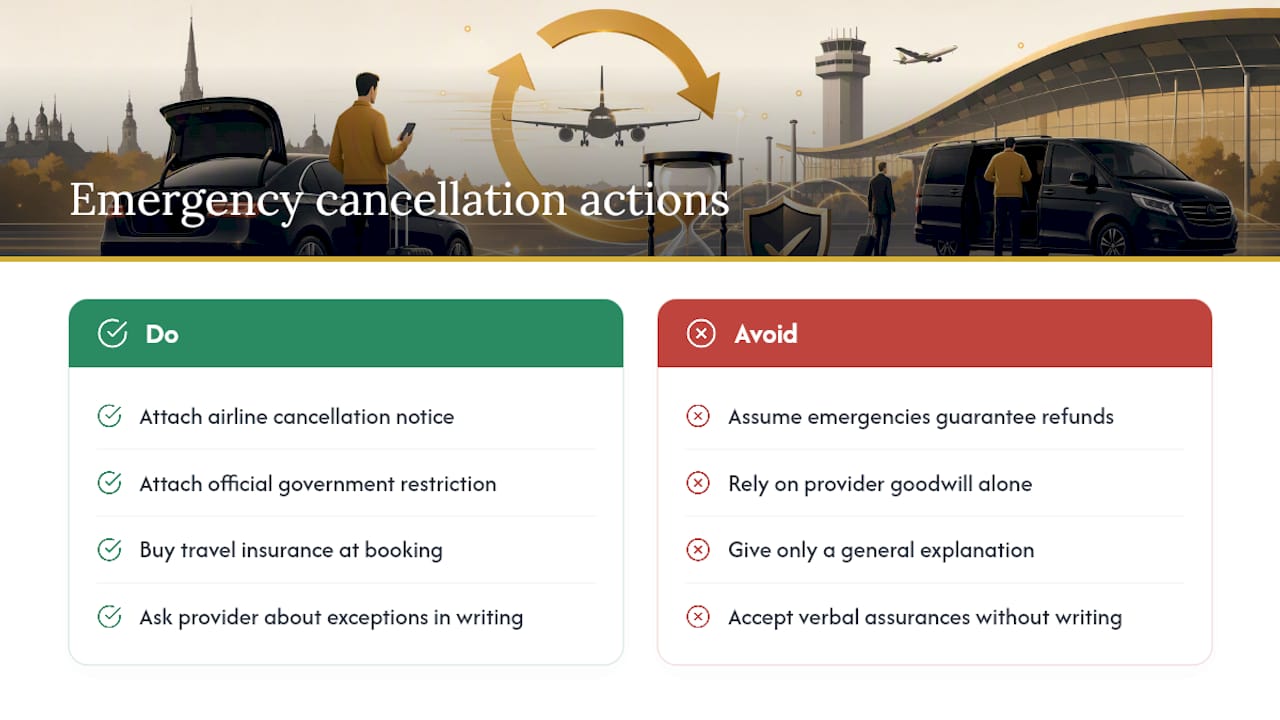
Emergency cancellations don’t automatically unlock a free refund, even though many travelers assume they do; having a reliable travel survival kit tips guide can help you be prepared for unexpected travel changes. Airport transfer providers in Estonia generally still apply their standard cancellation terms unless the booking specifically included cancellation cover or the provider has published an emergency exception.
If your flight is grounded due to a health emergency, severe weather, or a similar disruption, the fastest path is documentation, not argument. Attach the airline’s cancellation notice or any official government travel restriction to your cancellation request. Providers are far more likely to waive a fee or offer a full refund when there’s a clear, verifiable reason attached rather than a general explanation.
Travel insurance, where purchased separately at booking, is the more reliable safety net here. Cancellation cover exists precisely because standard fares rarely include free changes for unpredictable events, and relying on the provider’s goodwill during a widespread disruption (when support lines are also flooded) is a weaker position than having cover already in place.
If your emergency involves a genuine public health order, quarantine requirement, or government travel ban, some providers will treat that differently from a personal change of plans. Ask directly whether an exception applies to your situation rather than assuming the standard non-refundable clause still holds. The answer varies by provider, so get it in writing before you decide whether to push for a refund or accept a credit instead.
Who to Contact and When
Support responsiveness for airport transport refund issues varies by time of day and by whether the provider runs a 24/7 desk or standard office hours. If your transfer is scheduled early morning or late at night, check whether the provider actually staffs support during those windows. Some smaller operators only answer during business hours, which is a problem if your flight lands or departs outside them.
E-mail is the right channel for anything you need in writing, since it creates a paper trail automatically. Use it for the initial cancellation request. Follow with a phone call if you haven’t heard back within a few hours, particularly close to your pickup time, because a call gets escalated faster when a deadline is approaching.
Weekday mornings tend to see faster response times than weekend evenings, when many providers run reduced support staff. If you’re cancelling last minute, before a same-day pickup, call first and send the written follow-up afterward. That order protects your deadline while still creating the documentation you’d need for a dispute.
Providers with real-time flight monitoring and a dedicated support line tend to respond faster to cancellation requests tied to flight changes, since they’ve often already flagged the disruption on their end before you even call.
Real Cancellation Scenarios: What Actually Happens
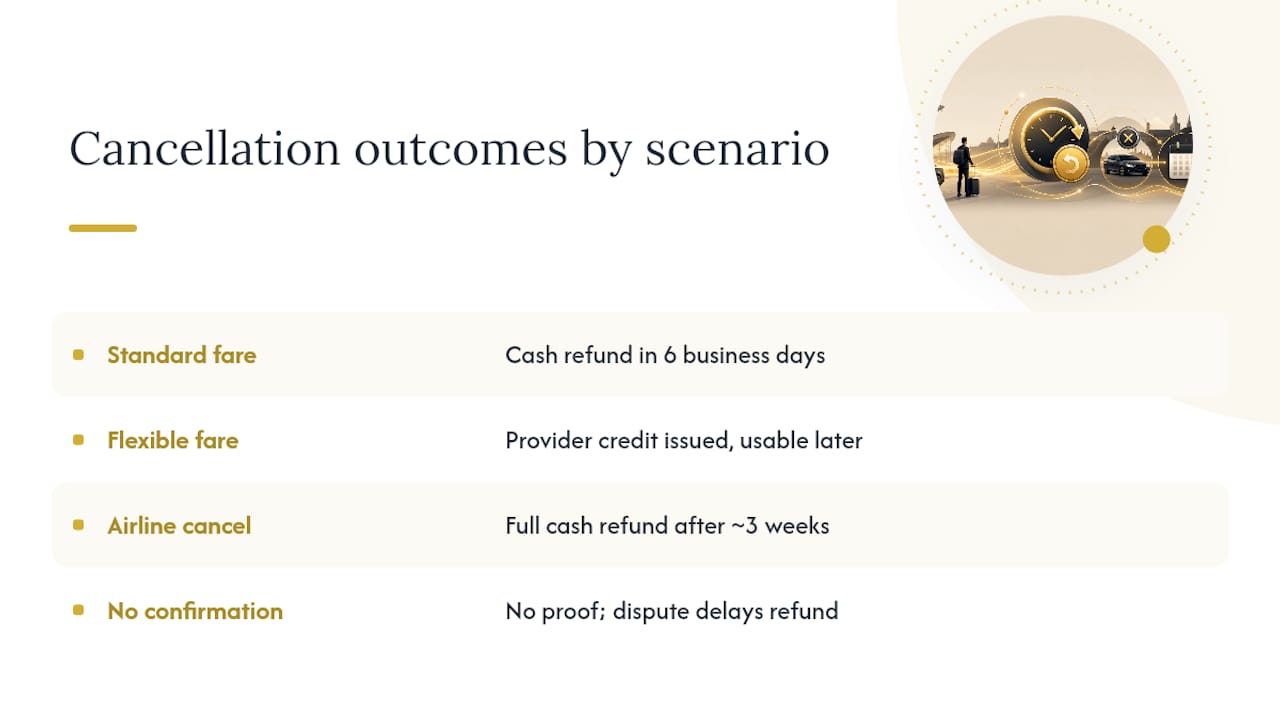
Scenario one: standard fare, cancelled three days ahead. A traveler books a standard-fare transfer for a Tallinn Airport pickup, then cancels 72 hours before pickup. The confirmation states cancellations inside 48 hours are non-refundable, so the traveler is within the free window. Refund lands in 6 business days, matching the typical 5 to 7 business day range.
Scenario two: flexible fare, cancelled the morning of pickup. A business traveler on a flexible fare cancels the same morning due to a rescheduled meeting. Flexible terms allow this without penalty, and the provider issues a credit instead of cash at the traveler’s request, usable for the return leg.
Scenario three: airline cancels the flight entirely. A passenger’s flight gets cancelled by the airline the night before departure. The transfer provider’s standard policy shows no refund inside 24 hours, but the passenger attaches the airline’s cancellation e-mail and asks for a policy exception. The provider agrees and issues a full refund, though it takes closer to three weeks because the request required manual review rather than automatic processing.
Scenario four: no written confirmation ever arrives. A traveler cancels by phone only, receives a verbal “you’re all set,” and never gets an e-mail confirmation. When the refund doesn’t appear after two weeks, there’s no paper trail to prove the cancellation happened. The dispute takes far longer to resolve than it should, purely because nothing was in writing.
Late Cancellation Penalties and Fees
Penalties scale with how close to pickup you cancel, and most providers structure them in tiers rather than a single flat cutoff. A cancellation made days in advance on a standard fare might cost nothing. The same cancellation made two hours before pickup often forfeits the entire fare, especially once a driver has already been dispatched.
Administrative fees are the quiet cost that catches people off guard even on refundable bookings. A provider might approve a full policy-compliant refund but still subtract a processing fee, so the amount returned is smaller than expected. That fee should be disclosed at booking, but it’s worth confirming in the cancellation confirmation itself rather than assuming.
No-show fees are typically the steepest penalty in the entire fee structure. If a passenger simply doesn’t show up (no cancellation message sent at all) most providers charge the full fare with zero refund, treating it identically to a same-day cancellation. That’s a meaningfully worse outcome than cancelling even a few hours ahead, so a quick message beats silence every time, even if you think it’s too late to matter.
Compare that to a driver no-show, which flips the penalty entirely: if the provider fails to show up for a confirmed pickup, passengers are generally entitled to a full refund regardless of fare class, since the failure sits with the provider rather than the traveler.
Cancelling Through Third-Party Booking Platforms
Booking through an aggregator instead of directly with the operator adds a layer readers often miss until it matters. The party that issued your order card, either the aggregator or the local operator, is usually the one responsible for processing your refund, and figuring out which one that is comes before anything else.
Check your confirmation e-mail for the company name that actually issued the booking, not just the platform name you searched on. If a marketplace connected you to a local operator, the operator’s cancellation terms usually govern, even though you paid through the platform’s checkout. Cancelling through the platform’s generic support form can create delays if that request has to be forwarded to the actual operator before anyone acts on it.
This matters most for deadlines. A platform’s marketing page might advertise a broad cancellation window, but the operator handling your specific vehicle or route can attach a tighter deadline that takes precedence over whatever the platform implies. Always check the confirmation you actually received rather than the general policy page you saw while browsing.
If a platform’s support team is slow to respond, contacting the local operator directly, when their contact details are listed on the confirmation, often resolves things faster than waiting in a marketplace’s general queue.
What Good Cancellation Handling Actually Looks Like
Most cancellation disputes I’ve seen trace back to two mistakes: nobody saved the confirmation, and nobody included the flight number when it mattered most. Passengers assume a phone call is enough proof; it isn’t, once a provider claims the call never happened. The fix costs nothing. Ask for a written note and keep it.
A professional transfer provider earns that trust by making cancellations boring rather than dramatic. That means real-time flight monitoring so delays and cancellations get flagged before the passenger even calls, prompt written confirmations instead of vague verbal assurances, and fixed quotes that don’t hide administrative fees inside vague policy language. SolidRide’s own operating model reflects that approach: flight tracking, a documented confirmation trail, and 24/7 availability rather than office-hours-only support.
The uncomfortable truth is that most cancellation friction isn’t the provider’s fault. It’s a passenger who never checked the fare label, never got anything in writing, and only discovered the deadline after it had already passed.
— Erki
How SolidRide Handles Cancellations and Changes
SolidRide is built around the exact friction points that turn a simple cancellation into a drawn-out dispute. Every booking comes with real-time flight monitoring, so pickup changes get caught automatically instead of relying on a passenger to call in a panic. Cancellation requests get a written confirmation, not a verbal promise you can’t produce later, and pricing is fixed and published upfront rather than buried behind vague administrative-fee language.

That transparency matters most at the moment you need to change or cancel a trip. SolidRide’s pricing page lists fixed rates by vehicle, from a Mercedes-Benz E-Class transfer at €33 per hour to a Mercedes-Benz S-Class at €70 per hour, so you know the exact cost structure before you book, not after a cancellation dispute forces you to dig through fine print. Route transfers, like Tallinn to Tartu from €270 or Tallinn to Pärnu from €190, follow the same clear pricing model. If you’re planning an airport pickup and want a provider that documents every step, from booking confirmation to cancellation note, check current availability and rates on the SolidRide pricing page before your next trip.
Sources
- Global VAT Compliance — VAT returns & recovery in Estonia
- Airport Transfers Now — cancellation policies overview
- TTJA — Travel services consumer rights (Estonia)
FAQ
How Do I Cancel My Airport Transfer Booking in Estonia?
Use the provider’s website or app if one is available, or e-mail support with your booking reference and request written confirmation. Follow up by phone if you don’t hear back within a few hours, especially close to your pickup time.
How Long Does It Take to Get a Transfer Refund?
Most refunds process within 5 to 7 business days, though complex cases involving intermediary platforms can take up to 30 to 60 banking days. The delay usually comes from bank processing, not the provider’s approval.
Will I Get a Full Refund if the Airline Cancels My Flight?
Not automatically. Some transfer providers keep their standard cancellation deadlines regardless of airline changes, so attach the airline’s cancellation notice and request a policy exception in writing.
What If My Refund Never Arrives?
Contact the provider first and request a written status update. If they don’t respond, you can dispute the charge with your card issuer or contact TTJA for consumer guidance on next steps.
Does SolidRide Charge a Cancellation Fee?
SolidRide’s pricing is fixed and published on its pricing page, with fixed hourly rates and one-off fares for various routes. Specific cancellation terms for your booking are confirmed in writing at the time you book.
Add a comment